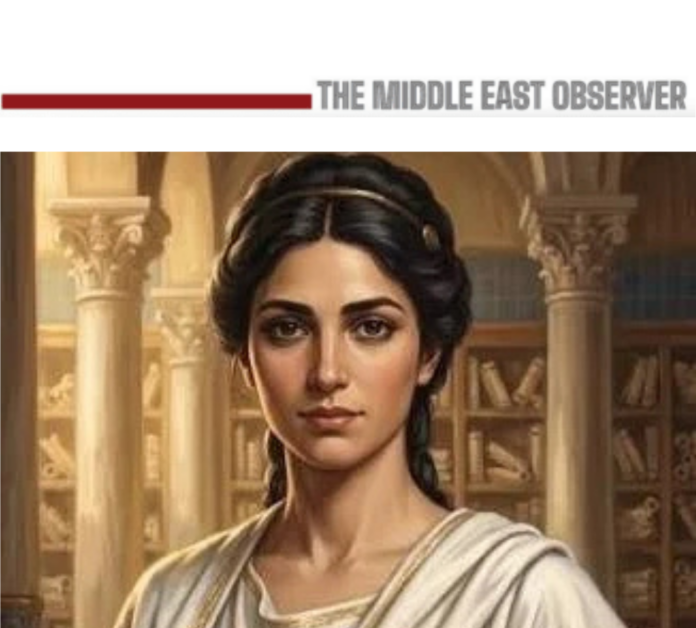
Part VII – Why the World Still Remembers Hypatia
“Civilizations are remembered not only by the empires they build, but by the ideas they refuse to abandon.”
On an ordinary spring day in AD 415, the citizens of Alexandria could not have imagined that the murder of a philosopher would echo across sixteen centuries.
Empires would rise and fall.
Religions would spread across continents.
New sciences would transform humanity’s understanding of the universe.
Yet the name of one teacher—whose own books would almost entirely disappear—would survive.
History rarely grants such immortality.
Hypatia earned it.
From Tragedy to Memory
For generations after her death, Hypatia remained a relatively obscure figure known chiefly to scholars of late antiquity.
The Roman Empire itself changed beyond recognition.
The western half collapsed.
The eastern half evolved into what modern historians call the Byzantine Empire.
Alexandria continued as an important city, but no longer occupied the unrivalled intellectual position it had once held.
The philosophers who inherited the Neoplatonic tradition increasingly looked elsewhere, particularly to Athens, where philosophical schools continued to flourish until they were closed by imperial decree in AD 529.
Yet even as institutions disappeared, memories endured.
Scattered references in chronicles, encyclopaedias and philosophical works preserved the outline of Hypatia’s life.
She had become part of the intellectual inheritance of the ancient world.
The Renaissance Rediscovers the Classical Mind
When Renaissance Europe began recovering Greek literature, mathematics and philosophy, scholars searched monasteries and private collections for forgotten manuscripts.
The writings of Plato, Aristotle, Euclid and Ptolemy returned to prominence.
So too did the names of those who had preserved them.
Hypatia re-emerged gradually.
Unlike Plato or Aristotle, she had left no complete works for Renaissance scholars to translate.
Instead, they encountered her through other authors—especially the historian Socrates Scholasticus and later Byzantine compilations.
The image that emerged fascinated humanists.
Here was a woman who had mastered mathematics, astronomy and philosophy at the highest level in an age when few women entered public intellectual life.
Her life seemed to bridge two worlds: the splendour of classical antiquity and the turbulent dawn of the medieval era.
The Enlightenment and the Symbol of Reason
The eighteenth century transformed Hypatia from an historical figure into an intellectual symbol.
Europe’s Enlightenment thinkers were engaged in fierce debates about reason, religious authority, scientific inquiry and freedom of thought.
They searched history for examples illustrating those struggles.
Hypatia seemed almost perfectly suited to the role.
Writers such as Voltaire viewed her story as a warning against fanaticism and an affirmation of rational inquiry.
Later, Edward Gibbon incorporated her death into his sweeping interpretation of the decline of the Roman Empire, portraying the episode as one of the many tragedies accompanying the transformation of the ancient Mediterranean.
Both writers admired Hypatia.
Both also interpreted her through the concerns of their own century.
The historical philosopher increasingly became a universal symbol.
That symbolism would prove remarkably durable.
The Victorian Imagination
During the nineteenth century, interest in classical history expanded dramatically.
Archaeological discoveries across Egypt and the eastern Mediterranean brought the ancient world vividly back to public attention.
Novelists, painters and playwrights embraced Hypatia as a compelling heroine.
Among the most influential was Charles Kingsley, whose novel Hypatia introduced her to a wide English-speaking audience.
Kingsley’s work blended careful historical research with Victorian ideals, religious reflection and fictional narrative.
Although modern historians recognise its departures from the historical record, the novel ensured that Hypatia would become part of popular culture rather than remaining the preserve of specialists.
Artists followed.
Paintings depicted her lecturing before attentive students or facing the mob with serene dignity.
These works said as much about nineteenth-century ideals of heroism and virtue as they did about fifth-century Alexandria.
Yet they kept her story alive.
Twentieth-Century Scholarship: Recovering the Historical Woman
The twentieth century marked a turning point.
Instead of asking what Hypatia symbolised, historians increasingly asked who she actually was.
They returned to the surviving sources with fresh questions.
Could later legends be separated from contemporary evidence?
How reliable were the ancient accounts?
What could be reconstructed with confidence?
Among the most influential scholars was Maria Dzielska, whose landmark study challenged both romantic exaggeration and simplistic interpretations.
Rather than diminishing Hypatia, Dzielska restored her humanity.
She emerged not as an impossible heroine but as an exceptionally gifted philosopher navigating an extraordinarily complex political world.
Other historians—including Edward J. Watts, Christopher Haas and Michael Deakin—expanded our understanding of late Roman Alexandria, its educational institutions, civic politics and philosophical traditions.
Their work has fundamentally reshaped modern understanding of Hypatia.
Today, the strongest scholarship neither idealises nor diminishes her.
It explains her.
A Pioneer Without Intending To Be
Modern readers frequently celebrate Hypatia as one of history’s greatest women in science.
The description is justified, provided it is understood in historical context.
She did not seek fame because she was a woman.
She sought excellence because she was a philosopher.
In doing so, she demonstrated that intellectual authority could transcend the social expectations of her age.
Her students respected her scholarship.
Governors sought her advice.
Even Christian bishops continued to acknowledge her influence.
That achievement remains extraordinary.
Without consciously leading a movement, she expanded the boundaries of what later generations believed possible.
For countless women entering universities, laboratories and observatories over subsequent centuries, Hypatia became an inspiration—not because she argued for equality in modern terms, but because she embodied it through accomplishment.
Knowledge Without Borders
Perhaps the most remarkable aspect of Hypatia’s legacy is its refusal to belong to any single civilisation.
She inherited Greek philosophy in Egypt under Roman rule.
Her students included pagans and Christians.
The scientific works she taught later flourished in Arabic translation during the Islamic Golden Age.
Those same texts returned to Renaissance Europe, helping lay the foundations of modern science.
Her intellectual world crossed languages, religions and empires.
It reminds us that civilisation advances through exchange rather than isolation.
Ideas migrate more easily than armies.
They survive political collapse.
They outlast rulers.
They belong ultimately to humanity rather than to any one nation or faith.
The Modern Alexandria
In October 2002, nearly sixteen centuries after Hypatia’s death, Alexandria witnessed an event rich in symbolism.
The Bibliotheca Alexandrina opened its doors on the Mediterranean waterfront.
Although not a direct continuation of the ancient Library, it consciously honours the spirit of the institution that once made Alexandria the intellectual capital of the ancient world.
Its architecture, collections and international mission reflect a simple idea: that preserving knowledge remains one of civilisation’s highest responsibilities.
Visitors walking through its reading rooms inevitably encounter the memory of those who shaped Alexandria’s scholarly tradition.
Among them stands Hypatia—not because her books fill the shelves, but because her life represents the ideals the library seeks to uphold.
Why Hypatia Matters Today
The questions that defined Hypatia’s world have not disappeared.
How should societies protect independent scholarship?
Can political power coexist with intellectual freedom?
What responsibilities accompany public influence?
How should competing beliefs engage with scientific inquiry?
Every generation answers these questions differently.
Yet the need to ask them remains constant.
Hypatia’s story therefore belongs not only to historians.
It belongs to educators, scientists, philosophers, students and anyone who believes that the pursuit of knowledge deserves protection.
She reminds us that learning is never entirely separate from society.
Ideas flourish only where dialogue remains possible.
The Measure of a Civilisation
There is a temptation to view Hypatia solely through the lens of her death.
That would be a mistake.
She spent decades teaching.
She spent only one day dying.
Her true legacy lies not in the violence that ended her life but in the thousands of hours devoted to explaining geometry, interpreting Plato, refining astronomical calculations and encouraging students to think critically.
Civilisations are sustained less by dramatic moments than by patient acts of teaching.
Every lecture delivered.
Every manuscript corrected.
Every student inspired.
Every question asked.
Those were Hypatia’s achievements.
The Last Light—and the First
History often describes Hypatia as “the last philosopher of the ancient world.”
The phrase is poetic.
It is also incomplete.
She was not the last philosopher.
Others followed.
She was not the last mathematician.
Nor the last astronomer.
Perhaps a better description is this:
She was among the last great scholars formed entirely within the classical intellectual tradition before the Mediterranean entered a new historical age.
She stood at the threshold between antiquity and the medieval world.
One civilisation was ending.
Another was beginning.
Her life became the bridge between them.
Epilogue
No complete manuscript by Hypatia survives.
No voice recording captures her lectures.
No portrait painted during her lifetime has reached us.
Yet across sixteen centuries, readers continue to search for her.
Not because history preserved everything.
But because history preserved enough.
Enough to recognise a teacher of extraordinary ability.
Enough to understand the complexity of her world.
Enough to appreciate that knowledge is among humanity’s most fragile inheritances.
Hypatia never sought immortality.
She sought understanding.
In the end, understanding granted her something greater.
The empire that governed Alexandria has vanished.
The political quarrels that consumed its leaders belong to history.
The mob that silenced her is anonymous.
But the philosopher they killed still speaks.
Not through surviving books.
Not through monuments.
But through an idea that has outlived kingdoms:
That truth is pursued through reason, preserved through learning, and passed from one generation to the next by those willing to ask questions, even when the answers are uncertain.
Series Conclusion
The life of Hypatia is more than the biography of a remarkable scholar. It is the story of Alexandria at the twilight of the ancient world, the endurance of ideas across civilizations, and the perpetual dialogue between history and memory. She belongs neither exclusively to pagan antiquity nor to Christian history, neither solely to science nor philosophy. She belongs to the shared intellectual heritage of humanity—a reminder that the greatest libraries are built not only of stone and manuscripts, but of minds committed to understanding the world.
End of the Series
Read also:
Hypatia of Alexandria – The Last Light of the Ancient World
Hypatia of Alexandria The Last Light of the Ancient World
Hypatia of Alexandria The Last Light of the Ancient World
Hypatia of Alexandria: The Last Light of the Ancient World
Hypatia of Alexandria The Last Light of the Ancient World
Hypatia of Alexandria The Last Light of the Ancient World
Hypatia of Alexandria The Last Light of the Ancient World