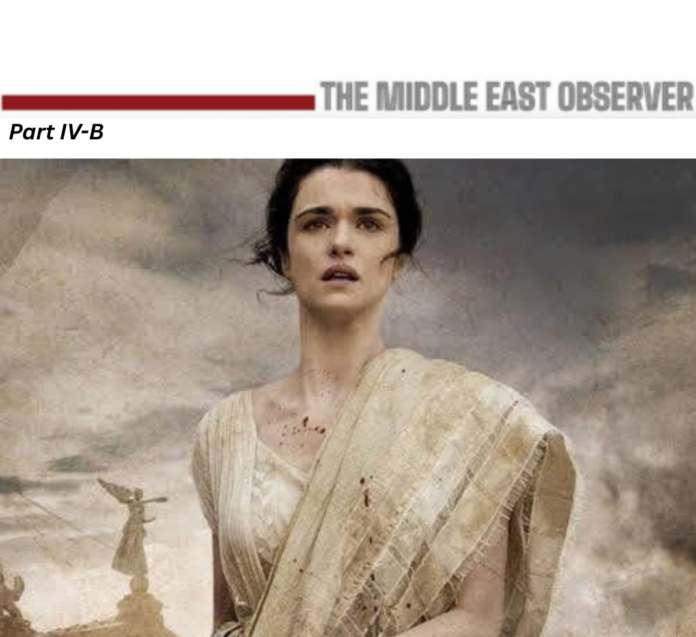
“History remembered the woman. Legend reinvented her.”
When the smoke cleared over Alexandria in the spring of AD 415, there was little reason to believe that Hypatia would become one of history’s most recognisable scholars.
She had left behind no surviving books bearing her name.
No school continued under her leadership.
No monument was erected in her honour.
Unlike emperors, bishops or military commanders, she possessed neither armies nor institutions to preserve her memory.
History is often unkind to philosophers.
Ideas survive only if someone continues teaching them.
Manuscripts survive only if someone continues copying them.
Memories survive only if later generations believe they matter.
For Hypatia, survival depended entirely upon others.
Remarkably, they did.
The First Memory
The earliest image of Hypatia entered history through writers who had never intended to create a legend.
Among them, the most influential remained Socrates Scholasticus.
Writing within a generation of the murder, Socrates presented neither a martyr nor a saint.
Instead, he described an exceptionally learned woman whose violent death disgraced Alexandria.
His restraint proved decisive.
Unlike later chroniclers who reshaped Hypatia according to theological or philosophical agendas, Socrates confined himself largely to what he believed had happened.
Modern historians continue to regard his account as the indispensable foundation for reconstructing the events of AD 415.
Had his work been lost—as so many ancient books were—the historical Hypatia might have disappeared almost entirely beneath later legend.
The Philosopher’s Version
A century later another voice emerged.
Damascius belonged to the last great generation of pagan philosophers.
For him, Hypatia represented far more than an admired teacher.
She embodied an entire civilisation that seemed to be slipping away.
His account transformed her from respected scholar into philosophical heroine.
Where Socrates offered careful reporting, Damascius supplied emotion.
He praised her extraordinary beauty, intellect and moral character.
He portrayed crowded streets falling silent as she lectured.
Governors deferred to her wisdom.
Students crossed seas to hear her speak.
Some details may preserve authentic traditions no longer available elsewhere.
Others almost certainly reflect literary embellishment designed to honour one of Neoplatonism’s greatest figures.
Yet Damascius accomplished something profoundly important.
He rescued Hypatia from obscurity.
Without him, later generations might never have regarded her as one of antiquity’s greatest philosophers.
The Christian Memory
Not all remembered her kindly.
More than two centuries after her death, the Egyptian bishop John of Nikiû offered an entirely different portrait.
Writing in a world transformed by centuries of Christian dominance, John described Hypatia not as a philosopher but as a dangerous pagan associated with magic, astrology and political manipulation.
Her death, in his telling, became a righteous act that purified Alexandria.
To modern readers, the account appears deeply hostile.
Yet historians value it precisely because it reveals how collective memory evolves.
John was not describing the Alexandria of AD 415.
He was reflecting the religious assumptions of the seventh century.
Between Socrates and John lies one of history’s most revealing transformations.
The same woman became, depending upon the observer, either an innocent scholar or a symbol of pagan resistance.
Historical memory had become theology.
Byzantium and the Quiet Centuries
Within the Byzantine Empire, Hypatia was never entirely forgotten.
The great tenth-century encyclopedia known as the Suda preserved valuable biographical information drawn from earlier sources now lost.
It remembered her as the daughter of Theon of Alexandria, celebrated her learning and described her public lectures.
Although brief, these entries performed an invaluable service.
At a time when countless ancient manuscripts disappeared forever, the Suda ensured that Hypatia’s name remained part of the Byzantine intellectual tradition.
Yet she no longer occupied centre stage.
Theological controversies, imperial politics and the preservation of Christian learning dominated Byzantine scholarship.
Hypatia survived largely as one distinguished philosopher among many figures inherited from antiquity.
The Islamic World and the Survival of Greek Learning
One of history’s greatest ironies is that while western Europe experienced centuries of intellectual fragmentation after the collapse of the Western Roman Empire, many works of Greek science found new life farther east.
From the eighth century onward, scholars working under the Abbasid Translation Movement translated mathematical, medical and astronomical texts from Greek into Syriac and Arabic.
The intellectual heirs of Euclid, Archimedes, Ptolemy and Galen flourished in cities such as Baghdad, Damascus and Córdoba.
Hypatia herself occupies only a modest place in surviving Arabic literature.
Her own writings had largely vanished before the great translation movement reached its height.
Nevertheless, many of the works she had studied, edited and taught became foundational texts within Islamic science.
In that indirect sense, her intellectual world continued to shape global civilisation.
The chain of transmission stretched from classical Greece through Alexandria to the scholars of the Islamic Golden Age and eventually back into Renaissance Europe.
Ideas, unlike empires, travelled remarkably well.
The Renaissance Rediscovers Antiquity
When Renaissance humanists began searching monasteries for forgotten Greek manuscripts, they rediscovered fragments of the classical world.
The names of Plato, Aristotle, Euclid and Ptolemy once again dominated European scholarship.
Hypatia returned more slowly.
Her reputation depended upon scattered references preserved by Byzantine historians rather than surviving books written in her own hand.
Even so, Renaissance scholars found in her story something irresistible.
A learned woman.
An ancient philosopher.
A dramatic death.
She appeared almost too symbolic to be historical.
Gradually, she became woven into the broader narrative of Europe’s rediscovery of classical civilisation.
The Enlightenment Creates an Icon
It was during the eighteenth century that Hypatia truly entered the modern imagination.
Enlightenment thinkers, seeking historical examples of reason confronting intolerance, found in Alexandria’s philosopher an almost perfect symbol.
Among those who drew upon her story was Voltaire, whose critiques of religious fanaticism helped transform Hypatia into an emblem of free inquiry.
Later, Edward Gibbon incorporated her death into his monumental history of the Roman Empire, presenting it as one illustration of the turbulence accompanying the transition from classical antiquity to the Christian Middle Ages.
Neither writer fabricated Hypatia.
Yet both interpreted her through the concerns of their own age.
For Enlightenment Europe, she represented Reason with a capital “R.”
History gradually yielded to symbolism.
The Victorian Imagination
The nineteenth century expanded the legend still further.
Novelists, painters and playwrights embraced Hypatia as a dramatic heroine.
Perhaps the most influential literary portrayal appeared in 1853 when the English novelist Charles Kingsley published Hypatia.
Although meticulously researched for its time, the novel blended historical fact with Victorian ideals, romance and religious reflection.
Kingsley’s Hypatia inspired countless readers.
She also inspired countless misconceptions.
By the twentieth century, fiction and history had become difficult to separate.
Cinema, Popular Culture and the Modern Myth
Modern audiences often encounter Hypatia not through ancient historians but through novels, documentaries and films.
These works have performed a valuable service by introducing millions to a remarkable historical figure.
At the same time, they have reinforced several persistent myths.
Some portray her as the last librarian of Alexandria.
Others depict her as discovering heliocentrism centuries before Nicolaus Copernicus.
Still others reduce her murder to a simple conflict between science and Christianity.
The historical record supports none of these claims in their popular form.
Reality proves simultaneously more complicated and more fascinating.
Hypatia neither invented modern science nor represented its final guardian.
She stood instead at the intersection of philosophy, mathematics, politics and religion during one of history’s most transformative centuries.
Recovering the Historical Hypatia
During the past half-century, historians have undertaken the painstaking task of separating the historical woman from the symbolic figure.
Foremost among them is Maria Dzielska, whose landmark study challenged many romantic exaggerations while restoring Hypatia’s authentic intellectual achievements.
Other scholars, including Edward J. Watts, Michael Deakin and Christopher Haas, have reconstructed the political, educational and philosophical world in which she lived.
Their work has not diminished Hypatia.
It has made her more human.
No longer merely a martyr or a legend, she emerges as an exceptionally gifted teacher navigating one of antiquity’s most volatile societies.
The Greatest Mystery
Ironically, the question historians ask most often is not how Hypatia died.
It is what she wrote.
How many books did she compose?
Which commentaries were genuinely her own?
How much mathematics vanished with the disappearance of her manuscripts?
How many scientific ideas survived anonymously because later copyists preserved them without recording their author?
These questions remain largely unanswered.
The greatest tragedy of Hypatia’s life may not have been her murder.
It may have been the disappearance of her voice.
History remembers that she taught.
It cannot hear her lectures.
History knows she wrote.
She cannot read her books.
History celebrates her intellect.
It possesses only fragments of her thought.
For scholars, that silence is perhaps the deepest mystery of all.
And it is there—among the missing manuscripts, vanished commentaries and lost pages of Alexandria—that the next chapter of Hypatia’s story begins.
End of Part IV-B
Coming in Part V – The Lost Books of Hypatia: a forensic reconstruction of every work attributed to Hypatia; her commentaries on Diophantus, Apollonius and Ptolemy; what modern historians believe she actually wrote; why almost all of her manuscripts disappeared; and how the survival of Greek mathematics depended upon generations of anonymous copyists whose quiet labour preserved the foundations of modern science.
Read also:
Hypatia of Alexandria – The Last Light of the Ancient World
Hypatia of Alexandria The Last Light of the Ancient World
Hypatia of Alexandria The Last Light of the Ancient World
Hypatia of Alexandria: The Last Light of the Ancient World