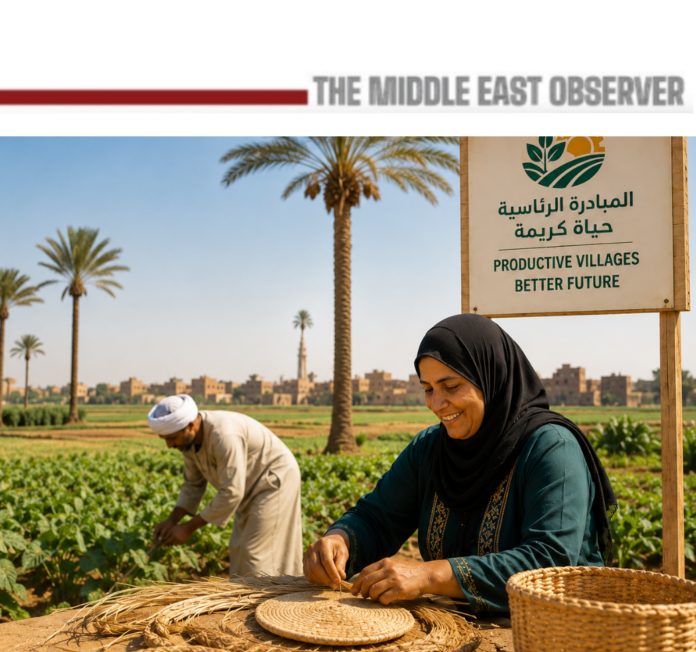
Egypt is betting that rural industrialization could become a key tool in addressing unemployment, strengthening local economies, and reducing migration pressures on major cities through its newly launched “Productive Villages” initiative.
The programmed, currently entering its pilot phase across selected governorates in the Delta and Upper Egypt, aims to establish small and medium-sized factories inside villages as part of a broader strategy to integrate manufacturing activity directly into rural communities rather than concentrating industrial growth around Cairo and traditional urban centres.
The initiative was reviewed during talks between Khaled Hashem and representatives from the International Labour Organization, alongside discussions on labour market reform, vocational training, and workforce development.
According to Egypt’s Ministry of Industry, the project seeks to maximise the use of local resources while creating employment opportunities within villages themselves. Several ministries, including local development, agriculture, environment, planning, and social solidarity, are participating in the initiative as part of a wider push toward decentralised economic development.
Industry Minister Khaled Hashem stated that vocational training, industrial skills development, and expanding employment opportunities for youth and women remain central pillars of Egypt’s industrial strategy, particularly as the country seeks to absorb growing numbers of young workers entering the labour market annually.
The core question surrounding the initiative is whether village-based industrialisation can move beyond limited pilot projects and evolve into a scalable national employment model. Policymakers increasingly view rural manufacturing not merely as a social programme, but as a long-term economic strategy capable of reducing unemployment, improving local supply chains, supporting regionally specialised industries, and easing demographic pressure on overcrowded urban centres.
As The Middle East Observer notes, previous smaller-scale experiences in remote Egyptian villages have already demonstrated the transformative impact targeted industrial activity can achieve. In several cases, communities that once suffered from severe unemployment later evolved into economically active production centres with significantly improved employment levels, expanded educational services, and broader community development following the establishment of successful local industries.
If organisations such as the Egyptian Businessmen’s Association and wider private-sector networks join forces with the government to establish a nationwide framework identifying suitable villages alongside the industries best matched to each region’s resources and labour profile, the initiative could evolve into a far more ambitious national development model.
Such an approach could significantly accelerate industrial growth, expand employment opportunities, and deliver broader and more sustainable economic gains across rural Egypt — potentially turning the “Productive Villages” initiative from a pilot programme into a long-term framework for decentralised industrial development.