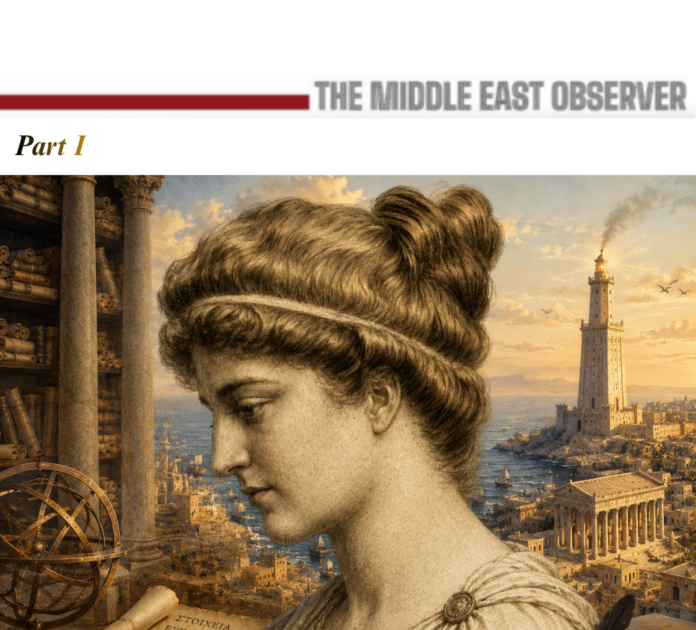
Part I – Alexandria: The City That Invented Knowledge
“Long before Oxford, Bologna or Harvard existed, there stood on Egypt’s Mediterranean coast a city where knowledge was treated as the greatest treasure on Earth. It was here that a little girl named Hypatia learned that ideas could outlive empires.”
By the time the Roman Empire reached its twilight, Alexandria had already lived several extraordinary lives.
Founded in 331 BC by Alexander the Great, the city was conceived as far more than another Mediterranean port. Alexander envisioned a meeting place where Europe, Africa and Asia would converge, their merchants exchanging goods while their scholars exchanged ideas. Although Alexander died before seeing his dream realized, his successors—the Ptolemies—transformed Alexandria into something unprecedented: humanity’s first truly international capital of knowledge.
For nearly seven centuries the city stood as the intellectual heart of the Mediterranean world. Ships entering Alexandria’s famous harbor carried not only grain, papyrus and spices but manuscripts from every known civilization. Under royal decree, every scroll arriving in the port was copied for the city’s vast collection. Original texts were often retained while copies were returned to their owners.
Thus was born the legendary Library of Alexandria.
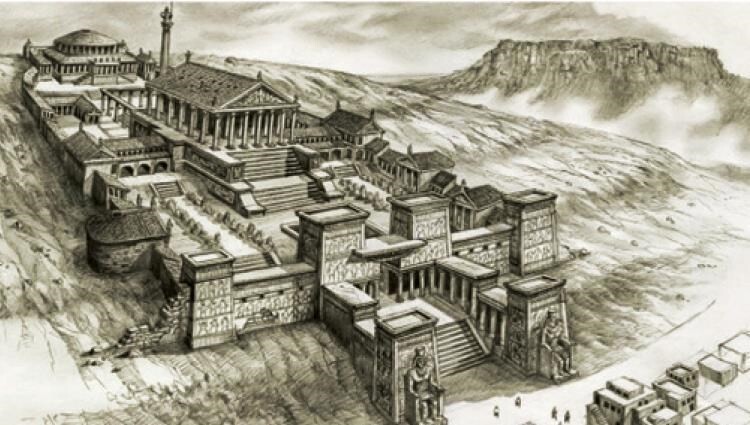
Although history has elevated the Library into near-mythical status, it was only one component of a much larger institution known as the Mouseion—a community of scholars supported by the state. More akin to a modern research university than a library, it provided accommodation, lecture halls, laboratories, botanical gardens, astronomical observatories and dining facilities for resident intellectuals.
Within its walls worked some of antiquity’s greatest minds.
Euclid formulated the geometry that would dominate mathematics for two millennia.
Eratosthenes calculated Earth’s circumference with astonishing accuracy using nothing more than shadows, geometry and careful observation.
Archimedes corresponded with Alexandrian scholars.
Claudius Ptolemy developed astronomical models that would guide astronomers until the Renaissance.
The Library became less a building than an idea: that every branch of human knowledge deserved preservation, comparison and debate.
A City Unlike Any Other
Alexandria’s uniqueness extended beyond scholarship.
Its streets echoed with dozens of languages.
Greek philosophers debated beside Egyptian priests.
Jewish theologians discussed scripture with Roman officials.
Merchants from India unloaded pepper while sailors from Hispania exchanged news from the western Mediterranean.
Few ancient cities possessed such diversity.
Few possessed such tension.
Religious disputes frequently erupted into violence. Ethnic communities competed for influence. Imperial politics shaped local rivalries, while philosophical schools competed for students and prestige.
Alexandria thrived on ideas—but ideas could also divide it.
The Vanishing Library
One of history’s most enduring myths portrays the Library as destroyed in a single catastrophic fire.
Reality proved far more complicated.
The institution declined gradually through centuries of political upheaval.
Part of its collections suffered during Caesar’s Civil War.
Later conflicts under successive Roman emperors further damaged Alexandria’s scholarly institutions.
The destruction of pagan temples during the late fourth century—including the famous Serapeum—eliminated another important repository of books.
By the time Hypatia entered the world, the magnificent Library celebrated by legend no longer existed in its original form.
Yet Alexandria itself remained among the world’s greatest centres of learning.
Schools flourished.
Philosophers lectured publicly.
Astronomers observed the heavens.
Mathematicians continued copying and interpreting Greek scientific texts.
Knowledge had survived—even if its greatest monument had not.
The Scholar Who Refused Convention
Around AD 355–370, into this extraordinary city, a daughter was born to one of its last great scholars.
Her father, Theon of Alexandria, was renowned for his commentaries on Euclid and Ptolemy. More than an original discoverer, Theon belonged to a generation whose greatest contribution lay in preserving ancient scientific knowledge during an era of profound political transformation.
Without scholars like him, much of Greek mathematics might have disappeared forever.
Unlike most fathers of his age, Theon did something remarkable.
He educated his daughter as though she were destined to become his intellectual equal.
Ancient sources reveal frustratingly little about Hypatia’s childhood.
No surviving letters describe her earliest years.
No diary records her youthful ambitions.
No contemporary biography recounts her education in detail.
Yet the achievements of her adulthood speak volumes about the rigor of her upbringing.
She mastered advanced mathematics.
She became fluent in philosophy.
She studied astronomy, rhetoric and logic.
She acquired the confidence to lecture before crowds composed almost entirely of men.
Such accomplishments were unimaginable without years of disciplined instruction.
Theon appears to have believed that excellence demanded balance.
Later traditions suggest he encouraged physical exercise alongside intellectual development, cultivating resilience of both body and mind. Whether every anecdote is literally true remains uncertain, but they reflect a consistent perception among later generations: Hypatia was regarded as exceptional not only for her brilliance but for her character.
Learning to Ask Questions
For Hypatia, education extended beyond memorising earlier thinkers.
Greek philosophy demanded inquiry.
Students were expected to question assumptions, challenge arguments and refine ideas through debate.
The classroom was not a place for passive learning but for intellectual combat.
Mathematics offered certainty.
Philosophy explored uncertainty.
Astronomy connected earthly observation with celestial order.
Together they formed a single pursuit: understanding the rational structure of the universe.
This worldview would define Hypatia’s life.
She did not see mathematics as merely practical.
Numbers revealed harmony.
Geometry reflected universal truth.
Astronomy demonstrated that nature obeyed intelligible laws rather than arbitrary whims.
To study the heavens was, in a sense, to glimpse the architecture of creation itself.
Alexandria’s Last Golden Generation
By the late fourth century, however, the world surrounding Hypatia was changing rapidly.
Christianity, once persecuted by Roman emperors, had become the empire’s dominant religion.
Pagan temples closed.
Traditional philosophical schools faced growing uncertainty.
Imperial politics increasingly intertwined with religious authority.
Alexandria remained intellectually vibrant, yet its atmosphere grew more polarized with each passing decade.
Many scholars adapted.
Some converted.
Others withdrew.
Hypatia chose another path.
She continued teaching.
Not in defiance of Christianity itself—many of her students were Christians—but in defense of philosophy as a universal pursuit transcending political and religious divisions.
She would soon become Alexandria’s most celebrated teacher.
She would also become its most famous victim.
End of Part I
Coming next tomorrow: Part II – The Woman Who Taught an Empire, exploring how Hypatia rose to become the most respected philosopher of her age, the scientific works she produced, the students who travelled across the Roman Empire to study under her, and why even future Christian bishops regarded her as one of the greatest minds of late antiquity.