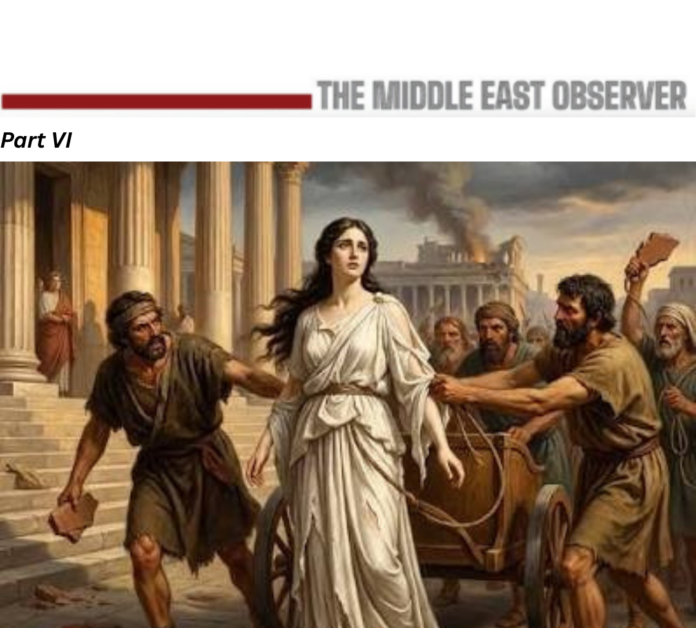
Part VI – Separating History from Myth
“The tragedy of Hypatia is not that legend remembered her. It is that legend often remembers her too simply.”
Few figures from late antiquity have been asked to carry as much symbolism as Hypatia.
To some, she is the last scientist of the ancient world.
To others, the final guardian of the Library of Alexandria.
To others still, a martyr of pagan philosophy, a feminist icon, a victim of religious fanaticism, or the embodiment of reason destroyed by intolerance.
Each image contains a fragment of truth.
None contains the whole truth.
Myth One: Hypatia Was the Last Librarian of Alexandria
This is the most common modern misconception.
Hypatia was not the last librarian of the Great Library.
By her lifetime, the original Library of Alexandria had already disappeared as a major institution. Its decline occurred gradually over centuries through political upheaval, institutional neglect, fires, war and the changing priorities of imperial power.
Alexandria remained a major centre of learning in Hypatia’s age, but she was not managing the ancient Library imagined by popular culture.
Historical verdict: false, though symbolically powerful.
Myth Two: Her Death Marked the End of Ancient Science
Hypatia’s murder was a devastating symbolic event, but it did not end science.
Mathematics, astronomy, medicine and philosophy continued in the Byzantine world. Greek scientific texts later passed into Syriac and Arabic, becoming central to the scholarship of the Islamic Golden Age before returning to Europe through translation.
What Hypatia’s death did mark was the decline of one public model of classical intellectual life in Alexandria: the philosopher as civic adviser, teacher and independent moral authority.
Historical verdict: exaggerated. Her death symbolised a turning point, not the extinction of science.
Myth Three: She Invented the Astrolabe
Hypatia almost certainly understood and taught the use of astronomical instruments. Surviving letters from Synesius show that he consulted her on such devices.
But the astrolabe existed before Hypatia.
The evidence supports her expertise, possible refinement and instruction, not original invention.
Historical verdict: unsupported as invention; credible as mastery and teaching.
Myth Four: She Was Killed Simply Because She Was a Scientist
This is too narrow.
Hypatia was a mathematician and astronomer, but her public identity was that of a philosopher. Her murder emerged from a dangerous intersection of politics, religion, civic rivalry and mob violence.
She was targeted because she was influential, close to Orestes, symbolically associated with pagan intellectual authority, and falsely accused of preventing reconciliation between the governor and Cyril.
Historical verdict: misleading. Science was part of her identity, but politics made her vulnerable.
Myth Five: Cyril Personally Ordered Her Murder
This remains unproven.
The earliest surviving account, by Socrates Scholasticus, condemns the murder and says it brought disgrace upon Cyril and the Alexandrian Church. But it does not state that Cyril ordered the killing.
Modern historians generally distinguish between direct responsibility and moral or political responsibility. Cyril’s conflict with Orestes helped create the hostile atmosphere. Whether he commanded the mob cannot be established.
Historical verdict: possible atmosphere of responsibility; no surviving proof of direct order.
Myth Six: Hypatia Was an Atheist
There is no evidence for this.
Hypatia was a Neoplatonist philosopher. Neoplatonism was deeply metaphysical and spiritual, concerned with the ascent of the soul, divine order and the structure of reality.
She was not a modern secular rationalist. Later Enlightenment writers sometimes recast her in that role, but this reflects their own intellectual battles more than hers.
Historical verdict: false.
Myth Seven: She Was Anti-Christian
The surviving evidence does not support this.
Some of her students were Christians. Her most famous pupil, Synesius of Cyrene, became a Christian bishop and continued to revere her as a teacher.
Hypatia’s world was not a simple battlefield between Christians and pagans. Intellectual friendships crossed religious boundaries.
Historical verdict: false as a general claim.
Myth Eight: She Was the Last Pagan Philosopher
She was one of the last great public pagan philosophers of Alexandria, but not the last pagan philosopher of antiquity.
Neoplatonic schools continued elsewhere, especially in Athens, for more than a century after her death. Pagan philosophy did not vanish with Hypatia.
Historical verdict: false literally; meaningful symbolically.
Myth Nine: She Was a Feminist Before Her Time
Hypatia is rightly celebrated as one of history’s most remarkable women scholars.
But calling her a feminist in the modern sense risks anachronism. She did not campaign for women’s rights as a political programme, at least not in any evidence that survives.
Her significance lies in achievement rather than activism. She entered the highest intellectual circles of her age and was recognised not merely as an exceptional woman, but as an exceptional philosopher.
Historical verdict: inspiring to feminism, but not a feminist in the modern political sense.
Myth Ten: Her Murder Was a Simple Clash Between Reason and Faith
This is the most seductive myth—and the most incomplete.
Hypatia represented reason, learning and philosophical discipline. Her killers were Christian zealots. But the broader world was more complicated.
Many Christians valued classical learning. Socrates Scholasticus, a Christian historian, condemned her murder. Synesius, a Christian bishop, revered her.
The murder was not Christianity killing science in a simple civilisational drama. It was urban factional violence in a city where religious authority, imperial administration and public opinion had become dangerously entangled.
Historical verdict: partly symbolic, historically oversimplified.
The Real Hypatia
Once the myths are stripped away, Hypatia becomes not smaller but greater.
She was not the last librarian.
She was not a modern scientist.
She was not an atheist martyr.
She was not a fictional heroine standing alone against an entire religion.
She was something rarer: a real scholar whose life reveals the complexity of a civilisation in transition.
She taught mathematics when manuscripts were fragile.
She preserved Greek science when knowledge depended upon copying.
She advised political leaders without holding office.
She commanded respect in a society that rarely granted public authority to women.
She welcomed students across religious lines.
She died because a city in crisis turned wisdom into suspicion.
That is not a lesser story.
It is a more human one.
Why the Myths Endure
Legends survive because they answer emotional needs.
Hypatia’s story offers a powerful image: knowledge violated by violence.
Every age has found its own Hypatia.
The Enlightenment saw reason oppressed by clerical power.
The nineteenth century saw a tragic heroine.
The twentieth century saw a woman scientist erased by patriarchy.
The twenty-first century sees a warning about extremism, polarisation and the fragility of intellectual freedom.
Each interpretation tells us something about Hypatia.
It also tells us something about ourselves.
The Historian’s Responsibility
To separate myth from history is not to diminish the past.
It is to respect it.
Hypatia does not need invented achievements to matter. Her authentic life is already extraordinary.
The surviving evidence gives us a philosopher of exceptional reputation, a teacher of future bishops and statesmen, a mathematician linked to the preservation of major Greek works, and a public intellectual murdered during one of Alexandria’s most dangerous political crises.
That is enough.
Indeed, it is more powerful than legend.
Because legend turns Hypatia into a statue.
History restores her as a person.
End of Part VI
Coming in Part VII – Why the World Still Remembers Hypatia: how Renaissance scholars, Enlightenment writers, modern historians, universities, scientists and advocates of women’s education transformed Hypatia into one of the enduring symbols of intellectual freedom—and why her story still matters in the twenty-first century.
Read also:
Hypatia of Alexandria The Last Light of the Ancient World
Hypatia of Alexandria The Last Light of the Ancient World
Hypatia of Alexandria The Last Light of the Ancient World
Hypatia of Alexandria: The Last Light of the Ancient World
Hypatia of Alexandria The Last Light of the Ancient World
Hypatia of Alexandria The Last Light of the Ancient World