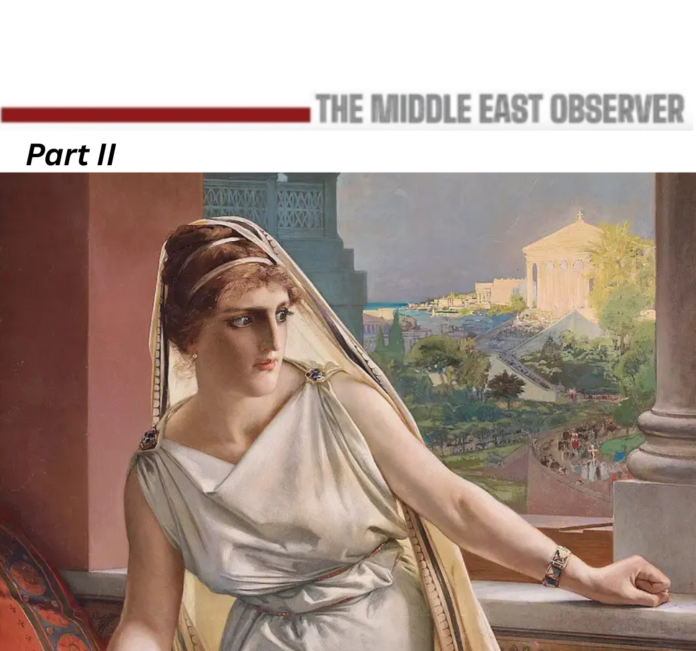
Part II – The Woman Who Taught an Empire
“Knowledge,” the ancient philosophers believed, “is the only possession that cannot be taken from us.” For Hypatia, that belief became both the purpose of her life and, ultimately, the reason she died.
By the opening years of the fifth century, Alexandria had changed dramatically.
The city that had once celebrated the gods of Greece and Egypt now stood at the crossroads of two civilizations. Christianity had become the dominant religion of the Roman Empire, while the intellectual traditions of classical antiquity fought to preserve their place in an increasingly Christian world.
It was during this period of profound transition that a woman accomplished something virtually unprecedented.
She became the most respected public intellectual in one of the world’s greatest cities.
A Philosopher Before She Was a Scientist
Modern portrayals often describe Hypatia as a mathematician or astronomer.
She was both.
Yet to understand her true influence, one must begin elsewhere.
Hypatia considered herself first and foremost a philosopher.
In antiquity, philosophy encompassed far more than abstract reflection. It represented a comprehensive way of life—combining ethics, mathematics, astronomy, logic, politics and the disciplined pursuit of truth.
She belonged to the tradition of Neoplatonism, whose adherents sought to understand reality through reason, contemplation and intellectual discipline.
The movement traced its origins to Plato but had evolved over six centuries into an intricate philosophical system under thinkers such as Plotinus and Porphyry.
Unlike popular stereotypes, Neoplatonists did not reject science.
Quite the opposite.
They regarded mathematics as the purest expression of universal order.
To understand numbers was to glimpse the rational structure underlying creation itself.
For Hypatia, geometry and astronomy were not separate disciplines.
They were pathways toward wisdom.
The School Without Walls
Unlike modern universities, Alexandria possessed no formal campus where students registered for courses.
Instead, renowned philosophers attracted followers through reputation.
By the beginning of the fifth century, Hypatia’s reputation had spread across the eastern Mediterranean.
Students travelled from Greece, Syria, Libya and Asia Minor to hear her lectures.
Some rented houses nearby.
Others lived with wealthy Alexandrian families while pursuing their education.
Many remained lifelong correspondents.
Her classroom was fluid.
Lectures took place in private residences, public buildings and open spaces throughout Alexandria.
Ancient accounts describe citizens stopping in the streets to greet her as she travelled through the city in her chariot—a remarkable image in an age when women rarely occupied positions of public authority.
The Byzantine encyclopedia known as the Suda, compiled centuries later but drawing on earlier sources, records that she lectured publicly while wearing the philosopher’s cloak (tribon), a garment traditionally associated with male philosophers.
It symbolised something extraordinary.
She wished to be judged not as a woman entering a man’s profession, but as a philosopher among philosophers.
Teaching Future Leaders
Hypatia’s students would become some of the Roman Empire’s most influential figures.
The best known was Synesius of Cyrene.
Born into an aristocratic family in present-day Libya, Synesius arrived in Alexandria seeking philosophical instruction.
He left transformed.
Years later, after becoming the Christian bishop of Ptolemais, Synesius continued writing affectionate and respectful letters to his former teacher.
Those surviving letters are among the most valuable historical sources about Hypatia.
They reveal an intellectual relationship remarkable for its warmth.
He requested scientific instruments from her.
He sought advice on difficult philosophical questions.
He discussed politics, astronomy and theology.
At no point does he suggest any contradiction between being a Christian bishop and regarding Hypatia as his intellectual mentor.
His correspondence offers important insight into Alexandria before sectarian conflict overwhelmed the city.
Hypatia’s classroom welcomed students regardless of religious identity.
Pagans attended.
Christians attended.
Government officials attended.
Knowledge transcended belief.
Preserving the Mathematics of Antiquity
One of history’s great ironies is that Hypatia’s fame rests largely upon works that no longer survive.
None of her confirmed writings has reached the present day.
Yet references preserved by later scholars allow historians to reconstruct much of her intellectual activity.
Like her father, Hypatia devoted considerable effort to editing and commenting upon earlier scientific masterpieces.
Today this might appear secondary.
In late antiquity it was indispensable.
Books existed only as handwritten manuscripts.
Every copy introduced new errors.
Mathematical diagrams deteriorated through repeated copying.
Commentaries clarified obscure passages and corrected mistakes accumulated over generations.
Hypatia worked on texts by Diophantus, whose Arithmetica explored sophisticated numerical problems that would later inspire Renaissance algebra.
She also prepared or revised commentaries on Apollonius of Perga’s monumental work Conics, the foundational study of ellipses, parabolas and hyperbolas.
Centuries later, these very geometric principles would enable Johannes Kepler to explain planetary motion and help lay the groundwork for modern physics.
Hypatia could not have imagined such future applications.
Yet by preserving these texts, she helped ensure that ancient mathematics survived to shape the Scientific Revolution more than a thousand years later.
Reading the Heavens
Astronomy occupied an equally important place in her work.
Alexandria had long been the world’s leading center for astronomical observation.
Its scholars inherited centuries of Babylonian records, Greek geometry and Egyptian calendrical knowledge.
Hypatia taught the astronomy of Claudius Ptolemy, whose Almagest remained the definitive astronomical treatise until the sixteenth century.
She almost certainly supervised calculations of planetary movements, eclipse predictions and astronomical tables used for both scientific and practical purposes.
Several later traditions credit her with constructing or improving scientific instruments such as the astrolabe.
Modern historians urge caution.
The surviving evidence indicates that she taught the use of these instruments and may have refined their design rather than inventing them outright.
Nevertheless, her expertise was sufficiently respected that Synesius asked her to obtain an astrolabe and a hydrometer—an instrument for measuring the density of liquids.
Such requests illustrate how closely philosophy and practical science remained connected.
A Reputation Beyond Alexandria
By now Hypatia’s influence extended well beyond Egypt.
Officials passing through Alexandria sought her counsel.
Travellers carried news of her lectures across the Roman Empire.
Even those who disagreed with her philosophical outlook admired her intellect.
The fifth-century historian Socrates Scholasticus—himself a Christian—described her as having attained “such a height of wisdom” that she surpassed all contemporary philosophers.
This is among the most remarkable tributes in late antique literature.
It came not from a disciple but from a historian writing within the Christian tradition.
His admiration demonstrates that Hypatia’s reputation transcended religious divisions.
She was respected because she was brilliant.
A Woman in a Man’s World
No aspect of Hypatia’s career has fascinated later generations more than her position as a female scholar.
Ancient Mediterranean society rarely offered women opportunities for advanced education.
Public life belonged overwhelmingly to men.
Philosophical schools were almost entirely male.
Hypatia defied every expectation.
Yet contemporary sources seldom dwell on her gender.
Instead, they emphasize her learning, eloquence and integrity.
To her students she was not an extraordinary woman.
She was an extraordinary philosopher.
That distinction matters.
Modern narratives sometimes portray Hypatia primarily as an early feminist icon.
While her achievements undoubtedly inspire women in science and scholarship today, imposing modern categories upon late antiquity risks obscuring what made her unique.
She did not campaign against existing social structures.
She simply embodied excellence so completely that conventional barriers became secondary.
The Adviser to Governors
Hypatia’s reputation inevitably attracted political attention.
Among those who admired her was Orestes, the imperial governor responsible for Alexandria.
Orestes governed one of the empire’s wealthiest provinces.
His responsibilities included taxation, public order, commerce and relations with the imperial court in Constantinople.
Like many educated Roman administrators, he valued philosophical counsel.
Hypatia became one of his trusted advisers.
No evidence suggests she held any official office.
Her influence rested entirely upon personal respect.
Yet in politically volatile Alexandria, intellectual authority could easily become political authority in the eyes of rivals.
Without intending it, Hypatia was approaching the centre of a storm that neither mathematics nor philosophy could calm.
The conflict that would consume Alexandria was no longer about ideas alone.
It was about power.
And in cities where power is contested, even the wisest voices may become targets.
End of Part II
Coming in Part III Tomorrow: When Politics Killed Philosophy — the dramatic confrontation between Patriarch Cyril and Governor Orestes; the escalating violence that engulfed Alexandria; the surviving eyewitness and near-contemporary accounts of Hypatia’s murder; what each ancient source says; and why historians continue to debate one of antiquity’s most infamous killings more than sixteen centuries later.
Read also:
Hypatia of Alexandria – The Last Light of the Ancient World