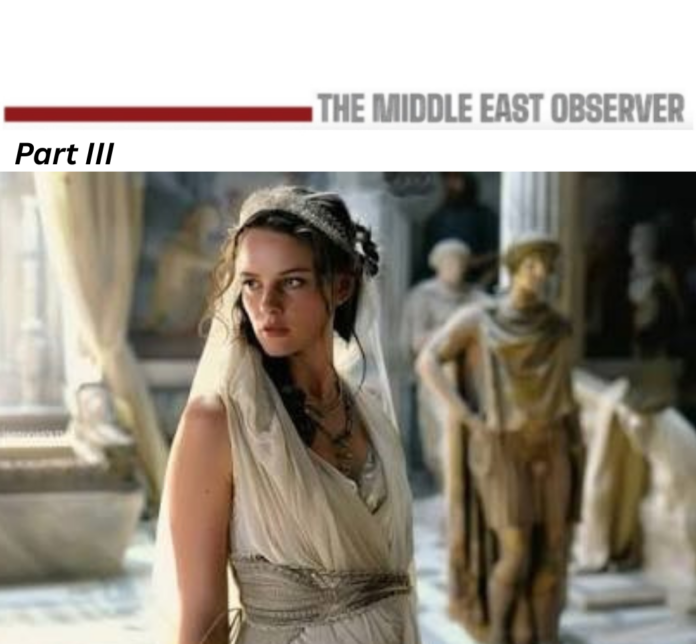
Part III – When Politics Killed Philosophy
“Cities are rarely destroyed by ideas alone. More often, ideas become weapons in struggles over power.”
In the spring of AD 415, Alexandria was no longer merely the intellectual capital of the Mediterranean.
It had become one of the Roman Empire’s most combustible cities.
For centuries, Alexandria had flourished because of diversity.
Egyptians, Greeks, Romans, Jews, Syrians and traders from across Africa and Asia lived within its walls. Philosophers debated theologians. Merchants negotiated in multiple languages. Temples, synagogues and churches stood within walking distance of one another.
Yet diversity also bred rivalry.
Political influence, economic privilege and religious identity increasingly overlapped, creating tensions that successive Roman governors struggled to contain.
By the beginning of the fifth century, the city had become a stage upon which two forms of authority confronted one another.
One represented the Roman state.
The other represented the rapidly expanding Christian Church.
Between them stood a philosopher who belonged to neither.
A New Alexandria
When Christianity became the Roman Empire’s official religion under Theodosius I in the late fourth century, the transformation of Alexandria accelerated.
Pagan temples closed.
Some were converted into churches.
Others fell into disuse.
Traditional philosophical schools survived, but their political influence steadily diminished.
The destruction of the Serapeum in AD 391 marked more than the loss of one of Alexandria’s grandest temples.
It symbolised the passing of an age.
Modern historians caution, however, against treating the event as the destruction of the Great Library itself. By then, the famous Library had already ceased to exist in its classical form, although collections of books and centres of scholarship continued elsewhere in the city.
Knowledge survived.
Its institutional foundations changed.
The Rise of Cyril
In AD 412, following the death of his uncle Theophilus, Cyril of Alexandria became Patriarch.
Few churchmen would shape Christian theology more profoundly.
Later recognised as one of Christianity’s greatest theologians and eventually canonised as a saint, Cyril would play a decisive role in the Christological controversies of the fifth century and emerge victorious at the Council of Ephesus.
Yet before becoming one of Christianity’s leading theologians, he faced a more immediate challenge.
Control of Alexandria.
The Patriarch governed not only the Church but an extensive charitable network, educational institutions and a substantial body of loyal followers.
His influence extended far beyond religion.
In many respects, Alexandria possessed two governments.
One answered to Constantinople.
The other answered to the Church.
Conflict between them became almost inevitable.
The Governor
Representing imperial authority was Orestes.
As Prefect, Orestes served directly under the Emperor.
He commanded police forces, supervised taxation, administered justice and maintained public order.
Unlike Cyril, whose authority derived from religion, Orestes embodied Roman civil administration.
The two men were not natural enemies.
Indeed, cooperation between bishop and governor was essential for governing Alexandria.
But personalities, ambition and mutual suspicion gradually poisoned their relationship.
Their disagreements soon expanded beyond policy.
Each became the symbol of competing visions of authority.
Violence in the Streets
Alexandria’s political disputes rarely remained confined to official meetings.
The city possessed a long tradition of street politics.
Crowds frequently assembled to support one faction or another.
Religious passions magnified political disputes.
One of the earliest flashpoints involved public entertainment.
According to the historian Socrates Scholasticus, disagreements erupted over theatrical performances and public announcements.
Soon afterwards, violence spread between Christian and Jewish communities.
Ancient sources differ on details.
They agree on consequences.
Numerous deaths followed.
Cyril responded by expelling much of Alexandria’s Jewish population and taking control of abandoned synagogues.
Orestes objected.
As Prefect, maintaining civil order—and deciding legal punishments—fell within his jurisdiction.
The dispute deepened.
Neither man wished to appear weak.
The Monks Arrive
Support for Cyril extended beyond Alexandria.
From the Nitrian Desert west of the Nile came hundreds of monks renowned for uncompromising devotion.
Hearing of the Patriarch’s conflict with Orestes, many travelled to Alexandria intending to defend their bishop.
What followed transformed political disagreement into open confrontation.
As Orestes travelled through the city, the monks surrounded him.
They accused him of pagan sympathies despite his own Christianity.
One monk, Ammonius, struck the governor on the head with a stone.
Bleeding heavily, Orestes narrowly escaped death after citizens intervened.
Ammonius was arrested.
Roman authorities tortured him before execution.
Cyril initially honoured Ammonius as a martyr.
Yet many Christians regarded the title as inappropriate because Ammonius had died not for refusing to renounce his faith but for participating in political violence.
Even among contemporaries, opinions differed.
The episode demonstrated how dangerously unstable Alexandria had become.
The Philosopher in the Middle
Throughout these events, Hypatia continued teaching.
She held no military command.
She governed no institution.
She led no political faction.
Yet influence is not measured only by office.
Ancient sources consistently portray Hypatia as one of Alexandria’s most respected advisers.
Her friendship with Orestes was widely known.
Government officials sought her counsel.
Leading citizens admired her judgement.
In calmer times, such respect enhanced her prestige.
In moments of crisis, it became perilous.
Rumours began spreading.
Some claimed Hypatia prevented reconciliation between Orestes and Cyril.
No contemporary evidence supports the accusation.
Socrates Scholasticus presents it merely as popular belief—not established fact.
Nevertheless, rumours often possess political power regardless of their truth.
Once public suspicion attached itself to Hypatia, her intellectual independence became politically dangerous.
She represented neither Church nor State.
Yet each side increasingly interpreted neutrality as allegiance to the other.
March AD 415
The precise day remains uncertain.
The sequence of events does not.
According to Socrates Scholasticus—the earliest surviving historian to describe the murder—Hypatia was travelling through Alexandria in her carriage when she was intercepted by a Christian mob led by Peter, a church reader.
She was dragged from the vehicle.
Her attackers took her to the Caesareum.
Originally constructed as a temple during Roman rule, the building had later become a Christian church.
There, according to Socrates, she was stripped of her clothing and killed.
He describes the murderers using sharp roof tiles or pottery fragments before dismembering her body and carrying the remains to a place called Cinaron, where they were burned.
The account is brief.
Its restraint makes it all the more powerful.
Socrates does not celebrate the killing.
He condemns it unequivocally.
He concludes that the murder “brought no small reproach upon Cyril and upon the Church of Alexandria.”
That sentence has echoed through sixteen centuries of historical debate.
Other Ancient Voices
Several centuries later, the philosopher Damascius offered a more detailed and dramatic account.
Writing around a century after the events, he portrayed Hypatia as the embodiment of philosophy destroyed by fanaticism.
His narrative contains vivid details absent from earlier sources.
Some may derive from authentic oral tradition.
Others may reflect literary embellishment.
Modern historians therefore treat Damascius with caution—valuable, but not equal in reliability to Socrates.
Another important account comes from John of Nikiû, writing more than two centuries later.
Unlike Socrates, John praises the destruction of Hypatia, describing her as a practitioner of pagan philosophy and accusing her of influencing Orestes against the Patriarch.
His account illustrates how profoundly historical memory had changed over two hundred years.
For John, Hypatia was not a victim.
She represented the final remnants of pagan intellectual authority.
The contrast between these sources is striking.
Socrates condemned.
Damascius lamented.
John justified.
Each reveals as much about his own age as about Hypatia’s.
Did Cyril Order the Murder?
This remains one of antiquity’s most debated questions.
No surviving contemporary document states that Cyril ordered Hypatia’s assassination.
No letter.
No official decree.
No eyewitness testimony.
Modern scholarship is therefore cautious.
Historians generally agree that Cyril’s fierce political struggle with Orestes created the atmosphere in which violence became possible.
His followers undoubtedly viewed Hypatia as an obstacle.
Whether he personally sanctioned the attack cannot be established from available evidence.
Some scholars argue he bore moral responsibility because of the hostile environment surrounding the conflict.
Others maintain that assigning direct culpability exceeds what the sources permit.
The distinction is important.
History must separate probability from proof.
More Than Religion
Popular retellings often reduce Hypatia’s death to a simple conflict between science and religion.
Reality was more complex.
Many Christians admired Hypatia.
Her most devoted surviving correspondent became a Christian bishop.
The earliest historian to condemn her murder was himself a Christian.
Likewise, many pagan elites participated in imperial politics without suffering similar fates.
Hypatia was not killed solely because she studied mathematics.
Nor solely because she remained a pagan.
Nor solely because she advised Orestes.
Rather, she occupied the intersection where philosophy, politics, personal influence and religious tension converged.
In ordinary times, those qualities made her exceptional.
In extraordinary times, they made her vulnerable.
Silence
The murder ended more than one remarkable life.
It signalled the disappearance of one of the last great public philosophers of classical antiquity.
Alexandria did not cease producing scholars after AD 415.
Nor did scientific inquiry suddenly vanish.
Yet something intangible was lost.
The city that had once welcomed every school of thought had witnessed the violent elimination of its most celebrated teacher.
The consequences extended far beyond Alexandria.
Across the Mediterranean, intellectuals understood the message.
Ideas remained powerful.
But even the greatest philosopher could not remain untouched when politics declared knowledge itself a battlefield.
End of Part III
Coming in the concluding chapter: Part IV – The Legend, the Myths and the Real Hypatia—what became of her writings, how the Renaissance rediscovered her, why Enlightenment thinkers transformed her into a symbol of reason, how modern historians separate myth from history, and why Hypatia remains one of the most influential women in the history of science and philosophy.
Read also:
Hypatia of Alexandria – The Last Light of the Ancient World
Hypatia of Alexandria The Last Light of the Ancient World