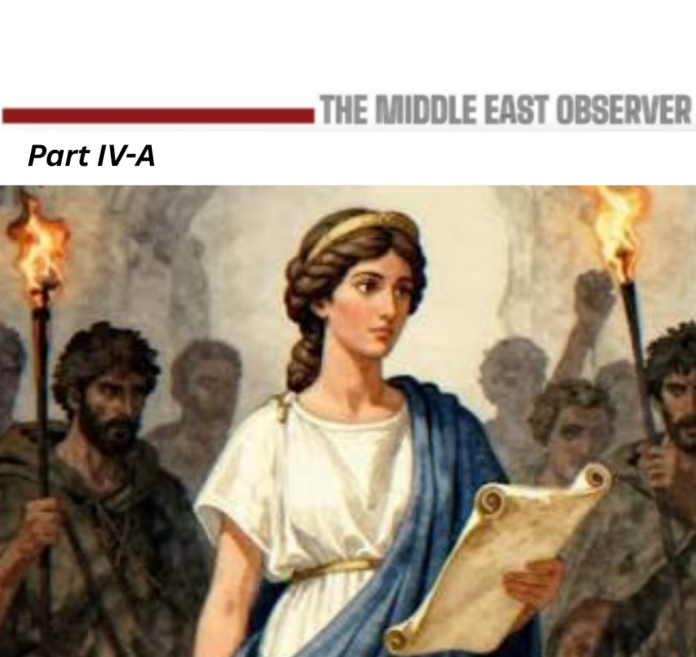
Part IV-A – The Death of a Scholar
“A philosopher had been murdered. Yet in the silence that followed, something even greater was at risk—the confidence that ideas could still be pursued without fear.”
The violence that ended Hypatia’s life lasted only a few brutal moments.
Its consequences would resonate for centuries.
For generations, historians have focused on the manner of her death: the mob, the Caesareum, the savage killing described by the earliest surviving accounts. Yet the deeper significance of March AD 415 lay not only in the loss of one extraordinary woman, but in the message her death conveyed to one of the world’s greatest intellectual capitals.
Alexandria had witnessed riots before.
It had seen emperors rise and fall, religious upheavals, ethnic violence and political assassinations.
But never had its foremost philosopher—the city’s most respected public teacher—been dragged from the streets and murdered by fellow citizens.
For many contemporaries, the event represented not merely a crime.
It marked the collapse of a fragile understanding that scholarship stood above factional politics.
The First Witnesses
History is often written by those who survive.
In Hypatia’s case, the earliest surviving narrative comes not from one of her students, nor from a pagan philosopher, but from a Christian historian.
Socrates Scholasticus was writing in Constantinople, far from Alexandria, when he composed his Ecclesiastical History only a few decades after the murder. Unlike many later writers, Socrates was close enough to the events in time to have drawn upon living memory and contemporary testimony.
His account is remarkable for what it does—and does not—say.
He praises Hypatia as a woman who had attained “the highest degree of learning,” excelling in mathematics and philosophy to such an extent that she surpassed many of the scholars of her age. He notes that governors and civic leaders regularly sought her advice, not because she wielded political authority, but because her wisdom commanded respect.
Then comes the pivotal observation.
According to Socrates, rumours spread through Alexandria that Hypatia was preventing reconciliation between the city’s Roman Prefect, Orestes, and the Patriarch, Cyril of Alexandria.
Socrates does not endorse the accusation.
He reports it as the belief that motivated those who attacked her.
That distinction is crucial.
The historian’s restraint has led many modern scholars to regard his account as the most reliable surviving narrative of the murder. Rather than assigning motives unsupported by evidence, he records only what he believed could be established.
His verdict, however, is unequivocal.
The killing, he writes, brought “no small disgrace” upon both Cyril and the Church of Alexandria.
Those few words have shaped historical debate for sixteen centuries.
They neither convict Cyril of ordering the crime nor absolve him of responsibility for the atmosphere in which it occurred.
Instead, they acknowledge an uncomfortable reality: whether planned or spontaneous, the murder damaged the moral authority of the Alexandrian Church.
Silence in the City
One might expect an event of such magnitude to have generated a flood of contemporary documents.
Instead, the historical record falls strangely quiet.
No official investigation survives.
No imperial decree concerning the murder has been preserved.
No transcript of legal proceedings has reached posterity.
If Roman authorities pursued the perpetrators, history has left little trace.
This silence has puzzled generations of historians.
Some interpret it as evidence that political considerations discouraged further action. Others suggest that Alexandria, accustomed to periodic urban violence, simply absorbed yet another tragedy into its turbulent civic life.
Whatever the explanation, one consequence is unmistakable.
Hypatia’s death disappeared remarkably quickly from official administrative records while surviving vividly in the memories of scholars.
History, once again, was preserved more faithfully by intellectuals than by governments.
The Grief of Her Students
Among those most deeply affected were Hypatia’s former pupils.
Although none left a direct description of the murder, their surviving correspondence reveals the intellectual community she had created.
The most important witness remains Synesius of Cyrene.
Years before the tragedy, Synesius had written to Hypatia with extraordinary affection and admiration. By the time of her death, he had become Bishop of Ptolemais, balancing Christian pastoral duties with the philosophical education he had received in Alexandria.
His letters portray Hypatia not as an ideological opponent of Christianity, but as a revered teacher whose counsel transcended religious boundaries.
The correspondence also challenges one of the most persistent modern myths: that Christian intellectuals uniformly rejected pagan scholarship.
Synesius never concealed his faith.
Nor did he conceal his gratitude to Hypatia.
His example reminds us that Alexandria’s intellectual life was considerably more nuanced than later polemics often suggest.
Unfortunately, no surviving letter records his reaction to her murder. Historians do not know whether he learned of the event before his own death around AD 413–414 or whether later correspondence has simply been lost. The silence is one of history’s poignant absences.
What remains unmistakable is the respect he had shown her throughout his life.
A School Without Its Master
Hypatia’s school did not close overnight.
Nor did philosophy suddenly disappear from Alexandria.
Yet something fundamental changed.
For decades, Hypatia had embodied the ideal of the independent philosopher—respected by officials, consulted by citizens and welcomed by students of different faiths. Her authority rested not upon wealth, hereditary privilege or political office, but upon learning.
That model proved difficult to sustain after AD 415.
The surviving evidence suggests that philosophical activity continued in Alexandria, though increasingly with less public prominence. Intellectual life gradually shifted toward centres where scholars could pursue their work with greater security.
Meanwhile, Athens emerged as the principal stronghold of late Neoplatonism, attracting philosophers who sought distance from Alexandria’s volatile political environment.
The murder did not end classical philosophy.
It altered its geography.
The Long Twilight of Alexandrian Scholarship
It would be misleading to portray Hypatia’s death as the moment ancient science collapsed.
Mathematics continued.
Astronomy continued.
Medicine, engineering and philosophy all survived in various forms across the Byzantine Empire and, later, the Islamic world.
Indeed, many Greek scientific works would eventually be translated into Syriac and Arabic, preserved by scholars from Baghdad to Córdoba before returning to medieval Europe.
Yet Alexandria itself slowly relinquished the role it had played for nearly seven hundred years.
The city remained important.
It no longer stood unrivalled.
The intellectual leadership once exercised by the heirs of the Mouseion gradually dispersed across the Mediterranean.
Hypatia’s death therefore symbolises not the end of ancient knowledge but the closing of one remarkable chapter in its history.
A Murder Reinterpreted
As decades passed, the memory of Hypatia’s death began to change.
For some Christian writers, the episode became an embarrassment best mentioned briefly.
For pagan philosophers, it represented the tragic triumph of political violence over reason.
By the sixth century, the philosopher Damascius transformed Hypatia into a near-heroic figure—the last great philosopher of Alexandria whose wisdom eclipsed that of all her contemporaries. His account, richer in detail than that of Socrates, also reflects the literary style and philosophical concerns of a later generation.
Centuries afterward, John of Nikiû offered an altogether different portrait, depicting Hypatia as a dangerous pagan influence whose removal benefited the city.
These contrasting narratives reveal a broader truth.
Historical memory is never static.
Each generation reshapes the past according to its own fears, ideals and convictions.
The real Hypatia gradually disappeared behind competing interpretations.
The philosopher became a symbol.
Beyond One Life
Measured against the rise and fall of empires, the death of a single scholar might appear insignificant.
Yet civilisation advances not only through rulers and armies, but through those who preserve, question and transmit knowledge.
Hypatia belonged to that quieter tradition.
She wrote no imperial laws.
She commanded no legions.
She founded no dynasty.
Her influence flowed instead through classrooms, conversations, manuscripts and students.
Such legacies are difficult to quantify.
They are also remarkably durable.
Sixteen centuries after her death, the political disputes that consumed Alexandria have largely faded into specialist history.
The questions Hypatia asked about reason, education and the pursuit of truth remain astonishingly contemporary.
The Beginning of Immortality
Ironically, Hypatia became more famous after her death than during her life.
The philosopher who had spent decades interpreting the ideas of Plato, Euclid and Ptolemy would herself become the subject of interpretation.
Was she the last guardian of classical civilisation?
A martyr for science?
A victim of religious intolerance?
A political casualty?
A feminist before her time?
Or simply an exceptional teacher caught in extraordinary circumstances?
The answers would change with every century.
And with each retelling, history would mingle with legend.
The scholar was gone.
The myth had only begun.
End of Part IV-A
Coming in Part IV-B: The Birth of a Legend—how Byzantine chroniclers, medieval scholars, Renaissance humanists and Enlightenment thinkers transformed Hypatia from a respected Alexandrian philosopher into one of history’s most enduring symbols of knowledge, reason and intellectual freedom, while modern historians painstakingly worked to recover the woman behind the legend.
Read also:
Hypatia of Alexandria ; The Last Light of the Ancient World
Hypatia of Alexandria The Last Light of the Ancient World
Hypatia of Alexandria The Last Light of the Ancient World