
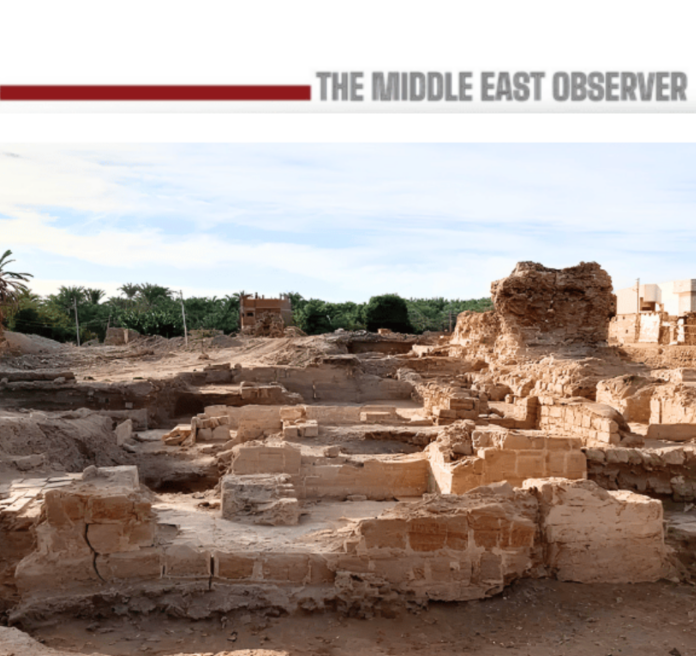
Archaeologists working in Egypt’s Bahariya Oasis have uncovered new architectural remains at the ancient Old Qasr Temple complex, providing fresh insights into the development of one of the region’s most important religious and administrative centres during the Late Period of ancient Egyptian history.
The discoveries were made by an Egyptian archaeological mission affiliated with the Supreme Council of Antiquities during ongoing excavations at Al-Qasr Al-Qadim, the ancient settlement that once served as the capital of the Bahariya Oasis. The latest findings include the remains of a sandstone chamber and a series of inscribed stone blocks bearing the names and royal titles of Psamtik I, the ruler credited with initiating the temple’s construction in the seventh century BC.
According to archaeologists, the newly discovered blocks are helping researchers reconstruct the temple’s architectural evolution and better understand the successive phases of construction that shaped the sanctuary over several generations. Previous studies have indicated that while the original structure was established during the reign of Psamtik I, significant expansions and modifications were later carried out under Apries and Amasis II, reflecting the growing importance of the oasis within Egypt’s western desert frontier.
The discoveries form part of a long-running excavation programme that has been underway since 2014. Over the past decade, archaeologists have gradually revealed substantial sections of the temple complex, including a hypostyle hall supported by sixteen sandstone columns arranged in a symmetrical layout. Excavations have also uncovered a network of adjoining rooms, chapels and ceremonial spaces that once played a central role in the religious life of the settlement.
The discovery comes as Egypt continues to expand investment in cultural heritage preservation and archaeological tourism, sectors viewed as important drivers of tourism revenues and international soft power. In recent years, authorities have intensified excavation, restoration and museum development projects across the country, seeking to showcase Egypt’s archaeological wealth beyond the traditional monuments of Giza, Luxor and Aswan. The strategy aims not only to preserve cultural heritage but also to diversify tourism offerings and encourage visitors to explore lesser-known historical destinations such as the western oases.
Researchers say the site continues to provide valuable evidence of the political, religious and economic significance of the Bahariya Oasis during the Late Period. In addition to the newly uncovered architectural remains, previous excavations have revealed inscriptions associated with major deities including Amun-Ra, Amunet and Khonsu, highlighting the oasis’s integration into the broader religious traditions of ancient Egypt.
Beyond its architectural significance, the latest findings are contributing to a broader reassessment of the role played by Egypt’s western oases in antiquity. Long regarded primarily as remote desert settlements, sites such as Bahariya are increasingly being understood as active centres of administration, commerce and religious life that maintained close links with the Nile Valley. The newly uncovered structures and inscriptions provide further evidence that the oasis functioned as an important regional hub within the state’s political and economic network.
Archaeologists have also identified artefacts dating to earlier periods, including a stone stela from the reign of Amenhotep II and remains linked to the era of Ramesses II, suggesting that the site was occupied and maintained religious significance long before the construction of the Late Period temple.
The discoveries also form part of a wider wave of archaeological research across Egypt. Recent years have witnessed a series of significant excavations and discoveries in Saqqara, Luxor, the Nile Delta and Egypt’s desert regions, reflecting a growing scholarly effort to better understand lesser-studied periods and regions of Egyptian history. Researchers say the expansion of fieldwork beyond the country’s most famous archaeological sites is yielding fresh insights into the diversity and complexity of ancient Egyptian civilisation.
For archaeologists, the significance of the Old Qasr Temple extends beyond the discovery of additional walls, chambers and inscriptions. Each new find is helping reconstruct the political, religious and economic networks that connected Egypt’s western desert frontiers to the Nile Valley and the wider ancient world. As excavations continue, the site is offering a more nuanced understanding of how power, belief and commerce were projected across one of history’s most enduring civilizations, while reinforcing the growing importance of the western oases in Egypt’s historical narrative.
Related news:
New Findings Reveal How Medieval Cairo Supplied Water to Its Citadel
Scenic Eyes Egypt’s Water Tourism Expansion Amid Luxury Cruise Push
Read also:
Libya Reaches Highest Oil Output Since 2013 Amid Investment Push
Nigeria and Egypt Forge Comprehensive Partnership to Tackle Regional Challenges