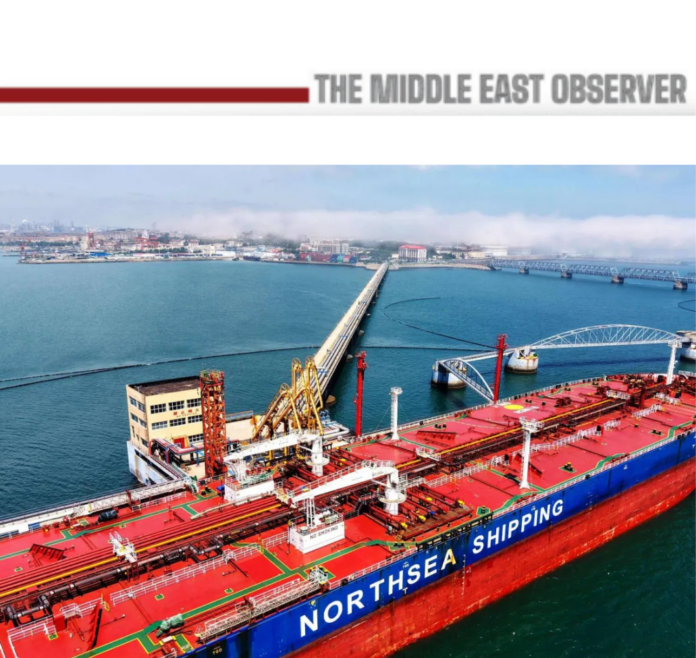
The global oil market has entered a new competitive phase in which aggressive production increases, record crude discounts and the temporary easing of U.S. sanctions on Iranian oil have transformed Asia into the world’s most fiercely contested energy market.
As OPEC+ gradually raises output and Gulf exports return to full strength following the reopening of the Strait of Hormuz, Saudi Arabia, the United Arab Emirates, Iraq, Qatar, Russia and Iran are increasingly sacrificing prices in a battle to secure long-term market share. The resulting competition has shifted unprecedented bargaining power to China, enabling the world’s largest crude importer to leverage its unrivalled purchasing strength to secure cheaper supplies, diversify import sources and reinforce its long-term energy security, while exporters wager that today’s price concessions will translate into tomorrow’s customer loyalty.
The transformation accelerated after OPEC+ agreed on 5 July to increase collective production by a further 188,000 barrels per day (bpd) from August, marking the fifth consecutive monthly output increase as the alliance continues to unwind the voluntary production cuts introduced in 2023.
For much of the past three years, Saudi Arabia and its OPEC+ partners defended oil prices by limiting supply. Today’s strategy reflects a different commercial reality. Faced with recovering exports, intensifying regional competition and moderate demand growth from China, the world’s leading producers are increasingly prioritising long-term market share over short-term price maximisation.
The strategic calculation is straightforward: accepting lower prices today may enable producers to secure larger export volumes, strengthen relationships with Asian refiners and position themselves more favourably once market conditions tighten again.
China Holds the Strongest Bargaining Position
China has become the focal point of the global crude market—not because its demand has surged, but because nearly every major exporter is competing for the same customers.
Saudi Arabia, the United Arab Emirates, Iraq, Qatar, Russia and Iran are all targeting Chinese refiners, creating one of the most competitive supply environments seen in years. The result has been a significant shift in bargaining power from sellers to buyers.
Chinese independent refiners, commonly known as “teapots”, have capitalised on the opportunity by securing large volumes of non-sanctioned Middle Eastern crude at substantial discounts.
Among the largest reported transactions, Abu Dhabi National Oil Company (ADNOC) sold two cargoes of two million barrels each of Upper Zakum crude to Dongming Petrochemical and Shenghong Petrochemical through competitive tenders at discounts estimated between US$7 and US$9 per barrel below Dubai benchmark prices on an FOB Fujairah basis. Shenghong also reportedly secured additional Saudi crude cargoes in the spot market.
Shandong-based Chambroad Petrochemical purchased two million barrels of Iraq’s Basrah Heavy crude for July loading at approximately US$5 per barrel below ICE Brent, while another independent Chinese refiner acquired two million barrels of Qatar’s Al-Shaheen crude for August delivery at a similar discount.
The cheaper feedstock has rapidly transformed refinery economics. Independent refiners that were operating at losses only weeks ago are now reporting refining margins of between 100 and 400 yuan per tonne, restoring profitability while encouraging higher utilisation rates.
More importantly, China is demonstrating that disciplined procurement, diversified sourcing and strong purchasing power can convert a period of global oversupply into a strategic economic advantage without requiring a corresponding increase in domestic oil demand.
Saudi Arabia Leads a New Battle for Market Share
Perhaps the most significant development is not the discounts themselves, but what they reveal about Saudi Arabia’s evolving commercial strategy.
Rather than defending price at all costs, Riyadh is increasingly defending its position in Asia’s refining market.
According to Bloomberg and market reports, Saudi Aramco reduced the August Official Selling Price (OSP) of its flagship Arab Light crude for Asian buyers by US$11 per barrel, placing the grade at approximately US$1.50 below the regional benchmark—the sharpest monthly reduction in more than two decades and significantly deeper than market expectations.
The reduction effectively removes much of the pricing advantage Gulf producers had regained during the recent Middle East conflict, allowing Saudi crude to compete directly with discounted Russian and Iranian supplies for Chinese refinery contracts.
The move signals a strategic shift. Higher production, larger export volumes and stronger long-term customer relationships are increasingly taking precedence over defending elevated spot prices.
A Rare 60-Day Opportunity for Global Importers
The competitive landscape has been reinforced by the reported 60-day U.S. sanctions waiver linked to Iranian oil exports under the interim understanding between Washington and Tehran. The temporary easing has introduced additional Iranian crude into an already well-supplied market, further intensifying competition among exporters.
For importing countries and refiners, the coming weeks represent one of the most favourable purchasing environments seen in recent years.
With multiple producers competing simultaneously, buyers are in a position to negotiate lower prices, diversify crude procurement, improve energy security and strengthen supply resilience.
Many importers are expected to use the current window to:
- Replenish strategic petroleum reserves.
- Increase commercial crude inventories.
- Renegotiate medium- and long-term supply agreements.
- Diversify away from reliance on single suppliers.
- Delay discretionary purchases where possible in anticipation of further commercial incentives.
China has historically expanded both commercial storage and its Strategic Petroleum Reserve during periods of abundant supply and lower prices, making the present market particularly attractive for large-scale buyers with available storage capacity.
Why Oil Prices Have Not Fallen Further
Despite growing physical supplies and increasingly aggressive pricing, international crude benchmarks have remained relatively resilient, with Brent continuing to trade around US$72–73 per barrel.
The apparent disconnect illustrates that oil prices are determined by considerably more than current supply and demand.
Although exports through the Strait of Hormuz have resumed, freight rates and marine insurance premiums remain above pre-conflict levels. Financial markets also continue to price in geopolitical risk as investors assess the durability of the U.S.-Iran understanding and broader regional stability.
Seasonal summer fuel demand across the Northern Hemisphere has also absorbed part of the additional production, while OPEC+ has deliberately introduced new supply in measured monthly increments rather than flooding the market.
Equally important, futures markets reflect expectations regarding economic growth, monetary policy, inventory levels, investor positioning and geopolitical developments. These factors have prevented benchmark prices from fully reflecting today’s physical oversupply.
Russia and Iran Face Growing Competitive Pressure
The resurgence of discounted Gulf crude has significantly increased pressure on Russian and Iranian exports.
Iranian crude is reportedly trading at discounts of around US$3 per barrel below ICE Brent, while Russia’s ESPO Blend has shifted from commanding premiums in Asia to trading at discounts. Russian Urals crude has also become increasingly discounted as exports from western Russian ports remain elevated.
Rather than merely replacing sanctioned barrels, Gulf producers are actively reclaiming customers lost during previous supply disruptions, reshaping Asian crude trade flows in the process.
Who Holds the Stronger Hand?
The current market favours importers in the short term, while exporters are investing in long-term commercial positioning.
Importers gain through:
- Multiple competing suppliers.
- Greater negotiating leverage.
- Lower procurement costs.
- Diversified supply chains.
- Opportunities to expand strategic reserves.
Exporters seek to gain through:
- Higher production volumes.
- Recovery of lost market share.
- Long-term refinery supply agreements.
- Stronger customer relationships.
- Improved competitive positioning once markets rebalance.
In effect, importers are capturing immediate financial benefits, while exporters are betting that today’s discounts will secure tomorrow’s customers.
Competition, Not Demand, Is Driving the Market
The defining characteristic of today’s oil market is not exceptional growth in global consumption but unprecedented competition among suppliers.
Unlike previous commodity cycles driven by expanding demand, the current environment is characterised by exporters competing more aggressively for broadly stable consumption levels. Pricing flexibility, supply reliability and commercial incentives have become as important as production capacity itself.
China’s advantage therefore stems less from stronger demand than from its position as the world’s largest buyer in an increasingly crowded sellers’ market.
Outlook
The coming 60 days are likely to represent a pivotal period for global energy markets.
Should geopolitical stability continue, exporters are expected to intensify commercial competition across Asia through increasingly flexible pricing, contractual incentives and targeted marketing strategies. Conversely, any renewed disruption to Middle Eastern shipping, stronger-than-expected global demand, hurricane-related supply interruptions or a change in OPEC+ production policy could quickly tighten the market and reverse today’s buyer-friendly conditions.
Rather than signalling a collapse in global oil prices, the current oversupply reflects a deliberate strategic contest for future customers. China has emerged as the immediate winner, using its purchasing power to secure highly competitive pricing while diversifying supply sources and strengthening energy security.
For now, the world’s largest oil importer is buying from a market in which exporters are effectively investing part of today’s revenues to secure future customer loyalty. Whether that strategy ultimately rewards producers or further strengthens the bargaining power of major importers will depend on how quickly today’s oversupply gives way to tomorrow’s tighter global oil market.
Related news:
Energy Security Drives China’s Response to Gulf Oil Crisis
China Unveils Nuclear-Powered Floating Port Concept for Next-Generation Shipping
Read also:
Hypatia of Alexandria The Last Light of the Ancient World
The New Soybean Race: Enzymes, Trade Wars, and What Egypt Should Watch