
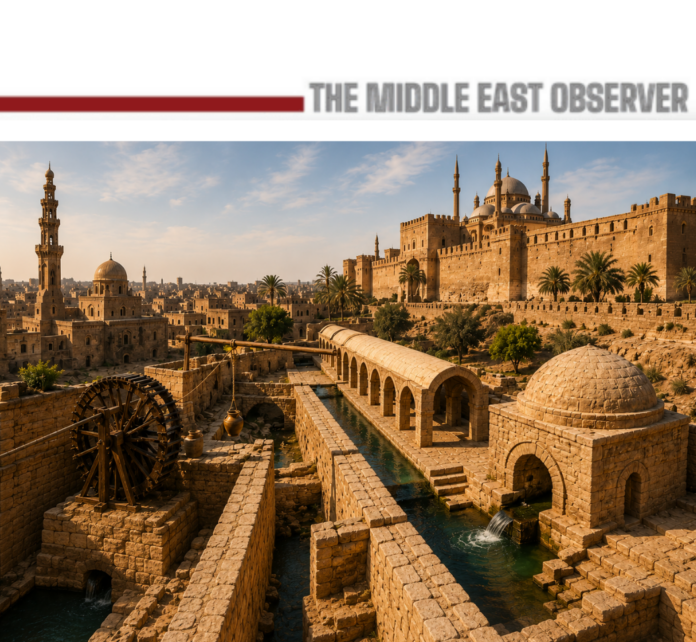
Cairo — An Egyptian-French archaeological mission has uncovered a sophisticated Mamluk-era water supply system and the remains of a historic mosque near the Citadel of Salah al-Din, offering fresh insights into the infrastructure that supported medieval Cairo’s political and administrative centre.
The excavation, conducted by the Supreme Council of Antiquities in cooperation with the French Institute for Oriental Archaeology (IFAO), revealed two large stone wells, remains of waterwheels, and an extensive network of channels linked to Cairo’s historic Magra al-Oyoun aqueduct system in the Arab al-Yasar district.
Researchers believe the discovery could significantly advance understanding of how the Citadel secured water supplies despite its elevated location overlooking Cairo. The newly uncovered wells, water-lifting mechanisms and distribution channels may represent a previously undocumented section of the hydraulic network that sustained one of the Islamic world’s most important seats of power for centuries.
Built by Salah al-Din in the 12th century, the Cairo Citadel served as Egypt’s seat of government and military command for nearly 700 years, making reliable access to water a critical strategic necessity.
In nearby al-Hattaba, archaeologists uncovered the remains of a Mamluk-era mosque, including sections of the qibla wall, mihrab, riwaq and original stone flooring, alongside tombs dating to different Islamic periods. Artefacts recovered from the site include ceramic water-lifting vessels, Mamluk and Ottoman coins, jewellery, metal seals and fragments of weapons dating to the 18th and 19th centuries.
The discovery comes as Egypt accelerates restoration and rehabilitation projects across Historic Cairo, a UNESCO World Heritage Site, to preserve its Islamic heritage and broaden cultural tourism beyond traditional destinations such as Giza, Luxor and Aswan. Tourism remains one of Egypt’s largest sources of foreign currency earnings, generating more than $15 billion annually in recent years, with authorities increasingly seeking to diversify visitor flows toward heritage districts, museums and historic urban centres.
Officials said the findings add a new dimension to understanding the urban, religious and engineering history of the capital while strengthening efforts to integrate heritage sites around the Citadel into future tourism routes.
Beyond the archaeological significance, the discoveries may provide one of the clearest pictures yet of how water management, religious life and daily economic activity were organised around Cairo’s medieval seat of power.