
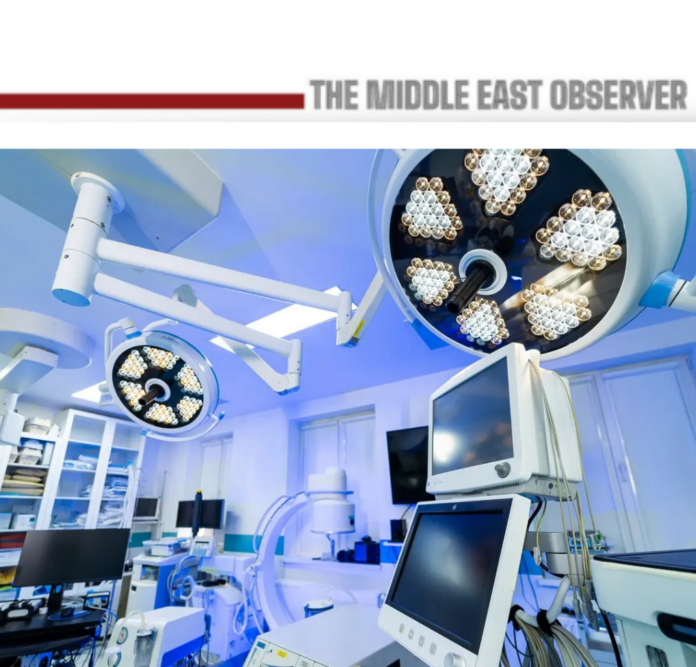
Tatweer Medical Industries, a subsidiary of El Ezaby Medical, and China’s Mindray plan to invest more than US$100 million over the next three years to expand medical device manufacturing in Egypt, supporting the localisation of advanced diagnostic equipment and positioning the country as a regional production and export hub for healthcare technologies.
Egypt is accelerating efforts to build a competitive medical technology manufacturing base as countries seek more resilient healthcare supply chains following the Covid-19 pandemic and heightened geopolitical uncertainty. Against this backdrop, Tatweer Medical’s expansion of its Badr City factory, in partnership with Mindray—China’s largest listed medical device manufacturer—ranks among Egypt’s largest recent private-sector investments in the sector and underscores the country’s ambition to reduce import dependence, strengthen industrial capabilities and expand exports to African markets.
The investment ranks among Egypt’s largest recent private-sector commitments to medical technology manufacturing and supports the government’s strategy to deepen industrial localisation, reduce dependence on imported healthcare technologies and establish Egypt as a regional production and export centre for high-value medical equipment.
The global medical devices market is valued at well over US$650 billion, while healthcare equipment demand across Africa is expected to outpace many mature markets over the coming decade as governments invest in hospital infrastructure, expand universal healthcare coverage and modernise diagnostic capabilities. Egypt is seeking to capture a greater share of this expanding market by combining local manufacturing with international technology partnerships.
Building Domestic Manufacturing Capacity
Located in Badr City east of Cairo, the factory occupies 10,000 square metres across two floors of 5,000 square metres each. The first operational phase, covering 2,500 square metres, has already been completed, while current investments have exceeded US$12 million.
According to company officials, total investment is expected to rise to approximately US$16 million by the end of 2026 before surpassing US$100 million during the third year of the expansion programme.
The facility has begun manufacturing ultrasound and diagnostic X-ray systems, marking an important step in Egypt’s efforts to establish domestic production of sophisticated medical technologies that have traditionally been supplied through imports. Egypt continues to import a substantial proportion of its advanced diagnostic imaging equipment, making localisation strategically important for reducing foreign currency outflows, strengthening healthcare resilience and improving supply-chain security.
Annual production capacity currently stands at approximately 2,000 ultrasound systems and 1,500 diagnostic X-ray units, while the company plans to expand its product portfolio from two to ten medical device categories through the addition of eight new products over the coming years.
The project supports Egypt’s broader industrial strategy of moving beyond conventional pharmaceutical production into higher-value medical technology manufacturing, strengthening domestic supplier networks while encouraging technology transfer and industrial upgrading.
Government Procurement Supports Local Industry
Tatweer Medical has already secured its first major government contracts, signing agreements to supply 100 ultrasound systems and 150 diagnostic X-ray units to the Ministry of Health and Population and the Egyptian Authority for Unified Procurement, Medical Supply and Technology Management.
The contracts, valued at an estimated EGP 300–400 million, provide an anchor customer during the factory’s initial production phase while demonstrating how government procurement can accelerate industrial localisation and reduce commercial risk for newly established manufacturing facilities.
According to Taha Abdel Nasser, Managing Director and Chief Executive Officer of Tatweer Medical Industries, the expansion programme is designed to broaden domestic manufacturing capabilities while supporting future exports to regional markets through the partnership with Mindray.
Company officials said deliveries of ultrasound equipment are scheduled to begin during July 2026, with diagnostic X-ray systems to be supplied in four phases beginning in August 2026.
Technology Transfer and Higher Local Content
The Tatweer-Mindray partnership establishes what the company describes as Egypt’s first local manufacturing facility dedicated to ultrasound and diagnostic X-ray systems.
Future expansion plans include commencing production of Automated External Defibrillators (AEDs) next year in support of national emergency healthcare programmes led by the Ministry of Health.
The company also intends to increase local content to approximately 60% beginning with the second production batch, reflecting a phased localisation strategy aimed at expanding domestic component manufacturing, strengthening supplier networks and embedding advanced manufacturing expertise within Egypt’s industrial base.
Egypt Eyes Regional Export Opportunities
While domestic demand remains the project’s immediate priority, its long-term strategy extends well beyond the Egyptian market.
Leveraging Mindray’s global distribution network, the factory is expected to serve as a regional manufacturing platform supplying medical equipment to African markets while establishing a spare-parts distribution and after-sales service hub covering the Middle East and Africa.
Africa represents one of the world’s fastest-growing healthcare equipment markets, supported by rapid population growth, rising healthcare investment and continued expansion of hospital infrastructure. These trends provide Egypt with an opportunity to strengthen its role in regional medical technology value chains while increasing exports of higher-value manufactured products.
The investment also reflects Egypt’s broader strategy of attracting capital into pharmaceuticals, biotechnology and advanced medical technology as part of wider efforts to diversify industrial production and increase knowledge-intensive manufacturing.
Building on Earlier Localisation Agreements
The project follows a memorandum of understanding signed in 2025 between the Egyptian Authority for Unified Procurement, El Ezaby Group and Mindray to localise advanced medical equipment manufacturing in Egypt. The agreement established the framework for technology transfer and industrial cooperation, making the current expansion the implementation of a phased localisation strategy rather than a standalone investment initiative.
The company has not yet disclosed the number of direct and indirect jobs expected to be created by the expansion programme.
If implemented as planned, the project is expected to strengthen Egypt’s position as a regional manufacturing platform for medical technology while supporting export diversification, industrial upgrading, skilled employment and greater resilience within the country’s healthcare supply chain.
More broadly, the investment reflects Egypt’s gradual shift from import substitution towards internationally integrated manufacturing capable of serving both domestic healthcare needs and regional export markets, illustrating how partnerships between Egyptian companies and global technology leaders can accelerate industrial competitiveness and long-term economic value creation.
Related news:
Egypt Partners with Philips to Localize Medical Device Manufacturing
Read also:
China Joins Elite Space Powers with Historic Orbital Booster Recovery