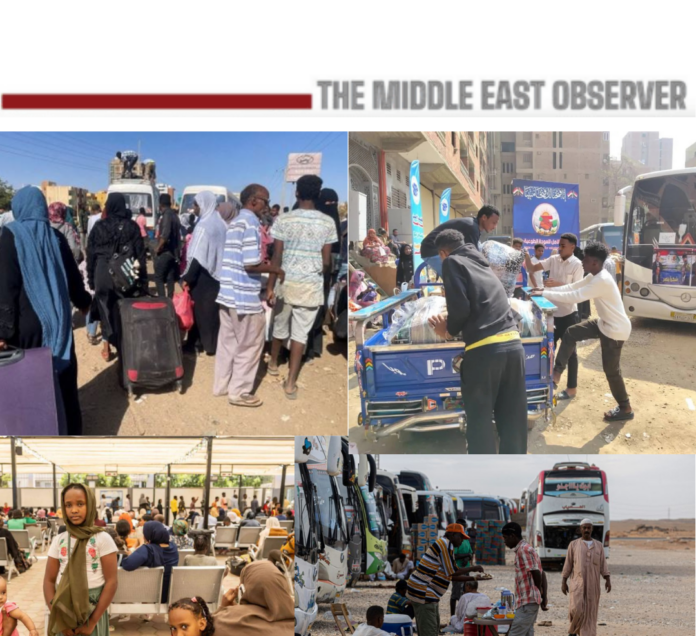
Recent reports by The Guardian and Amnesty International have drawn attention to the hardships facing Sudanese refugees in Egypt, citing poverty, discrimination, detention concerns and the desire among some refugees to seek a future in Europe.
These concerns deserve attention. Refugees fleeing conflict should be treated with dignity and protected under the law. Yet any fair assessment must also consider the wider context in which Egypt has absorbed one of the region’s largest displaced populations.
Over the past century, Egypt has repeatedly served as a refuge for populations displaced by war and instability, from Armenians fleeing persecution and Europeans displaced during the Second World War to Kuwaitis after the 1990 Iraqi invasion, and later Iraqis, Syrians, Libyans, Yemenis, Palestinians and Sudanese. Many integrated successfully, established businesses and became part of Egypt’s social and economic fabric. Their experience demonstrates that, despite periodic challenges, Egypt has historically functioned more as a country of refuge and integration than one of exclusion.
The current challenge, however, is exceptional in both scale and timing. Since the outbreak of Sudan’s war in 2023, Egypt has received hundreds of thousands of Sudanese arrivals, joining large foreign communities already present from across the region. This has occurred while Egypt itself faces inflation, housing shortages, pressure on public services and broader economic strains affecting citizens and refugees alike.
None of this diminishes the difficulties faced by Sudanese refugees, many of which are shared by Egyptians confronting the same economic pressures. Many struggle with rising living costs, limited employment opportunities and uncertainty regarding their future. However, it is important to distinguish between individual experiences, broader trends and official state policy. Human-rights organisations and international media play an important role in highlighting cases that require scrutiny, but selected testimonies alone cannot fully represent the experience of an entire refugee population.
The same principle applies in reverse. Isolated criminal incidents involving refugees should not be used to stigmatise entire communities. Like any large population, displaced communities consist overwhelmingly of law-abiding families alongside a minority who may violate the law. The responsibility of the state is to enforce the law against offenders while protecting the rights of the wider community. It is also important to recognise that public visibility differs across countries: in many European cases, crimes involving migrants or refugees can receive extensive national and international media coverage, whereas in Egypt such incidents are more often handled through routine police and judicial procedures and attract comparatively limited publicity. This difference in visibility can shape perceptions without necessarily reflecting the overall scale of the underlying issue.
Egypt’s concerns are not solely economic. The Sudan conflict has generated irregular migration routes, human trafficking, document forgery, smuggling networks and other security challenges that affect both refugees and host communities. Refugees themselves are often among the principal victims of these criminal networks. These pressures illustrate a wider dilemma facing countries on the front line of regional crises: they are expected simultaneously to act as humanitarian hosts, security partners and migration buffers, often with limited international support.
The debate therefore extends beyond Egypt itself. Across North Africa, transit countries continue to absorb the immediate consequences of displacement, while much of the international discussion remains focused on managing migration rather than addressing the underlying causes that force people to leave their homes.
That remains the central policy failure. Durable solutions require conflict resolution, reconstruction, development finance, anti-trafficking cooperation, legal migration pathways and long-term investment capable of creating jobs and stability in countries of origin. Innovative approaches, including converting portions of sovereign debt into infrastructure and industrial development projects, could help create sustainable economic opportunities and reduce migration pressures over time.
Egypt should be judged fairly and on the basis of the full context rather than isolated incidents or selective narratives. Sudanese refugees deserve protection, dignity and the opportunity to rebuild their lives in safety. Equally, Egypt and its citizens deserve recognition for accommodating one of the region’s largest displaced populations while managing significant economic, social and security pressures, many of which originate from conflicts and crises beyond its borders.
The question is therefore not simply why some Sudanese refugees seek to leave Egypt for Europe. It is why millions across Africa and the Arab world continue to be displaced by conflict, instability and economic failure—and why the international community remains far more effective at managing migration than at preventing the conditions that drive it. Until equal political and financial attention is devoted to conflict prevention, economic development and regional stability, the burden of displacement will continue to fall disproportionately on frontline states expected to absorb crises they did not create.