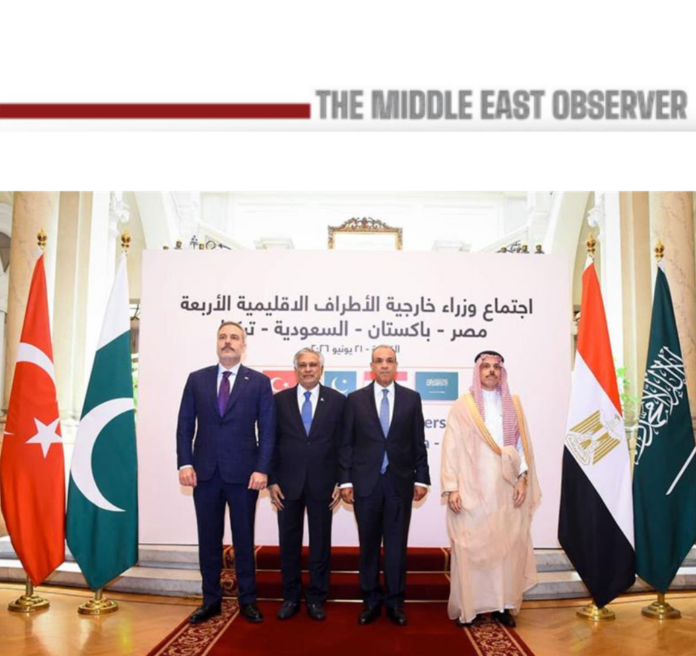
Egypt, Saudi Arabia, Turkey and Pakistan moved to strengthen regional diplomatic coordination on Monday as President Abdel Fattah El-Sisi hosted the foreign ministers of the four countries in Cairo, amid growing efforts to shape a more stable Middle East following recent geopolitical shifts and the emerging diplomatic track between the United States and Iran.
Meeting Saudi Foreign Minister Prince Faisal bin Farhan, Turkish Foreign Minister Hakan Fidan, Pakistani Deputy Prime Minister and Foreign Minister Mohammad Ishaq Dar, and Egyptian Foreign Minister Badr Abdelatty, El-Sisi welcomed the fourth ministerial meeting of the Quadrilateral Group and called for transforming the consultative mechanism into a more structured institutional framework capable of addressing the region’s increasingly complex political and security challenges.
From Consultation to Regional Coordination
Established as a platform for dialogue among four influential regional powers spanning the Arab world, South Asia and the broader Islamic sphere, the Quadrilateral Group has gained prominence amid a period of heightened geopolitical uncertainty. The mechanism reflects a growing recognition among regional states that many of the Middle East’s security challenges require coordinated diplomatic responses rather than unilateral action.
Collectively, Egypt, Saudi Arabia, Turkey and Pakistan represent a combined population of more than 500 million people and encompass some of the Middle East and South Asia’s most influential political, economic and military powers. Their geographic reach spans critical trade routes linking the Mediterranean, Red Sea, Gulf and Indian Ocean, giving the group significant strategic relevance amid evolving regional and global power dynamics.
Beyond security coordination, the four countries are also increasingly exploring opportunities for trade, investment, energy cooperation and connectivity initiatives linking the Middle East, North Africa and South Asia, further strengthening the strategic rationale behind the grouping.
El-Sisi said recent developments had reinforced the strategic importance of Egypt, Saudi Arabia, Turkey and Pakistan as pillars of regional stability, stressing the need to build a more effective framework capable of generating sustainable solutions to regional crises.
Supporting the US-Iran Diplomatic Track
A central focus of the Cairo discussions was the evolving diplomatic process between Washington and Tehran following the recently announced US-Iran memorandum of understanding.
The Egyptian president reaffirmed Cairo’s support for the agreement and urged continued regional efforts to ensure the successful implementation of its provisions and the completion of negotiations towards a comprehensive and lasting settlement. He also praised Pakistan’s role in facilitating dialogue and helping narrow differences between the two sides.
Turkey’s participation carries particular significance given its unique position as a NATO member, a major regional power and an increasingly active diplomatic mediator in conflicts stretching from the Black Sea to the Middle East. Ankara’s growing engagement reflects a broader effort by regional actors to shape outcomes through diplomacy rather than confrontation.
The discussions reflected a broader regional consensus that diplomatic engagement offers the most effective path to reducing tensions that have weighed heavily on regional security, energy markets and investor confidence.
Gulf Security and Freedom of Navigation
El-Sisi stressed that any final agreement between Washington and Tehran must take into account the security concerns of Gulf Cooperation Council states and the wider Arab region. He emphasized respect for state sovereignty and territorial integrity, adherence to the principles of good neighbourliness, and the peaceful resolution of disputes.
The President also highlighted the importance of safeguarding freedom of navigation, a priority carrying significant implications for global trade and energy markets. The Gulf region remains home to some of the world’s most critical maritime corridors, including routes through which a substantial share of global oil and liquefied natural gas exports passes.
Any sustainable reduction in tensions between the United States and Iran would therefore extend beyond regional politics, potentially enhancing maritime security, reducing geopolitical risk premiums and supporting greater stability in global energy markets. The stakes are considerable: roughly one-fifth of global oil consumption and approximately one-quarter of global seaborne oil trade pass through the Strait of Hormuz, making stability in the Gulf a matter of global economic importance.
Palestinian Statehood Remains Central
Despite the focus on Iran and regional security, El-Sisi reiterated that a just and comprehensive solution to the Palestinian issue remains the cornerstone of lasting peace in the Middle East.
Egypt has consistently argued that sustainable regional stability cannot be achieved without addressing the Palestinian question through a negotiated settlement that guarantees legitimate Palestinian rights and supports long-term regional coexistence. The issue continues to shape Arab diplomatic priorities even as regional governments seek to address a rapidly evolving security landscape.
The participating ministers welcomed the constructive discussions held in Cairo and expressed support for further institutionalising coordination among the four countries.
Regional Powers Shape a New Diplomatic Architecture
The Cairo meeting highlights a broader shift in regional diplomacy as influential middle powers increasingly seek to shape security outcomes through consultation, mediation and coordinated political engagement. At a time when global power dynamics are evolving and regional crises are becoming more interconnected, Egypt, Saudi Arabia, Turkey and Pakistan appear intent on establishing a more active role in managing regional challenges and reducing the risk of future instability.
As negotiations between Washington and Tehran progress, the Quadrilateral Group’s growing coordination could emerge as an important diplomatic channel supporting de-escalation, strengthening regional security and contributing to a more stable political and economic environment across the Middle East. More broadly, the initiative reflects an emerging trend in which regional powers are assuming greater ownership of Middle Eastern diplomacy, seeking to craft indigenous solutions to regional challenges rather than relying exclusively on external actors to shape the region’s future. In an increasingly multipolar world, the ability of regional actors to coordinate policies, mediate disputes and build consensus may become one of the defining factors shaping the next phase of Middle Eastern stability and development.
Related news:
Gulf Defence Groups Deepen European Ties at Eurosatory 2026
Egypt’s Quiet Power: How Cairo Became the Middle East’s Most Trusted Mediator
Read also:
Taiwan Opens $405m Danjiang Bridge to Boost Connectivity and Regional Growth
Afghanistan’s Untapped $1-3 Trillion Mineral Wealth Could Reshape Global Supply Chains