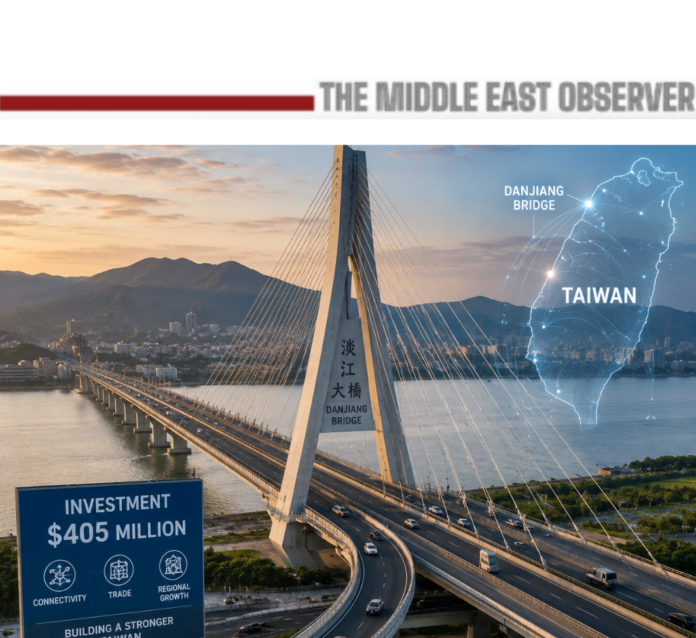
Taiwan has completed a US$405 million bridge project designed to ease congestion, improve access across one of the island’s most important economic corridors and strengthen transport links in northern New Taipei City. The opening of the Danjiang Bridge marks the culmination of nearly three decades of planning and represents one of Taiwan’s most significant recent infrastructure investments.
Spanning the mouth of the Tamsui River, the bridge connects the Tamsui and Bali districts through a 920-metre crossing. The project is expected to shorten journeys by around 15 kilometres and cut commuting times by approximately 25 minutes. Authorities also expect traffic on the heavily congested Guandu Bridge to fall by nearly 30 per cent. Improved links to central Taipei, Taoyuan International Airport and the Port of Taipei are expected to further strengthen a transport corridor that plays a vital role in the island’s economy.
The Danjiang Bridge forms part of Taiwan’s broader efforts to modernise infrastructure in northern regions that host a significant share of the country’s technology, services and logistics activity. As Asian economies compete to improve urban mobility, logistics efficiency and economic productivity, governments across the region are increasing investment in transport networks that support long-term growth and regional competitiveness.
While the bridge’s economic role is central, its engineering achievements have also attracted international attention. Designed by Zaha Hadid Architects, the structure is the world’s longest single-mast asymmetric cable-stayed bridge. A single 200-metre-high concrete tower supports the crossing’s 450-metre main span, creating a distinctive silhouette while minimising disruption to the estuary below.
The design balances infrastructure needs with environmental considerations. By relying on a single mast and a fan of supporting cables rather than multiple river supports, the bridge reduces its footprint on the estuary while preserving views across the Tamsui waterfront, one of the area’s most recognised natural attractions.
Beneath its elegant appearance lies a highly sophisticated engineering system. Taiwan’s location along the Pacific Ring of Fire required the structure to be designed to withstand earthquakes of magnitude 7 and above. Hydraulic dampers, friction pendulum bearings, cable-stay systems and specialised support mechanisms work together to absorb seismic forces while maintaining structural stability.
The bridge’s development was far from straightforward. First proposed in 1998, the project encountered years of environmental reviews, budget revisions, engineering challenges and procurement delays before construction finally began in 2019. The final steel deck connection was completed in 2025, allowing the bridge to open to traffic in May 2026.
The crossing accommodates vehicles, buses, cyclists and pedestrians, while also reserving space for a future extension of the Danhai Light Rail network. The multi-modal design reflects a broader shift in infrastructure planning, where projects are increasingly expected to support a range of transport options rather than simply expand road capacity.
For Taiwan, the Danjiang Bridge is more than a record-breaking structure. It represents a strategic investment in mobility, regional integration and economic competitiveness. Its architectural distinction may attract global attention, but its lasting significance will be measured by its ability to improve the movement of people, goods and investment across one of Taiwan’s fastest-growing urban regions.