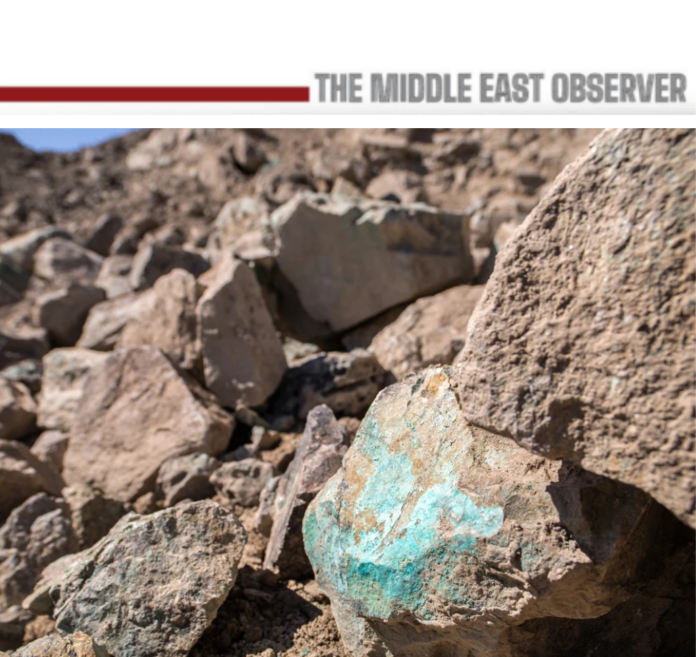
Afghanistan’s estimated $1-3 trillion mineral endowment is increasingly attracting attention from governments, mining companies and industrial strategists seeking access to the raw materials needed for the global energy transition. Yet the country’s vast deposits of lithium, copper, iron ore, cobalt and rare earth elements remain among the least developed major resource assets in the world.
The growing importance of resource security has transformed critical minerals from a mining issue into a strategic economic priority. As demand accelerates for electric vehicles, renewable energy infrastructure, semiconductors, artificial intelligence hardware and advanced manufacturing technologies, access to reliable supplies of strategic metals is becoming a key determinant of industrial competitiveness.
For now, however, Afghanistan’s mineral wealth remains largely a story of unrealised potential. While geological surveys point to some of the world’s most promising undeveloped deposits, the greatest beneficiaries today are not manufacturers or consumers, but those securing early access to future production.
Current Beneficiaries Hold the Strongest Position
Despite limited large-scale development, several groups are already benefiting from Afghanistan’s mineral sector.
Chinese companies hold some of the most strategically important positions through projects such as the Mes Aynak copper deposit, one of the world’s largest undeveloped copper resources. China Metallurgical Group Corporation and other Chinese investors secured access to key assets years before critical minerals became a central feature of global industrial policy.
The Taliban administration has also increasingly relied on mining revenues, concession fees and export permits as an important source of income following the collapse of much international aid. Meanwhile, commodity traders, transport operators and foreign processors capture a significant share of the value generated by existing mineral exports, many of which leave Afghanistan in raw or semi-processed form.
The result is a familiar pattern seen across many resource-rich developing economies: much of the highest-value activity occurs outside the country where extraction takes place.
China Sees More Than a Mining Opportunity
Afghanistan’s mineral potential fits neatly into China’s broader strategy of strengthening control over critical-mineral supply chains.
China already dominates large segments of global refining and processing capacity for lithium, rare earth elements, graphite and other strategic materials. Securing future sources of raw minerals helps reinforce that position while supporting industries ranging from electric vehicles and batteries to renewable energy technologies.
For Beijing, Afghanistan represents more than an extraction opportunity. Its location between Central Asia, South Asia and western China offers potential long-term integration into regional trade and logistics networks connected to broader Eurasian supply chains.
This strategic dimension helps explain why Chinese interest in Afghan resources has persisted despite years of political uncertainty and difficult operating conditions.
The Real Opportunity Lies Beyond Extraction
The most overlooked aspect of Afghanistan’s mineral wealth is that the largest economic gains may ultimately come not from mining itself, but from downstream industries.
A tonne of lithium ore exported in raw form generates only a fraction of the value created when processed into battery-grade chemicals, cathode materials or finished battery components. Similarly, copper refining, metal fabrication and component manufacturing often create several times more economic value than the extraction stage alone.
If infrastructure, investment and stability improve, Afghanistan could theoretically develop processing facilities linked to copper, lithium and rare earth supply chains. Such industries would generate greater employment, higher export revenues and deeper industrial capabilities than raw-material exports.
Achieving that transition, however, would require substantial investment in power generation, water infrastructure, transport corridors and industrial zones—areas where significant gaps remain.
A Regional Opportunity for the Middle East
The implications extend well beyond Afghanistan.
As Gulf countries seek to diversify their economies, critical minerals are becoming an increasingly important component of industrial strategy. Saudi Arabia has expanded international mining investments through its Vision 2030 programme, while the UAE continues to strengthen its role as a logistics and commodities hub linking Africa, Asia and the Middle East.
For Egypt, Afghanistan’s resources could eventually support regional manufacturing ambitions in sectors ranging from electrical equipment and automotive components to battery-related industries. Morocco, meanwhile, is rapidly positioning itself as a battery and electric-vehicle production centre serving European markets.
In this context, Afghanistan’s mineral wealth represents more than a national resource. It could become part of a broader supply-chain ecosystem stretching from Central Asian mines and Gulf logistics hubs to North African manufacturing platforms and European industrial markets.
The challenge remains transforming geological potential into economic reality. Yet as governments compete to secure future supplies of strategic metals, Afghanistan’s untapped resources are increasingly being viewed not merely as a mining opportunity, but as a potential building block in the next generation of global industrial and energy supply chains.
Related news:
Russia’s War Economy Threatens Its 2030 Critical Minerals Ambitions
China’s 15th Five-Year Plan Signals Strategic Shift in Energy, Metals and Critical Minerals
Read also:
Economic Growth in Asia: A Bright Future Ahead
New Administrative Capital to Host Egypt Mining Forum in September