
Egypt’s Suez Canal, energy hub ambitions and industrial strategy sit at the centre of a rapidly evolving Asia–Middle East economic landscape
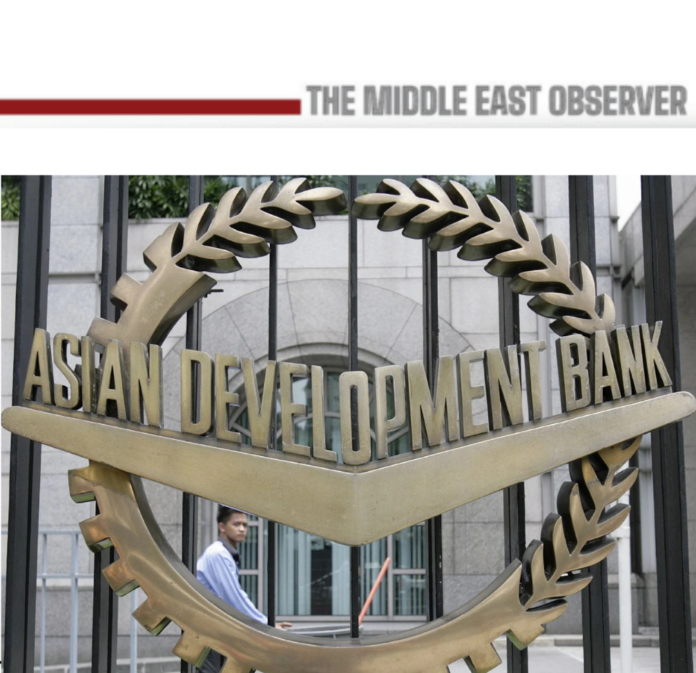
The Asian Development Bank’s (ADB) latest Asian Development Outlook (ADO), published in July 2026, delivers a message that extends well beyond Asia’s economic prospects. While the report updates growth and inflation forecasts for the world’s fastest-growing region, it also highlights a broader structural shift in the global economy: geopolitical stability in the Middle East has become an increasingly important determinant of economic performance across Asia.
Unlike previous editions, which concentrated primarily on domestic demand, monetary policy and structural reforms, the latest outlook places geopolitical developments alongside traditional macroeconomic variables. In the ADB’s assessment, disruptions affecting energy markets, maritime trade routes and global supply chains are no longer peripheral risks but central drivers of inflation, investment confidence and industrial activity across developing Asia.
The report therefore reflects a wider change in economic thinking. The interaction between geopolitics and economics has become increasingly inseparable, with conflicts affecting strategic shipping corridors now capable of influencing growth prospects thousands of kilometres away.
ADB Revises Regional Outlook as External Risks Intensify
The ADB has lowered its growth forecast for developing Asia and the Pacific (DAP) to 4.9% in 2026, down from the 5.1% projected in April and below the 5.5% expansion recorded in 2025. Growth is expected to recover modestly to 5.1% in 2027, assuming that energy markets stabilise, shipping conditions improve and external pressures gradually ease.
Inflation, meanwhile, is projected to rise to 4.3% in 2026, compared with 3.0% last year, before easing to 3.4% in 2027. According to the ADB, higher energy prices, increased freight costs and persistent supply-chain disruptions are transmitting inflationary pressures across manufacturing, transport and food markets throughout the region.
Unlike earlier economic slowdowns driven primarily by domestic financial conditions, the current deceleration reflects a combination of external geopolitical shocks and heightened uncertainty surrounding global trade. The report therefore suggests that economic resilience increasingly depends not only on sound macroeconomic management but also on the stability of critical international transport and energy corridors.
The findings broadly reinforce a growing consensus among international economic institutions that geopolitical fragmentation is emerging as one of the principal long-term risks facing global growth, investment and productivity.
Uneven Regional Performance Reflects Different Degrees of Exposure
Although the overall regional outlook has weakened, the ADB notes significant divergence among Asian economies, reflecting differing exposure to external shocks and varying levels of domestic resilience.
Developing East Asia is projected to expand by 4.6% in 2026 and 4.5% in 2027, supported by relatively resilient exports, continued infrastructure investment and industrial policy initiatives despite subdued private consumption in China.
South Asia is forecast to grow 6.0% in 2026 before accelerating to 6.7% in 2027, although higher energy import costs, rising freight charges and uncertainty surrounding remittance flows have moderated earlier expectations.
Across Southeast Asia, growth is expected to slow to 4.6% in 2026, reflecting weaker external demand, elevated commodity prices and softer manufacturing activity before recovering modestly to 4.8% in 2027.
Meanwhile, growth across the Caucasus and Central and West Asia has been revised down to 3.8% in 2026 and 4.2% in 2027, largely because of disrupted trade flows, higher logistics costs and continuing geopolitical uncertainty.
The Pacific is expected to expand by 3.3%, with higher imported fuel and food costs offsetting government support measures.
Taken together, these projections illustrate how a single geopolitical shock can produce markedly different economic outcomes across regions depending on their energy dependence, export structure and integration into global supply chains.
Middle East Stability Has Become a Core Macroeconomic Variable
Perhaps the report’s most significant implication is that developments in the Middle East can no longer be viewed solely through a geopolitical or security lens.
Although the ADB stops short of assigning exclusive responsibility to any single event, its analysis demonstrates how prolonged instability across key energy-producing and maritime regions has become a major transmission channel for inflation and slower economic growth throughout Asia.
The region remains heavily dependent on imported crude oil and liquefied natural gas supplied by Gulf producers. Consequently, disruptions affecting energy production, shipping routes or maritime security rapidly feed through into industrial production costs, electricity prices, consumer inflation and business investment decisions across many Asian economies.
Additional costs arising from longer shipping routes, higher insurance premiums and increased freight charges have further reduced competitiveness among export-oriented manufacturers while complicating efforts by central banks to return inflation to target levels.
Unlike the pandemic, which primarily disrupted production capacity, or the Russia–Ukraine conflict, which initially concentrated its effects on energy and agricultural markets, the current environment combines energy insecurity with heightened risks to one of the world’s most important maritime trade networks. This simultaneous disruption of commodity flows and logistics infrastructure represents a more complex challenge for policymakers and businesses alike.
In effect, the report elevates the security of the Gulf, the Strait of Hormuz, Bab el-Mandeb, the Red Sea and other critical maritime corridors from regional concerns to fundamental components of global macroeconomic stability.
Supply Chains Continue Their Strategic Transformation
Despite near-term headwinds, the ADB also identifies several structural strengths that continue to support Asia’s medium-term growth prospects.
Domestic consumption remains a key driver across many economies, supported by resilient labour markets, expanding services sectors and sustained public investment. Technology exports—including semiconductors, artificial intelligence infrastructure and digital services—continue to demonstrate relative resilience despite a weaker external environment.
At the same time, multinational corporations are accelerating efforts to diversify manufacturing networks beyond traditional production centres. Rather than pursuing cost efficiency alone, companies are increasingly balancing efficiency with resilience by expanding production across multiple jurisdictions and reducing dependence on individual transport corridors.
This broader shift towards friend-shoring, regionalisation and supply-chain diversification has continued to benefit economies including Vietnam, India, Indonesia and Malaysia, which have attracted growing investment as businesses seek greater operational flexibility in an increasingly uncertain geopolitical environment.
For international manufacturers, resilience is becoming as important as productivity. Access to reliable logistics, political stability, predictable regulation and secure energy supplies is increasingly influencing long-term investment decisions alongside labour costs and taxation.
Downside Risks Remain Elevated
While the ADB’s baseline outlook anticipates gradual improvement over the coming two years, it cautions that downside risks remain significant.
Among the principal threats identified are renewed escalation of tensions in the Middle East, prolonged volatility in global energy markets, tighter international financial conditions, renewed food-price inflation, heightened trade policy uncertainty and a deeper-than-expected correction in China’s property sector.
The report also highlights the possibility that further volatility in global financial markets—including technology equities linked to artificial intelligence investment—could weaken business confidence and delay corporate capital expenditure.
Higher inflation resulting from sustained energy price pressures could also postpone monetary easing across several Asian economies, maintaining elevated borrowing costs for governments and businesses alike. Such an environment would weigh on infrastructure investment, private-sector expansion and consumer spending, potentially extending the current period of slower growth.
Taken together, these risks underline a broader conclusion emerging from the ADB’s latest assessment: governments are no longer managing macroeconomic performance in isolation from geopolitics. Energy security, resilient supply chains and secure maritime trade routes have become integral components of sustainable economic growth, placing geopolitical stability alongside fiscal and monetary policy as one of the defining variables shaping the global economy.
Why Global Investors Should Pay Attention
Beyond governments and central banks, the ADB’s latest assessment carries important implications for institutional investors, multinational corporations and global supply-chain planners. The report suggests that geopolitical resilience has become an increasingly important determinant of investment decisions alongside traditional macroeconomic indicators such as growth, inflation and fiscal stability.
Persistent volatility in energy markets, longer shipping routes and higher insurance premiums are prompting companies to reassess global manufacturing strategies. Rather than pursuing the lowest-cost production model, businesses are increasingly prioritising operational resilience by diversifying manufacturing locations, strengthening inventories and reducing dependence on individual transport corridors.
As a result, countries offering political stability, efficient logistics infrastructure, competitive industrial zones, reliable energy supplies and preferential access to major export markets are expected to attract a growing share of manufacturing, infrastructure and export-oriented investment. For international capital, geopolitical resilience is rapidly becoming an investment criterion comparable in importance to labour costs, taxation and regulatory quality.
Why the Report Matters for the Middle East
Although the ADB’s mandate focuses on Asia and the Pacific, its analysis implicitly elevates the strategic significance of the Middle East within the global economic system.
The region is increasingly viewed not simply as a supplier of hydrocarbons but as a critical pillar of international trade, energy security and supply-chain continuity. The uninterrupted operation of the Strait of Hormuz, Bab el-Mandeb, the Red Sea and the Suez Canal now carries implications extending far beyond regional commerce, influencing inflation, industrial production and business confidence across much of Asia.
Conversely, sustained de-escalation across these strategic waterways would help reduce freight costs, lower marine insurance premiums, shorten delivery times and ease inflationary pressures throughout global manufacturing networks. The economic dividends of regional stability therefore extend well beyond the Middle East, reinforcing its importance to global growth and financial stability.
Egypt: Positioned at the Centre of Asia’s New Trade Geography
While the ADB does not examine Egypt directly, its conclusions have significant implications for economies occupying critical trade corridors.
The report reinforces Egypt’s strategic position at the intersection of three long-term structural trends reshaping international commerce: the search for secure maritime routes, the diversification of global supply chains and the transition towards more resilient energy systems.
Few countries combine geographical location, maritime infrastructure, industrial capacity and regional market access as comprehensively as Egypt. Situated at the crossroads of Europe, Asia and Africa, the country is increasingly positioned to benefit from the reconfiguration of global production and logistics networks as multinational companies seek to reduce geopolitical risk while maintaining efficient access to major consumer markets.
The Suez Canal: Opportunity Through Stability
The ADB’s analysis reinforces the strategic importance of restoring confidence in navigation through the Red Sea and the Suez Canal.
The disruption of commercial shipping over recent years has highlighted the vulnerability of one of the world’s most important maritime trade corridors. The diversion of vessels around the Cape of Good Hope has increased transit times, freight rates, insurance costs and inventory requirements for manufacturers and retailers worldwide.
For Egypt, the restoration of secure navigation would support a recovery in Suez Canal revenues, strengthen foreign-exchange inflows, improve logistics activity and reinforce investor confidence in the country’s transport infrastructure.
Beyond direct transit revenues, greater maritime security would enhance the competitiveness of Egyptian ports, logistics parks and industrial zones integrated with global value chains. As supply chains increasingly depend upon reliability rather than speed alone, secure maritime connectivity is becoming an economic asset comparable in importance to physical infrastructure.
Industrial Strategy Receives Fresh Momentum
The report also strengthens the economic rationale underpinning Egypt’s industrial development strategy.
As multinational manufacturers continue diversifying production beyond traditional Asian hubs, Egypt is becoming an increasingly attractive export platform serving European, African and Middle Eastern markets simultaneously.
Recent investment commitments across the Suez Canal Economic Zone—including renewable energy projects, automotive manufacturing, tyre production, petrochemicals, industrial components and green fuels—illustrate how international investors are already responding to these structural shifts.
Supported by extensive free trade agreements, expanding transport infrastructure, competitive labour costs and continued industrial reforms, Egypt is well positioned to integrate more deeply into evolving global value chains.
Sectors expected to benefit include automotive components, electrical equipment, petrochemicals, fertilisers, pharmaceuticals, food processing, textiles, engineering industries and renewable-energy technologies.
Energy Hub Ambitions Gain Greater Strategic Relevance
The ADB’s assessment also reinforces Egypt’s ambition to establish itself as a regional energy hub.
As Asian economies seek greater diversification of energy supplies, Egypt’s liquefied natural gas infrastructure, natural gas transmission network and strategic location assume greater regional importance. At the same time, expanding electricity interconnections with neighbouring markets and major investments in renewable energy and green hydrogen position the country to play an increasingly important role in the evolving regional energy landscape.
Beyond hydrocarbons, opportunities continue to expand in electricity trading, battery supply chains, sustainable fuels and hydrogen exports as governments pursue cleaner and more secure sources of energy. These developments support Egypt’s objective of becoming not only an energy producer but also a regional platform for energy distribution, industrial processing and cross-border infrastructure.
Trade and Investment Opportunities Continue to Expand
Asia’s growing middle class, continuing urbanisation and sustained infrastructure investment are expected to underpin long-term demand for imported food products, fertilisers, petrochemicals, construction materials and manufactured goods.
For Egyptian exporters, these trends create opportunities to expand market access while diversifying export destinations. They also strengthen the prospects for increased Asian foreign direct investment across manufacturing, logistics, renewable energy, infrastructure and industrial development.
Chinese, Japanese, South Korean, Indian and Southeast Asian companies are increasingly seeking production locations capable of providing efficient access to multiple regional markets. Egypt’s strategic location, expanding industrial base and extensive trade agreements position it favourably within this evolving investment landscape.
A Strategic Message Beyond Asia
The July 2026 Asian Development Outlook ultimately conveys a message that extends well beyond regional economic forecasts. It illustrates how geopolitical stability, energy security and resilient supply chains have become fundamental determinants of sustainable economic growth in an increasingly interconnected world.
The report marks an important evolution in international economic analysis. Geopolitical developments are no longer treated as temporary external shocks but as structural variables shaping inflation, investment decisions, industrial competitiveness and global trade. Economic resilience now depends as much upon secure trade routes and reliable energy supplies as it does upon prudent fiscal management and effective monetary policy.
For Asia, the challenge will be to sustain growth while reducing vulnerability through diversified energy sources, stronger regional integration and more resilient production networks. For the Middle East, the report reinforces the region’s evolving role not only as a supplier of energy but also as an indispensable contributor to global economic stability and commercial connectivity.
For Egypt, the implications are particularly significant. As international manufacturers diversify supply chains and Asian economies seek secure trade corridors and reliable industrial partners, the country is uniquely positioned to strengthen its role as a logistics gateway, regional manufacturing platform and integrated energy hub connecting Asia, Europe and Africa.
The ADB’s latest outlook therefore offers a broader lesson than its regional focus might initially suggest. The geography of economic growth is increasingly being shaped by the geography of geopolitical stability. Countries that combine strategic location, resilient infrastructure, diversified industrial capacity and dependable commercial institutions will be best placed to capture the next wave of global investment.
In this emerging economic landscape, the Middle East is no longer viewed solely as a source of energy, while Egypt is increasingly recognised as more than a transit corridor. Together, they are becoming integral components of a more resilient global trading system—one in which secure connectivity, diversified supply chains and economic stability will define international competitiveness in the years ahead.
Related news:
China Exploits Global Oil Glut as Exporters Battle for Asian Market Share
UAE, Qatar Deepen Asia Trade Ties with South Korea in Strategic Shift
Read also:
Egypt Expands Capital Market Reform with 10 New Non-Banking Financial Licences
Egypt Draft Law Transforms Future of Egypt Authority Into Strategic Investment Institution
