UAE’s EDGE leads wave of industrial partnerships as Saudi Arabia and Qatar accelerate defence localisation strategies
The 2026 edition of Eurosatory in Paris marked a significant shift in relations between Gulf states and Europe’s defence industry, with the UAE, Saudi Arabia and Qatar increasingly positioning themselves as industrial partners, technology developers and investors rather than traditional buyers of military equipment.
Leading the transformation was Abu Dhabi-based EDGE Group, which dominated headlines throughout the exhibition with a series of strategic announcements that underscored the Gulf’s growing ambition to secure a permanent place within the global defence-industrial ecosystem.
EDGE Establishes Permanent European Presence
The most consequential announcement came with the launch of EDGE Europe, a new European commercial enterprise headquartered in Paris with an engineering and manufacturing hub in Bordeaux. The move gives the Emirati defence group its first permanent industrial foothold in Europe and signals a long-term commitment to investing in European defence capabilities.
EDGE said the new operation would focus on government engagement, industrial partnerships, technology development and manufacturing, while leveraging France’s aerospace and defence supply chain.
The expansion reflects the growing scale of EDGE itself. Since its establishment in 2019, the group has evolved into one of the world’s largest defence and advanced technology conglomerates, comprising more than 35 entities operating across missiles, precision-guided munitions, autonomous systems, electronic warfare, cyber technologies, naval platforms and advanced manufacturing. The company has become a central pillar of the UAE’s strategy to develop indigenous defence capabilities and expand the contribution of advanced industries to the national economy.
Strategic Partnerships Expand Across Europe
Alongside the launch of EDGE Europe, the UAE group unveiled a series of partnerships with leading European defence companies.
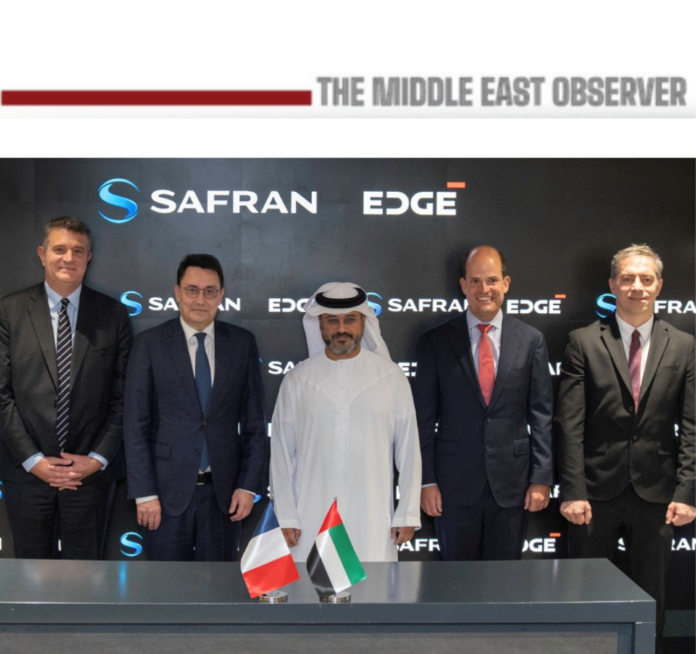
A strategic cooperation agreement with French aerospace and defence group Safran expanded collaboration across defence electronics, smart weapons, aerospace technologies and next-generation defence systems. The agreement builds on decades of cooperation between the two sides and reflects growing collaboration in unmanned systems, electronic warfare and precision-guided weapons.
The companies subsequently signed a framework agreement to establish joint ventures in France and the UAE focused on developing next-generation missile systems, including an extended-range precision-guided weapon derived from Safran’s HAMMER family, as well as future air-launched weapons and unmanned-platform capabilities.
Perhaps the most commercially significant development involved Italy’s Leonardo. EDGE and Leonardo detailed plans for a joint venture targeting more than €4bn in orders over the next five years, focusing on advanced sensors, radars, combat-management systems, airborne electronics and defence technologies for international markets. The venture, owned 51% by EDGE and 49% by Leonardo, is expected to launch with contracts already worth several hundred million euros.
These agreements illustrate a broader shift from procurement-based relationships towards co-development, intellectual-property sharing and industrial integration.
A Wider Gulf Industrial Strategy
While the UAE generated the largest announcements, Eurosatory also highlighted the broader transformation underway across the Gulf defence sector.
Saudi Arabia’s participation was led by the General Authority for Military Industries (GAMI), which organised a national pavilion featuring Saudi Arabian Military Industries (SAMI) and several defence companies. Riyadh used the exhibition to showcase progress toward its Vision 2030 objective of localising 50% of military spending by the end of the decade, compared with less than 5% when the programme was launched.
SAMI and GAMI continue to pursue partnerships with major international defence companies across aerospace, naval systems, advanced electronics and land platforms, seeking to build a sustainable domestic industrial base capable of serving both national requirements and export markets.
Qatar’s Barzan Holdings was likewise active in pursuing partnerships and technology collaborations designed to strengthen domestic defence capabilities, support research and development and enhance sovereign technological capacity.
The common theme across Gulf participants was a determination to move beyond procurement and toward industrial integration, local production and advanced technological capability.
Europe’s Defence Expansion Creates New Opportunities
The timing is significant. Europe is undertaking its largest defence-industrial expansion since the Cold War as governments increase military spending, replenish depleted inventories and seek greater strategic autonomy amid rising geopolitical tensions.
Military expenditure across Europe has risen sharply since Russia’s invasion of Ukraine, while NATO members continue moving toward higher defence-investment targets. Governments across the continent are collectively committing hundreds of billions of euros to rearmament programmes, ammunition production, missile systems, air-defence networks and defence-industrial capacity expansion.
For Gulf defence groups, this environment presents a rare opportunity to access advanced technologies, integrate into European supply chains and participate directly in the development of future military systems.
For European companies, Gulf partners offer capital, rapidly expanding industrial capacity, export-market access and long-term procurement programmes. The result is a growing model of co-development and co-production that differs markedly from the traditional buyer-seller relationship that historically characterised Europe-Gulf defence ties.
Export Markets Become the Next Battleground
Beyond localisation and technology transfer, Gulf defence groups are increasingly targeting export markets. The objective is not merely to manufacture domestically but to develop globally competitive products capable of securing contracts across Africa, Asia and the Middle East.
Joint ventures with European companies provide access to advanced technologies, international certification standards and established distribution networks, enabling Gulf firms to move from licensed production toward the co-development and export of sophisticated defence systems.
As regional defence industries mature, export growth is becoming an increasingly important measure of success, particularly as Gulf governments seek to diversify economies and build high-value manufacturing sectors.
From Arms Buyers to Defence Investors
The developments at Eurosatory 2026 highlight a profound shift in the global defence industry. For decades, the Gulf’s role was largely defined by procurement, with European and American companies supplying equipment to regional customers. Today, that relationship is evolving into one based on investment, co-development, manufacturing and technology sharing.
The launch of EDGE Europe, Saudi Arabia’s localisation drive and Qatar’s continued investment in defence innovation all point to the emergence of a new Gulf defence-industrial model. As Europe expands military production and Gulf states pursue technological sovereignty, industrial diversification and export growth, the two regions are becoming increasingly integrated within the same defence supply chains.
Eurosatory 2026 may therefore be remembered not simply as a defence exhibition, but as a milestone in the evolution of Gulf defence companies from major buyers of military technology into influential participants in the global defence-industrial ecosystem.
Related news:
El-Sisi, Bin Zayed Endorse US-Iran Deal as Region Seeks Post-Conflict Reset
Europe Tests AI Alternative to Palantir’s Battlefield System
Read also:
Spain’s Renewable Surge Turns Energy Transition into Economic Advantage
Egyptian Pound Leads Emerging-Market Gains as Oil Prices Ease