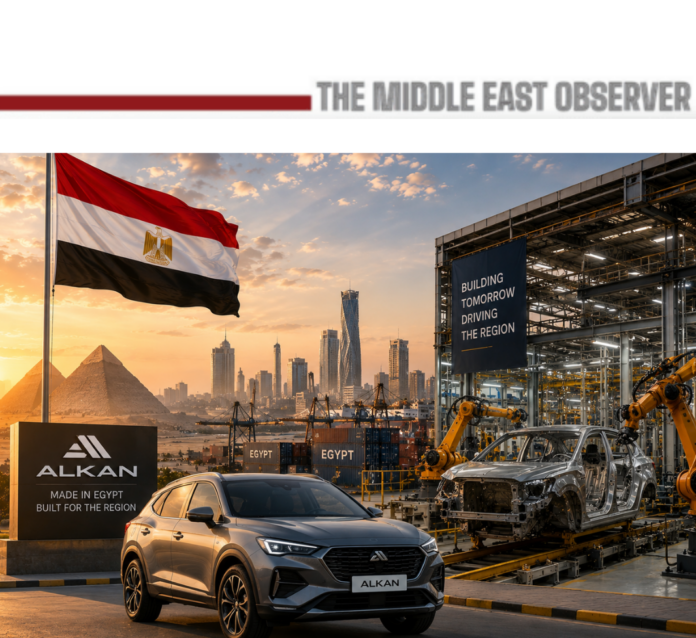
Egypt’s automotive manufacturing ambitions received a fresh boost after Alkan Holding announced plans to invest $120 million in a new vehicle assembly facility, positioning local manufacturing at the centre of its next growth phase while supporting Cairo’s wider effort to turn the country from a vehicle importer into a regional production and export platform.
Khaled Nosseir, Chairman of Alkan Holding, said the project is currently in the design phase, with first production expected during 2027. The facility will initially assemble vehicles for South Korea’s Kia and China’s BAIC, with local content levels expected to begin at between 46% and 48% before increasing as domestic supply chains deepen.
The project comes as Egypt’s automotive sector enters a new expansion phase, supported by government incentives for local-content production, renewed interest in component manufacturing and a broader industrial policy aimed at reducing import dependence. It follows recent momentum in automotive-related industries, including tyre production, wiring harnesses, vehicle assembly and supplier localisation.
Egypt’s Automotive Strategy Gains Momentum
The planned factory will have an annual production capacity of 75,000 vehicles, although output is expected to start at around 10,000 units during its first year. Part of production will be directed toward export markets across Africa and the Arab world.
Local Kia production carries particular economic significance. It could reduce exposure to currency volatility, import costs and supply-chain disruptions while allowing Egypt to capture more value domestically through assembly, components, labour and after-sales networks. For consumers, local manufacturing may also support more stable pricing over time if localisation deepens and import dependency declines.
BAIC’s inclusion adds another strategic layer. Chinese automakers are expanding rapidly across Africa and the Middle East, using competitive pricing, flexible model ranges and local assembly partnerships to build market share. For Egypt, hosting Chinese-brand production strengthens its position within this shifting automotive map and could help attract additional component suppliers.
Localisation Could Deliver Wider Economic Gains
Industry executives view localisation rates approaching 50% as an important threshold for creating supplier clusters. If scaled successfully, Alkan’s project could support direct and indirect job creation, reduce pressure on foreign currency by substituting some imported vehicles and components, and open export channels into Arab and African markets.
The economic upside will depend on how quickly the plant moves beyond assembly into deeper local content. Higher localisation would increase demand for Egyptian-made parts, logistics, engineering services and maintenance networks, while exports could help offset the foreign-currency cost of imported components.
Tourism Emerges as a Parallel Growth Engine
Alongside its industrial investments, Alkan is expanding in tourism and hospitality, sectors benefiting from Egypt’s record visitor growth and rising hotel occupancy rates.
Nosseir said the company is in the final stages of selecting an international operator for three hotels planned within the Citadel Plaza development overlooking the Citadel of Saladin. The project is expected to add 550 rooms through a mix of boutique, upscale and luxury five-star properties, with a final management agreement anticipated within three months.
The group is also studying two hotels near the Pyramids, including one five-star and one three-star property, while exploring a large industrial investment elsewhere in Africa.
Founded in 1974, Alkan operates across telecommunications, information technology, manufacturing, real estate, tourism, aviation, automotive and consumer finance in Egypt and more than 17 countries.
Taken together, the group’s latest plans highlight a broader transformation in Egypt’s private sector, where industrial production, tourism development and African expansion are increasingly seen as complementary growth pillars. Alkan’s investment is therefore more than a corporate expansion story: it is a test of whether Egypt can convert automotive assembly into a deeper manufacturing ecosystem capable of generating jobs, exports, supplier networks and foreign-currency savings.