
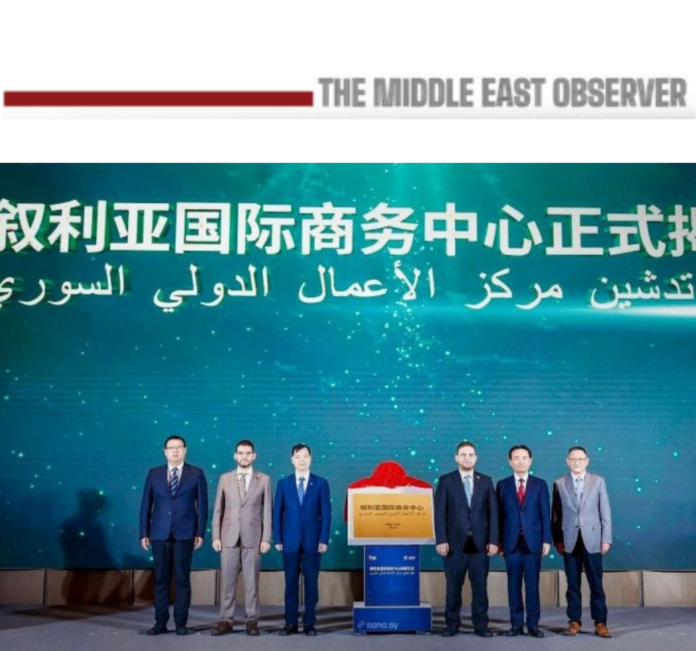
Syria and China have launched the “Syria International Smart Industrial Cities” platform, establishing a new framework for industrial cooperation aimed at supporting Syria’s reconstruction through Chinese investment, technology transfer and the planned development of smart industrial cities. The initiative was unveiled in Beijing by the Syrian-Chinese Business Council, in cooperation with Suzhou Land Group and the GrowFast investment and entrepreneurship platform, reflecting the two countries’ efforts to deepen long-term economic cooperation.
The initiative reflects Syria’s growing emphasis on rebuilding productive industrial capacity as a cornerstone of long-term economic recovery, with manufacturing expected to play a central role in generating exports, employment and private investment.
The platform is intended to facilitate the transfer of Chinese industrial expertise through partnerships between Syrian and Chinese industrial cities, workforce training, technology and knowledge transfer, investment promotion and the planned development of smart industrial zones. Organisers said the initiative is designed to create a practical framework for transforming reconstruction opportunities into long-term industrial development projects while strengthening cooperation between public institutions and the private sector.
Speaking at the launch ceremony, Syria’s Chargé d’Affaires in China, Zakaria Lababidi, said Damascus welcomed Chinese companies and institutions interested in participating in the country’s reconstruction, describing expanding bilateral relations as a strong foundation for broader industrial and investment cooperation. He also praised the Syrian-Chinese Business Council for helping convert investment opportunities into commercially viable projects.
The chairman of the Syrian-Chinese Business Council, described the platform as a transforming bilateral relations into a long-term partnership
Fadi Al-Ahmed Al-Muheimid, Chairman of the Syrian-Chinese Business Council, described the platform as a strategic step towards transforming bilateral relations from traditional trade into a long-term industrial partnership centred on manufacturing, innovation and technology transfer. Zhang Wei, Mayor of Changshu and Deputy Secretary of the city’s Communist Party Committee, reaffirmed China’s interest in expanding industrial and investment cooperation with Syria.
As an initial phase, organisers announced plans to develop “Smart Furniture” industrial clusters in Damascus and Aleppo. The projects are intended to introduce advanced manufacturing technologies and Industry 4.0 production methods into Syria’s furniture sector and serve as pilot models for broader industrial modernisation. No implementation timetable has yet been announced.
The initiative builds on a memorandum of understanding signed in Suzhou in January 2026 between the Syrian-Chinese Business Council and Suzhou Land Group, covering cooperation in industrial city management, artificial intelligence applications, smart manufacturing and city-twinning programmes. The newly launched platform represents the first institutional framework established to advance those objectives.
The project also reflects China’s steadily expanding economic engagement with Syria under the broader framework of the Belt and Road Initiative, which Syria joined in 2022. With Western sanctions continuing to constrain access to international finance and reconstruction funding, Damascus has increasingly looked to Chinese industrial expertise, technology and investment as alternative sources of support for rebuilding productive capacity. While Beijing has expressed support for Syria’s reconstruction, analysts note that future Chinese investment is likely to remain commercially driven and subject to political and financial risk assessments.
Rebuilding manufacturing has become a central pillar of Syria’s economic recovery strategy after more than a decade of conflict severely damaged industrial facilities, disrupted supply chains and reduced productive capacity across key sectors. Supporters of the new platform argue that strengthening industrial production, attracting private investment and developing a skilled workforce will be essential to restoring exports, creating employment and reducing reliance on imports. Although the initiative remains at an early stage, it signals both Syria’s determination to diversify its reconstruction partnerships and China’s continuing interest in expanding its industrial footprint across the Middle East through technology-led industrial cooperation.
Related news:
Syria Rejoins Global Payment Networks After 15 Years of Isolation
Syria Seeks $1bn in Grants from World Bank as Reconstruction Accelerates
Read also:
US Supreme Court Strikes Down Trump’s Birthright Citizenship Order
Egypt Secures $300m Chinese Investment to Deepen Automotive Supply Chain