
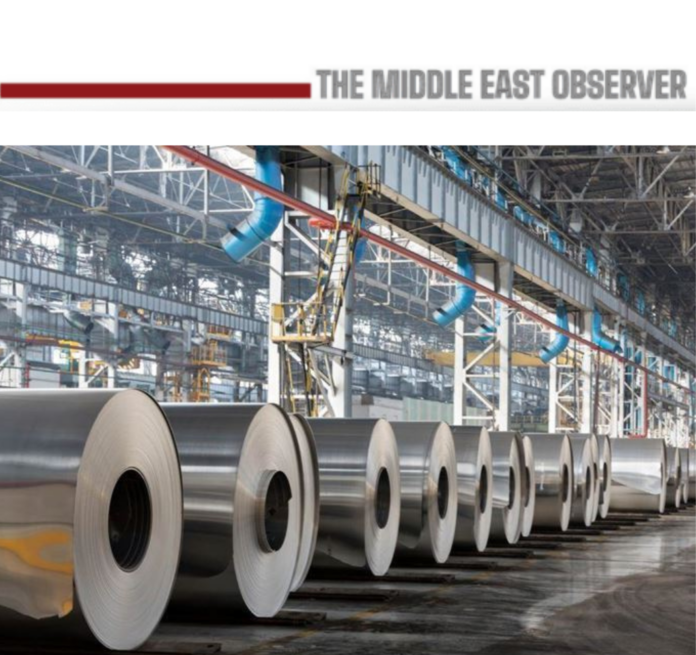
Morocco’s steel decision highlights a new era where trade compliance, market intelligence and competitiveness matter as much as production capacity
Morocco’s decision to impose anti-dumping duties of up to 84.39% on Egyptian cold-rolled steel may appear to concern one product and one export market. In reality, it points to a broader challenge facing Egypt’s export strategy as global trade becomes more defensive, more rules-based and more legally demanding.
The Moroccan case follows a wider pattern. The European Union has already imposed anti-dumping duties on Egyptian hot-rolled steel, while the United States continues to pursue trade-remedy investigations into Egyptian reinforcing steel, or rebar. Although each case differs in product scope, legal basis and duty rate, together they underline a clear warning: expanding production capacity is no longer sufficient to secure sustainable export growth.
The European Union’s investigation also demonstrated that trade-remedy cases are not predetermined. The case against India was ultimately terminated after investigators concluded that the legal conditions for imposing anti-dumping measures had not been established. The outcome illustrates that robust cost accounting, transparent pricing, complete documentation and effective legal engagement can materially influence the final decision.
Over the past decade, trade-defence instruments have become one of the fastest-growing features of global commerce. Major economies, including the United States, the European Union, India, China, Türkiye and Brazil, have increasingly relied on anti-dumping, countervailing and safeguard measures to protect strategic industries ranging from steel and chemicals to renewable-energy equipment and electric vehicles. Rather than signalling a retreat from globalisation, this trend reflects a shift towards more rules-based competition, in which countries continue to trade openly while making greater use of WTO-permitted legal mechanisms to defend domestic industries.
For Egypt, the issue is not whether countries are legally entitled to use trade-defence instruments. Under World Trade Organization rules, anti-dumping, countervailing and safeguard measures are legitimate when investigations establish dumping, material injury and a direct causal relationship. The real question is whether Egyptian exporters and institutions are sufficiently prepared to operate in a trading environment where such measures are becoming more frequent, more technical and increasingly commercially disruptive.
This is particularly important as Egypt seeks to expand industrial exports, generate higher foreign-currency earnings and strengthen its presence across regional and international markets. Steel is only the latest example. Similar risks could emerge in chemicals, fertilisers, engineering products, building materials, textiles and food processing if exporters continue to rely primarily on price competitiveness without giving equal attention to documentation, certification, market intelligence and legal preparedness.
Egypt therefore needs to evolve from an export-promotion strategy into a comprehensive export-competitiveness strategy. Trade compliance should become an integral pillar of industrial policy rather than a technical exercise undertaken only after disputes arise.
The first priority should be establishing a National Trade Intelligence and Defence System. The Ministry of Investment and Foreign Trade, working alongside Egypt’s Commercial Representation Authority, export councils, the Federation of Egyptian Industries, customs authorities and specialised legal experts, should continuously monitor anti-dumping, countervailing and safeguard investigations across priority export markets. Early-warning mechanisms would enable exporters to adjust pricing strategies, strengthen documentation and engage with investigating authorities before disputes escalate into punitive measures.
The second priority is modernising Egypt’s commercial representation offices abroad. Their role should extend well beyond traditional export promotion to become strategic market-intelligence centres capable of identifying regulatory changes, technical standards, carbon-border measures, subsidy investigations, public procurement policies and emerging protectionist trends months before they affect Egyptian exporters. Their performance indicators should increasingly be measured not only by the number of trade missions organised, but also by the quality of market intelligence delivered, trade risks identified and commercial opportunities secured for Egyptian exporters.
Third, exporters require stronger WTO-compliant documentation. Many trade-remedy investigations are ultimately decided by the quality of production records, cost accounting, pricing methodologies, origin documentation and subsidy disclosures. While major exporters should establish dedicated trade-compliance units, small and medium-sized enterprises require practical support through export councils, chambers of commerce and specialised advisory programmes.
Fourth, Egypt should diversify export markets before barriers emerge. Excessive dependence on a limited number of destinations increases exposure to trade actions. Expanding commercial engagement across Africa, ASEAN, Central Asia, Latin America and selected Eastern European markets should form part of a long-term risk-management strategy rather than a reaction after traditional markets become more difficult.
Fifth, Egyptian industry must increasingly compete on value rather than price alone. Future competitiveness will depend on product quality, specialised manufacturing, downstream processing, environmental performance, international certification, technological innovation and after-sales services. Low-cost exports may achieve rapid market penetration, but they are also more vulnerable to anti-dumping allegations.
Government institutions have a pivotal role to play. Export councils should issue quarterly sectoral trade-risk outlooks for priority industries. The Federation of Egyptian Industries should establish a permanent Trade Defence Centre to coordinate technical and legal support where multiple producers face investigations. The Industrial Modernisation Centre should accelerate programmes that improve quality standards, traceability and industrial certification. Customs and standards authorities should strengthen origin verification and data integrity, while commercial representation offices should feed market intelligence into a unified national export-risk platform.
Exporters themselves must also regard compliance as a strategic investment. Maintaining detailed production and cost records, adopting digital traceability systems, continuously monitoring overseas market developments, diversifying customer bases, investing in internationally recognised certification and participating in coordinated legal defence mechanisms will increasingly determine export resilience.
The Morocco steel decision should therefore be viewed less as an isolated setback than as a strategic warning. International trade is entering an era in which WTO-compliant trade-defence measures are becoming a normal feature of industrial competition. Countries are protecting domestic industries more actively, and exporters that lack robust documentation, legal preparedness and diversified market strategies will face increasing commercial risks.
For Egypt, the next decade of export growth will not be determined solely by manufacturing efficiency or competitive pricing. It will depend equally on the country’s ability to anticipate regulatory change, strengthen institutional capacity and build an integrated export ecosystem where government, commercial representation offices, industry associations and exporters work together to protect and expand Egypt’s position in global markets.
In the emerging international trading system, the countries that succeed will not necessarily be those producing at the lowest cost, but those combining competitive manufacturing with regulatory preparedness, institutional coordination and commercial intelligence. For Egypt, future-proofing exports has become as much a governance challenge as an industrial one.
Related news:
Egypt’s Steel Braving Trade Winds and the Quest for New Channels
Steel Market Shifts as Ezz Cuts Prices and Repays Dealers
Read also:
Hypatia of Alexandria – The Last Light of the Ancient World
Egypt to Begin Allocating New Mobile Spectrum Under $3.5bn Telecom Deal
