
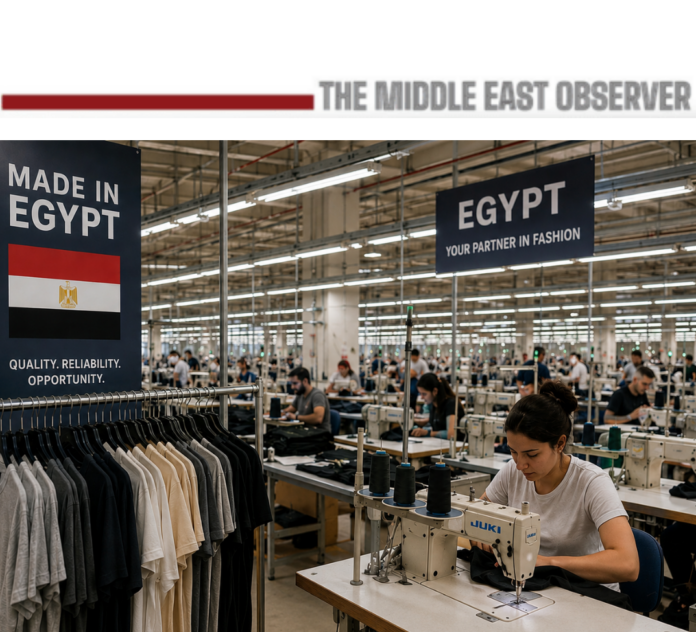
Turkish apparel Şahinler Egypt manufacturer is expanding its Egyptian operations as global retailers diversify sourcing networks beyond Asia, reinforcing Egypt’s emergence as a strategic manufacturing and export hub serving Europe, North America and regional markets.
Prime Minister Mostafa Madbouly this week inaugurated the latest expansion of Şahinler Egypt 2 in New Borg El Arab, Alexandria, adding 32 production lines and a technologically advanced central cutting facility as the company targets exports of approximately $55 million in 2026. The expansion, which covers more than 10,900 square metres with a built-up area exceeding 16,600 square metres, is expected to create around 1,500 direct jobs and 4,500 indirect employment opportunities.
The investment comes as Egypt’s ready-made garments sector records sustained export growth. Apparel exports exceeded $3 billion in 2025, making the industry one of the country’s leading non-oil export earners and a key source of foreign currency revenues.
For international manufacturers, Egypt offers a combination of advantages that few competing markets can match. Producers benefit from preferential access to the European Union, the United Kingdom, African markets through COMESA, and duty-free entry to the United States under the Qualified Industrial Zones (QIZ) framework. These agreements, combined with shorter shipping times to Europe, have increasingly positioned Egypt as an attractive alternative sourcing destination.
The shift reflects broader changes in global supply chains. While Bangladesh and Vietnam continue to dominate large-scale garment production, Egypt is increasingly competing with Morocco for near-shoring contracts as retailers seek greater supply-chain resilience and faster delivery times to Western markets.
Şahinler Egypt manufactures sportswear, casualwear, swimwear and activewear for international retailers. Current export destinations include the United States, Canada, the United Kingdom, Germany, Spain, Australia, Brazil, Morocco, Jordan and Türkiye. Industry records indicate that existing customers include Walmart, Decathlon, Quiksilver and Stafford Textiles, while future expansion plans have been linked to potential production for additional global fashion groups, including brands associated with Inditex, owner of Zara, although no formal agreement has been announced.
The project also highlights the growing scale of Turkish investment in Egypt. Turkish investments are estimated at more than $3 billion, with manufacturers increasingly using Egypt as a production and export platform serving multiple markets.
Looking ahead, the company plans a third expansion phase, Şahinler Egypt 3, which is expected to add further production capacity, create additional jobs and increase exports by an estimated $7 million annually. For Egypt, the significance extends beyond a single factory. As global brands rethink sourcing strategies, investments such as Şahinler’s underscore the country’s ambition to move beyond low-cost manufacturing and establish itself as a competitive export hub integrated into international fashion supply chains.