Recent reports of cash shortages at ATMs during the Eid al-Fitr and Eid al-Adha holidays reignited concerns that Egypt may be facing a liquidity problem. Long queues at cash machines and temporary shortages of banknotes led some consumers to question the availability of funds within the banking system.
Yet new analysis suggests the issue is not a shortage of liquidity, but rather the growing challenge of distributing cash across an economy undergoing rapid monetary expansion and digital transformation. Research by the Egyptian Center for Economic Studies (ECES) indicates that Egypt’s financial system is operating with record liquidity levels, even as seasonal spikes in cash demand continue to place pressure on ATM networks during major holidays.
The findings point to a broader structural question facing policymakers: can Egypt’s financial infrastructure keep pace with the rapid growth of both overall liquidity and digital financial transactions?
Liquidity Has Reached Record Levels
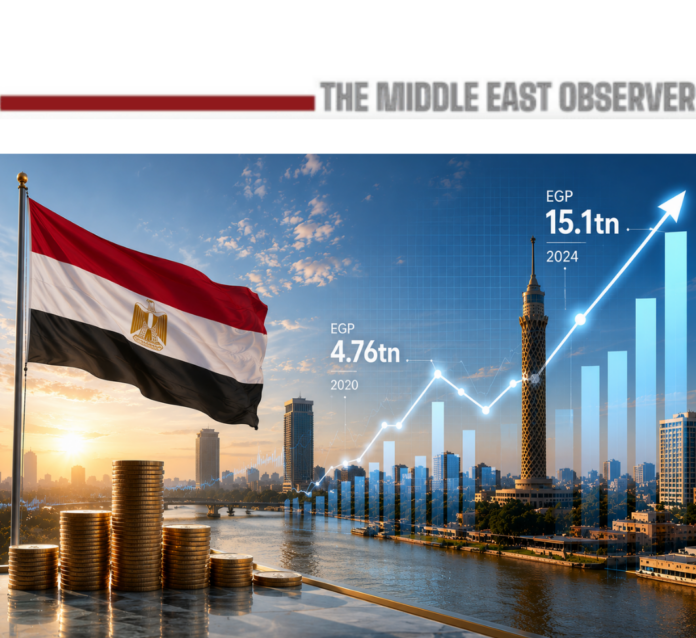
Egypt’s domestic liquidity (M2), the broadest measure of money circulating within the economy, increased from EGP 4.76 trillion in September 2020 to a record EGP 15.1 trillion by March 2026. Over the same period, narrow money (M1), which includes currency and demand deposits, rose from EGP 1.13 trillion to EGP 4.19 trillion.
Currency circulating outside the banking system also increased significantly, reaching EGP 1.58 trillion compared with EGP 610 billion six years earlier. However, despite this growth in absolute terms, cash has maintained a remarkably stable share of total liquidity, accounting for around 10-13% of M2 throughout the period and standing at 10.5% in the first quarter of 2026.
The expansion reflects several overlapping factors shaping Egypt’s economy over recent years, including inflationary pressures, growth in bank deposits, expanding private-sector and government credit, and the revaluation of foreign-currency assets and deposits following exchange-rate adjustments. Together, these factors have increased the nominal size of the money supply while deepening the role of the banking system as the primary repository of liquidity.
This suggests that the expansion of liquidity has been driven not by a greater reliance on cash, but by a parallel increase in bank deposits and financial assets held within the banking system. More than EGP 10.9 trillion of total liquidity remains in deposits and quasi-money instruments, while demand deposits alone account for approximately EGP 2.6 trillion.
For economists, this distinction is critical. A shortage of physical cash available at a particular ATM does not necessarily imply a shortage of liquidity across the financial system.
Digital Finance Is Growing, but Cash Remains Essential
The debate comes at a time when Egypt is experiencing rapid growth in digital payments. Mobile wallets, electronic transfers and platforms such as InstaPay are increasingly allowing money to move within the banking system without requiring physical cash withdrawals.
The trend also reflects broader efforts by the Central Bank of Egypt to promote financial inclusion, expand electronic payments and reduce reliance on cash transactions. Initiatives such as InstaPay, mobile wallets and instant payment networks have accelerated the movement of funds within the banking system, helping digital transactions become an increasingly important component of daily economic activity.
Nevertheless, holiday periods continue to reveal the enduring importance of cash in everyday economic activity. Religious celebrations, gift-giving traditions, salary payments, pension withdrawals and increased retail spending create temporary surges in demand for banknotes that often exceed normal withdrawal patterns.
The experience highlights a reality often overlooked in discussions surrounding digitalisation. While electronic payments are expanding rapidly, Egypt remains in a transitional phase where cash and digital transactions coexist. Large segments of retail commerce and informal economic activity continue to rely heavily on cash, particularly during peak spending periods.
As a result, cash demand can rise sharply even as digital transaction volumes continue to increase.
Infrastructure, Not Liquidity, Is the Real Challenge
The ECES analysis suggests that the more important policy issue is no longer the availability of liquidity but the capacity of the infrastructure that supports it.
As the money supply expands and economic activity grows, infrastructure requirements become more complex. This includes increasing ATM density in high-demand areas, strengthening cash transportation and replenishment networks, improving real-time liquidity management systems, expanding merchant acceptance of digital payments and upgrading payment-processing capacity to accommodate rising transaction volumes. The challenge is no longer simply creating liquidity, but ensuring it can move efficiently through both physical and digital channels.
Many public discussions have interpreted ATM shortages as evidence of financial stress. The data points to a different conclusion. Egypt’s banking system currently holds record levels of liquidity, while the share of cash within the broader money supply remains broadly stable. The issue is therefore one of distribution and infrastructure rather than funding availability.
The ATM shortages witnessed during holiday periods may ultimately prove less important than what they reveal about Egypt’s economic transformation. The country is increasingly operating as two financial systems at once: a rapidly expanding digital economy powered by instant payments and electronic transfers, and a deeply cash-dependent consumer economy that continues to rely on physical currency for a significant share of everyday transactions.
As liquidity, financial inclusion and digital payments continue to grow simultaneously, Egypt’s next challenge will be ensuring that the infrastructure moving money evolves as quickly as the money itself.