
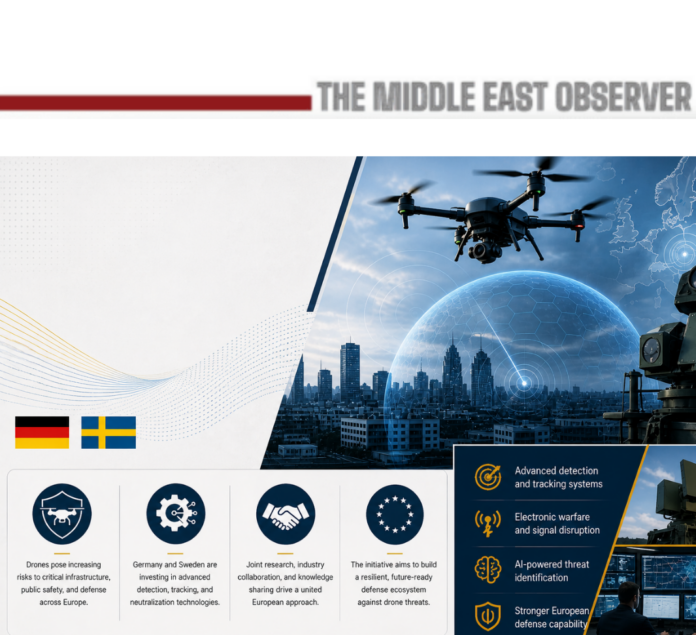
Europe is stepping up efforts to develop advanced counter-drone capabilities, as Germany and Sweden launch a joint innovation model aimed at accelerating defense technology and securing critical infrastructure, according to official agency statements and policy discussions across the region.
The initiative brings together Federal Agency for Disruptive Innovation and Vinnova, marking an unprecedented collaboration between the two public innovation bodies. The partnership is designed to fund and fast-track breakthrough technologies capable of protecting airports, nuclear facilities, and civilian sites from hostile drone activity.
The programme, formalised in 2025, reflects a broader European push to address gaps in innovation speed and scale, highlighted in recent competitiveness assessments led by Mario Draghi. Officials argue that Europe must adopt more flexible, risk-tolerant funding models to compete globally in advanced technologies.
Among the projects supported is a Czech-led initiative developing autonomous drone interception systems. The technology aims to deploy drones capable of identifying and neutralising hostile aerial threats, an area gaining urgency amid increased drone usage in conflict zones and repeated security incidents near European airports.
Both SPRIND and Vinnova are loosely modelled on the US Defense Advanced Research Projects Agency, though with a civilian-led framework. Germany has granted SPRIND expanded financial autonomy, including the ability to take equity stakes in startups—an uncommon practice among public institutions—while Sweden’s Vinnova has long operated with similar flexibility, contributing to the country’s strong innovation track record.
Officials stress that fragmented demand across European markets has historically hindered the development of scalable drone defense solutions. By coordinating funding and requirements across countries, the initiative aims to create viable commercial pathways for startups and attract private investment into the sector.
The growing urgency behind the programme is underscored by rising concerns over foreign-made drone technologies and their potential risks to critical infrastructure. European authorities are increasingly focused on developing sovereign capabilities in response to both geopolitical tensions and domestic security threats.
As The Middle East Observer notes, Europe’s emerging “DARPA-style” approach signals a structural shift in how the region approaches defense innovation—moving from fragmented national efforts toward coordinated, mission-driven funding models designed to accelerate technological breakthroughs in an increasingly contested security environment.
