Earlier this year, I had the opportunity to speak at the Cairo International Book Fair. Like many Egyptians, I have always thought of the fair primarily as a cultural event—a place of books, debates and chance encounters in crowded halls.
This year, however, I noticed something different.
Publishers were discussing artificial intelligence and machine translation. Rights managers were negotiating international publishing agreements. Young entrepreneurs were presenting digital publishing platforms and emerging business models. The National Centre for Translation was unveiling hundreds of newly translated titles from around the world. Almost without intending to, the Book Fair had become a meeting point where culture, technology and economics increasingly intersected.
Walking through the exhibition halls, I found myself thinking about translation—not simply as the movement of words between languages, but as the ability to move ideas, products and institutions across different cultural environments. Increasingly, that ability has economic value.
For many years, discussions about Egypt’s place in the global economy revolved around familiar advantages: geography, demographics and relatively competitive labour costs. Those factors still matter, but they no longer explain the whole story. Egypt’s fastest-growing export sectors increasingly depend on something less tangible: the ability of Egyptians to operate confidently between different linguistic and cultural worlds.
The country’s digital services industry offers an obvious example. Customer support centres, software companies, outsourcing providers and digital marketing agencies do not simply export labour hours. They export interpretation, mediation and cultural fluency.
Their task extends beyond answering calls or writing code. It is to make global systems intelligible to local users while making local consumers intelligible to international companies. That process creates value every bit as real as manufacturing or logistics.
Digital exports have more than doubled since 2018, and the government hopes to expand them further in the coming years. Yet it would be misleading to attribute this growth entirely to wage competitiveness. If low labour costs alone determined success, many poorer economies would dominate the sector.
What Egypt offers is something more distinctive.
Its workforce combines technical skills with access to one of the Arab world’s largest cultural markets, one of its most influential media industries and a dialect understood well beyond the country’s borders. Egypt occupies an unusual position: culturally central to the Arab world while geographically connecting Europe, Africa and the Gulf. That combination is difficult to replicate.
The importance of cultural fluency becomes particularly visible in advertising and digital communication. Many campaigns targeting Egyptian consumers are still conceived elsewhere in the region and imported with only minor modifications, as though Arabic-speaking audiences constitute a single market.
They do not.
An advertising slogan that feels perfectly natural in Dubai or Riyadh may sound overly formal—or emotionally distant—in Cairo or Mansoura. Humour, social references and patterns of speech carry commercial consequences because they influence trust, attention and ultimately consumer behaviour. In digital markets, authenticity converts. Companies that understand local cultural codes frequently outperform competitors with larger budgets but weaker local insight.
This creates a genuine comparative advantage for Egyptian firms capable of moving comfortably between international platforms and domestic audiences.
The challenge is that many local companies continue to occupy only the lower end of that value chain. Egyptian professionals adapt global campaigns, localise interfaces and moderate content, while strategic decisions, platform ownership and intellectual property remain elsewhere. The country risks becoming a supplier of linguistic expertise while importing the systems that organise, monetise and ultimately capture the value generated by that expertise.
Artificial intelligence makes this challenge even more urgent.
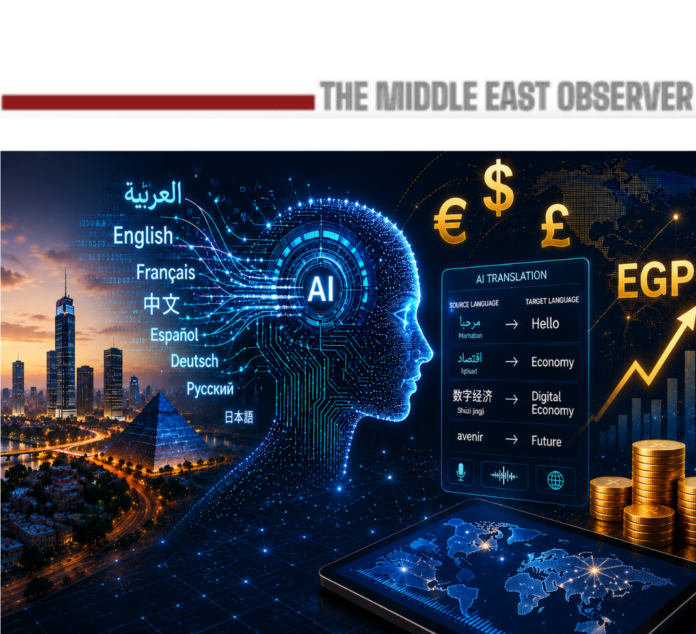
Translation software can now perform tasks that once required teams of specialists. Marketing campaigns can be localised automatically. Content can be generated simultaneously across multiple languages and dialects. Some observers interpret this as a threat to translators and language professionals.
I am not convinced.
If anything, automation increases the value of cultural judgement. Artificial intelligence can translate words with remarkable accuracy. It remains far less successful at translating humour, ambiguity, irony, status signals and social context. Machines process language. Markets continue to operate through meaning.
The more important question is therefore not whether translation will survive automation, but who will own the infrastructure through which translation increasingly takes place. Will Egyptian firms develop the platforms, language models, datasets and intellectual property that organise these flows of information? Or will they simply provide skilled labour to systems designed, trained and owned elsewhere?
This is not merely a technological question.
It is fundamentally a development question.
Countries that control standards, digital platforms and intellectual property consistently capture far more value than those that simply supply skilled labour.
This is perhaps why the Book Fair struck me as such an interesting place from which to think about Egypt’s economic future. On the surface, it remained what it has always been: a celebration of books and ideas. Yet beneath that familiar surface, another economy was becoming visible.
Publishers were experimenting with AI-assisted translation. Discussions increasingly revolved around publishing rights rather than simply printed books. Intellectual property was becoming a commercial asset rather than merely a cultural one. The fair itself was adapting to an economy in which ideas travel faster, farther and more profitably than ever before.
Culture was no longer sitting outside the economy.
It was becoming one of its strategic inputs.
Egypt’s future in the digital economy will not be determined by labour costs alone. Nor will it depend solely on infrastructure spending or investment incentives. Increasingly, competitiveness will be defined by the ability to move between worlds: between Arabic and English, between local consumers and global firms, between Egyptian realities and international markets.
For a country with Egypt’s linguistic reach and cultural influence, that represents a significant opportunity.
But opportunities create choices.
Egypt can become a producer of platforms, intellectual property and AI-enabled digital services built upon its own cultural strengths. Or it can remain a supplier of highly skilled labour within systems designed and owned elsewhere.
Ultimately, the difference between those two futures may depend not simply on how well Egypt translates languages, but on who controls the technologies, platforms and intellectual property through which translation itself increasingly takes place.
Related news:
Egypt Awards €690m Rail Upgrade Contracts to Alstom Consortium
Is Artificial Intelligence a Bogeyman Threatening Human Activity?
Read also:
Egypt, France Expand Strategic Partnership Through Health, Skills and Green Industry Investments