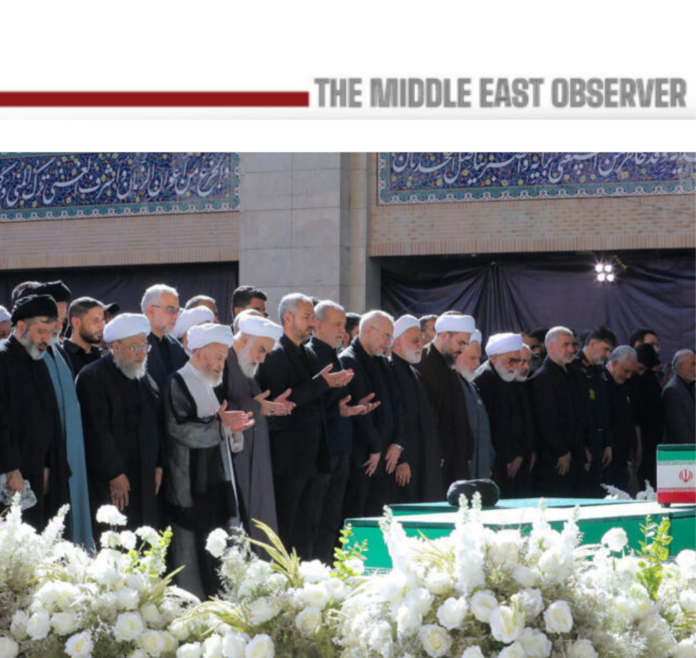
July, 2026 witnessed an unprecedented political and military spectacle: the funeral procession of late Iran’s Supreme Leader, Ali Khamenei, who was assassinated on the first day of a 40-days war between Iran on one side, and Israel and the United States on the other. This war, marked by intense bombardment of Iran and retaliatory strikes on U.S. bases in the Gulf and Israeli cities, exposed new equations of power in the region. Yet, what captured the world’s attention was not merely the military dimension, but the awe-inspiring mass turnout that accompanied Khamenei’s farewell.
The funeral of the Iranian leader unveiled the profound impact of Western propaganda in painting a relentlessly negative image of Iran, not only in the eyes of the Western public but also within the Arab world. Not since the funeral of the late Egyptian President Gamal Abdel Nasser has the world witnessed a procession where the participants displayed such palpable grief. Tears and genuine sorrow do not lie. This massive outpouring of public emotion disrupted the Western media narrative, which has long depicted the Iranian regime as an isolated entity completely detached from its people.
Western media outlets have historically relied on a reductive strategy that equates entire populations with their political regimes, portraying adversaries as despotic structures alienated from their citizens. In the case of Iran, the imagery of “an oppressed population waiting for revolution” has been consistently reinforced, ignoring internal social and political complexities. However, the scenes from Khamenei’s funeral revealed two twin realities: First: The existence of a highly resilient social core that believes in the state’s ideology and strategic direction, viewing resistance as an integral part of its national identity. While this core is not necessarily uncritical of the regime’s policies, it firmly rejects the Western worldview sought to be imposed on its status and identity. Second: The failure of Western propaganda to penetrate the Iranian popular consciousness. Events proved that the media portrayal represents only a fraction of the truth, and that the Iranian public possesses an independent Political awareness grounded in reality rather than the fabricated images projected by naïve intelligence.
On the Arab front, the landscape is considerably more complex, reflecting a sharp polarization. Large segments of the Arab public view Iran as the sole power that militaterally confronted Western-Israeli hegemony, rendering it a natural ally despite ideological differences with certain Arab states. Conversely, other factions view Iran as a destabilizing force within several Arab capitals, seeing the expansion of its influence as a strategic challenge. This divergence demonstrates that perceptions of Iran are not formed in a vacuum; rather, they are shaped by geopolitical lenses and direct national interests. It is inaccurate to assume that Arab public opinion is merely a “translation” of Western propaganda; it is, first and foremost, a domestic arena of intense political and ideological contestation.
On the military front, Iran succeeded under a suffocating siege in constructing a domestic military arsenal that enabled it to endure and impose complex deterrence equations in the region. Economically, however, despite efforts to build a “resistance economy”, claiming that the nation “has no need for imports” departs from reality. The embargo has led to hyperinflation, a severe depreciation of the currency, and a heavy reliance on smuggling networks and international partners to sustain the economy.
A comparison between the funerals of Khamenei and Abdel Nasser reveals fundamental commonalities. In the case of Nasser (1970), his passing came just a few years after the 1967 Defeat (Naksa). Despite the bitterness of military loss, millions took to the streets in a spectacle that stunned the world- not in celebration of a lost war, but in stubborn adherence to the sovereign project and national dignity he personified. In the case of Khamenei (2026), following devastating attacks and the liquidation of top leadership, the funeral transformed into a “referendum by tears.” The grief here was not merely a lamentation for an individual, but a collective declaration of defiance against foreign diktats and an expression of commitment to the state’s political identity in the face of two nuclear powers. The answer to whether mass emotion stems from leadership charisma or a collective sense of defiance and grievance lies in the dialectical interaction between the two. Political charisma translates a shared sense of external challenge into mass political action. A charismatic leader does not manufacture emotion from nothing; rather, they give it form, consciousness, and direction. Thus, the immense crowds at Khamenei’s funeral reflected both the Iranians’ attachment to their political identity and its articulation through the symbol of Khamenei, who became synonymous with it. Cultivating an understanding of the historical lesson that assassinating political opponents has often elevated them to martyrdom, allowing their ideas and ideologies to outlive them and resonate across generations.
The participation of official and popular delegations from over a hundred countries underscores a vital point: while Western propaganda succeeded in shaping official governmental opinion in the West, it failed to isolate these symbols from their depth in the Global South. We witnessed this with Nasser, a titan of the Non-Aligned Movement, and we see it today in Tehran. The participating delegations reflect a complex network of alliances and popular sympathy that transcends borders, proving that systematic media demonization could not erase the man’s status as a symbol of defiance for his supporters.
In such existential crises, domestic political fractures temporarily dissolve, giving way to a “collective survival instinct.” This massive influx of people cannot be understood in isolation from the Shia theological reservoir rooted in the “culture of Karbala’a”. In this doctrine, sacrifice and the death of leaders when confronting superpowers is viewed not as a catastrophic military defeat, but as a “personal victory and martyrdom” that reproduces the narrative of righteous grievance against brutal force. For many mourners, the late leader represented the resilience of a sovereign state that had developed indigenous military capabilities and endured 40 days of unprecedented bombardment, a military achievement that reinforced pride among the regime’s supporters regardless of the immediate political outcome.
Khamenei’s funeral served as a moment for reproducing the regime’s legitimacy in the eyes of the solid social core of Iranian society. The popular cohesion around the late leader, despite harsh economic conditions, confirms that the state still commands a social base capable of resilience and renewal. Regionally, this mass mobilization is poised to grant Tehran a new diplomatic wildcard, proving that the state is not isolated and that any future settlement must take into account its formidable popular dimension.
Finally, Khamenei’s funeral, much like Nasser’s before it, exposed a fundamental truth: the peoples of this region are profoundly moved by symbols that craft a narrative of “resistance and independence”, even when the society pays exorbitant costs in its economy and welfare. The tears shed in Tehran were not merely a lament for a leader; they were the declaration of an unwritten social contract between the state and its popular base. This contract is founded on the premise that “standing firm against hegemony” is a core value worth the ultimate sacrifice. While this bond has proven its resilience in moments of profound loss, its long-term viability will depend on the regime’s capacity to translate this emotional legitimacy into tangible achievements that improve the everyday lives of ordinary Iranian citizens.
Related news:
Read also: