
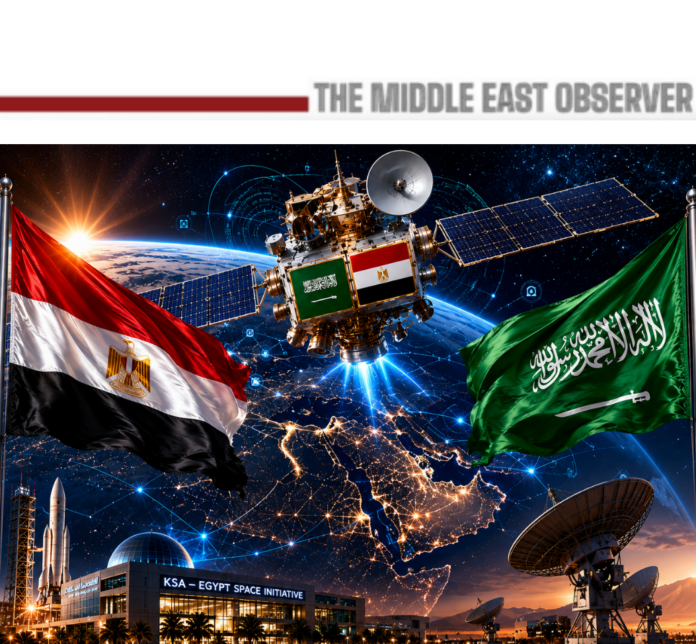
Saudi Arabia has approved an initiative to design and build the first jointly developed Saudi-Egyptian satellite, marking a significant milestone in bilateral cooperation in space technology and underscoring growing regional ambitions to develop indigenous capabilities in advanced industries.
The initiative was approved by the Saudi Council of Ministers as part of broader efforts to strengthen scientific and technological collaboration between the Kingdom and Egypt. The project is expected to become one of the most prominent examples of Arab cooperation in the rapidly evolving space sector, although technical specifications, investment costs and implementation timelines have yet to be disclosed.
The decision builds on a memorandum of understanding signed in December 2023 between the Saudi Space Agency and the Egyptian Space Agency, which established a framework for cooperation in peaceful space activities, satellite technologies, research and development, capacity building and the localisation of industries associated with space technology.
Officials from both countries have increasingly highlighted the strategic importance of developing domestic expertise in advanced technologies as part of wider economic diversification programmes aimed at reducing dependence on traditional sectors and creating new high-value industries.
Expanding Arab Space Capabilities
The satellite initiative reflects the accelerating pace of investment in space programmes across the Middle East, where governments are increasingly viewing space technologies as strategic assets with applications extending far beyond scientific exploration.
Earth observation, communications, environmental monitoring, disaster management, agricultural planning and infrastructure management have become key drivers behind regional investments in satellite technologies. Governments across the Gulf and North Africa are also seeking to develop local engineering expertise and advanced manufacturing capabilities to capture a greater share of the global space economy.
According to international industry estimates, the global space economy is projected to exceed $1 trillion over the coming two decades, driven by demand for satellite communications, Earth observation services, navigation technologies and commercial space applications. As competition intensifies among major powers including the United States, China and the European Union, emerging economies are increasingly seeking positions within a sector viewed as critical to future economic competitiveness.
Saudi Arabia’s Expanding Space Strategy
For Saudi Arabia, the project aligns closely with Vision 2030, which places technology localisation, innovation and advanced manufacturing at the centre of the Kingdom’s economic transformation agenda. The Kingdom has significantly expanded its space ambitions in recent years through astronaut missions, satellite programmes, research initiatives and investments aimed at building a domestic space ecosystem.
Saudi Arabia’s growing involvement in space activities reflects a broader effort to diversify the economy beyond hydrocarbons while creating highly skilled employment opportunities in science, engineering and advanced technologies. The Kingdom increasingly views space capabilities as an extension of its wider digital transformation and industrial development strategies.
Egypt’s Emerging Role as a Regional Space Hub
Egypt has simultaneously positioned itself as one of Africa’s leading centres for space research and satellite development. Through major investments in the Egyptian Space Agency and Space City in Cairo, the country has expanded domestic capabilities in satellite design, assembly, integration and testing.
The establishment of the headquarters of the African Space Agency in Cairo has further strengthened Egypt’s role within the continent’s emerging space sector. Over recent years, Egyptian institutions have pursued multiple satellite programmes and international partnerships aimed at building local expertise while supporting national development priorities through satellite-based services.
The joint initiative with Saudi Arabia builds upon these foundations and could accelerate the transfer of knowledge, technical expertise and industrial capabilities between the two countries.
From Cooperation Agreements to Industrial Projects
The satellite project signals a transition from policy coordination towards practical industrial collaboration. Rather than limiting cooperation to research exchanges and technical dialogue, the initiative seeks to create a tangible technological asset jointly designed and developed by specialists from both countries.
Industry observers view the project as an important step towards establishing a broader Arab ecosystem for space technologies, including research institutions, manufacturing facilities, engineering expertise and specialised supply chains.
The initiative could also contribute to the development of a new generation of Arab aerospace engineers and scientists while supporting future commercial opportunities in satellite services and related industries.
Technology Sovereignty and Strategic Independence
Beyond its technological significance, the project reflects a growing emphasis on technological sovereignty across the Middle East. Governments increasingly regard access to independent satellite capabilities as essential for communications, environmental monitoring, resource management, infrastructure planning and national development strategies.
The ability to generate, process and control strategic data has become an increasingly important component of economic resilience and national competitiveness. As countries seek to reduce dependence on foreign technological infrastructure, domestic satellite capabilities are gaining strategic importance alongside investments in artificial intelligence, digital infrastructure, cybersecurity and advanced manufacturing.
For Saudi Arabia and Egypt, the initiative represents an opportunity not only to develop technical expertise but also to strengthen regional capabilities in critical technologies that are expected to play a growing role in future economic development.
Strategic and Economic Implications
The project could create opportunities for future collaboration in Earth observation systems, communications satellites, geospatial services and commercial space applications. Analysts note that successful implementation may pave the way for additional joint ventures involving advanced technologies, research programmes and industrial partnerships.
The initiative also demonstrates the increasing maturity of Arab technology cooperation. Rather than focusing solely on technology acquisition, regional governments are placing greater emphasis on co-development, localisation and the creation of domestic industrial capacity.
Details Awaited
While the approval marks an important policy milestone, authorities have not yet announced the satellite’s mission profile, launch arrangements, development schedule or financial structure. Additional details are expected to be released by the Saudi Space Agency and the Egyptian Space Agency during the implementation phase.
The success of the project will ultimately be measured not by the launch itself, but by whether it helps create a sustainable regional ecosystem for satellite manufacturing, engineering and space-based services capable of competing internationally. For Saudi Arabia and Egypt, the initiative represents an early test of whether Arab cooperation can translate technological ambition into industrial capability, while positioning both countries more prominently within the rapidly expanding global space economy.
Related news:
Read also:
Standard Chartered Forecasts EGP49 Dollar Rate by the end of 2026
WE and AASTMT inaugurate Cybersecurity Innovation Lab in Smart Village