
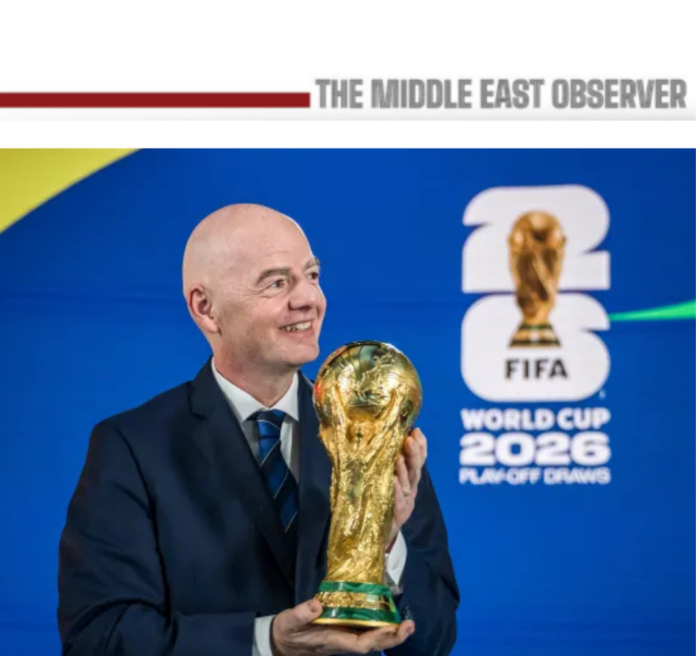
The 2026 FIFA World Cup, which kicked off on June 11 across the United States, Canada and Mexico, has already secured its place in history. It is the first World Cup to be jointly hosted by three nations, the first to feature 48 teams, and the largest ever in terms of scale, with 104 matches scheduled over the course of the tournament.
Yet behind the record-breaking numbers lies a more complex question: who can actually access the world’s biggest sporting event? For millions of football supporters, particularly those from developing countries, attending the tournament has become an increasingly difficult financial and logistical challenge.
FIFA’s expansion of the competition from 32 to 48 teams has undeniably created unprecedented commercial opportunities. Revenues from the 2026 edition are projected to reach nearly $13 billion, with approximately $8.9 billion expected to be generated during the tournament year alone. Broadcasting rights are estimated at close to $4 billion, up roughly 34% from Qatar 2022, while ticket sales are expected to exceed $3 billion—three times the amount generated during the previous World Cup. Sponsorship and marketing revenues have also surged, supported by the commercial strength of the North American market.
Prize money has increased accordingly. The tournament winner will receive $50 million, while each participating federation is guaranteed at least $12.5 million. Nevertheless, for many smaller football associations, these payments only partially offset the substantial costs of preparation, travel, accommodation and logistics, which can exceed $20 million.
The host countries, meanwhile, expect economic gains of more than $30 billion and the creation of hundreds of thousands of jobs. By most commercial measures, the tournament represents a major success. The more difficult question is whether ordinary supporters—particularly those from poorer nations—are benefiting from that success.
One of the most controversial developments has been the introduction of dynamic pricing, a model widely used in entertainment and sports but deployed at an unprecedented scale during a FIFA World Cup. While organisers initially promoted entry-level tickets beginning at around $21 for selected matches, actual prices in many host cities rose dramatically as demand increased.
In major U.S. cities such as Miami and Los Angeles, average group-stage ticket prices often exceeded $1,000. The lowest-priced tickets for the final surpassed $4,000, while premium hospitality packages reached tens of thousands of dollars.
The result has been a growing perception that World Cup attendance is becoming increasingly linked to purchasing power rather than supporter loyalty. Stadium attendance may be strong, but many long-time football supporters now find themselves priced out of the tournament.
The challenge becomes even clearer when viewed from the perspective of developing economies. In Egypt, for example, the minimum monthly wage is approximately EGP 6,000, equivalent to roughly $120 at prevailing exchange rates. Even the cheapest World Cup ticket represents more than a month’s income for many workers. Once flights, accommodation, local transportation and visa costs are included, the total expense of attending a single match can easily range between $8,000 and $12,000 per person.
For much of the middle class in developing countries, such costs place attendance beyond reach. The dream of watching football’s greatest spectacle in person is increasingly replaced by viewing matches on television or in local cafés thousands of miles away from the host venues.
Financial barriers have been compounded by immigration requirements. For many supporters from developing countries, securing a U.S. visa has proven as challenging as affording the trip itself.
Critics argue that stringent visa procedures have disproportionately affected supporters from parts of Africa, the Middle East and South Asia, raising broader questions about whether the tournament’s global character is being undermined by barriers that extend beyond ticket prices.
One of the most widely discussed incidents involved Somali referee Omar Abdulkadir Artan, who reportedly faced entry difficulties despite holding valid travel documentation and international accreditation. The case attracted significant attention and became, for many observers, a symbol of the tension between security considerations and the inclusive ideals associated with international sport.
Artan had been set to become the first Somali referee to participate in a FIFA World Cup. Instead, his experience generated debate over how immigration procedures can affect not only supporters but also individuals directly involved in the tournament itself.
Iranian supporters encountered similar frustrations. Although the Iranian national team ultimately participated in the tournament, broader political tensions between Washington and Tehran created uncertainty regarding travel and supporter access. Critics argued that such developments risk introducing geopolitical considerations into an event that aspires to unite nations through sport.
From a purely economic perspective, dynamic pricing and restrictive entry procedures may generate short-term advantages. Higher ticket prices increase revenue, while tighter immigration controls may reduce pressure on infrastructure and security services.
However, these policies also carry indirect costs. Critics point to potential damage to FIFA’s image, reduced accessibility for traditional supporters, and the erosion of one of football’s most valuable assets: its reputation as a truly global game. Some tourism operators have also expressed concern that perceptions of high costs and travel difficulties could affect future demand for major sporting events.
The contrast among the three host countries has further highlighted these issues. While the United States has faced the strongest criticism regarding ticket prices and visa procedures, Canada and Mexico have generally offered more accessible conditions for international supporters. The result has been noticeably different fan experiences across the tournament, with many observers pointing to a more diverse and vibrant supporter presence in Canadian and Mexican venues.
The debate surrounding the 2026 World Cup ultimately extends beyond football. It raises broader questions about who has access to major global events in an era of rising commercialisation.
The tournament remains an extraordinary sporting and economic achievement. Its expansion has brought more nations, more matches and greater global visibility. Yet it has also exposed a growing tension between profitability and accessibility.
Commercial success and inclusivity need not be mutually exclusive. Future tournaments could preserve both by ensuring a fairer allocation of affordable tickets, streamlining travel procedures for legitimate supporters, and maintaining a balance between commercial objectives and football’s social mission.
Football became the world’s most popular sport because it transcended borders, income levels and political divisions. The challenge facing FIFA is ensuring that its largest tournament continues to reflect those values.
The story of the 2026 World Cup may ultimately be remembered not only for its unprecedented scale, but also for the questions it raised about who gets to participate in the global celebration of the beautiful game.
Related news:
Mohamed Salah: Premier League’s Reigning King Named EPL’s Best by Sportsdunia
Arab Athletes Are Rewriting Global Sports — And Inspiring a Generation
Read also:
East African States Advance Joint Regional Satellite Initiative
Egyptian Innovations Win Five Medals at Geneva International Exhibition of Inventions