
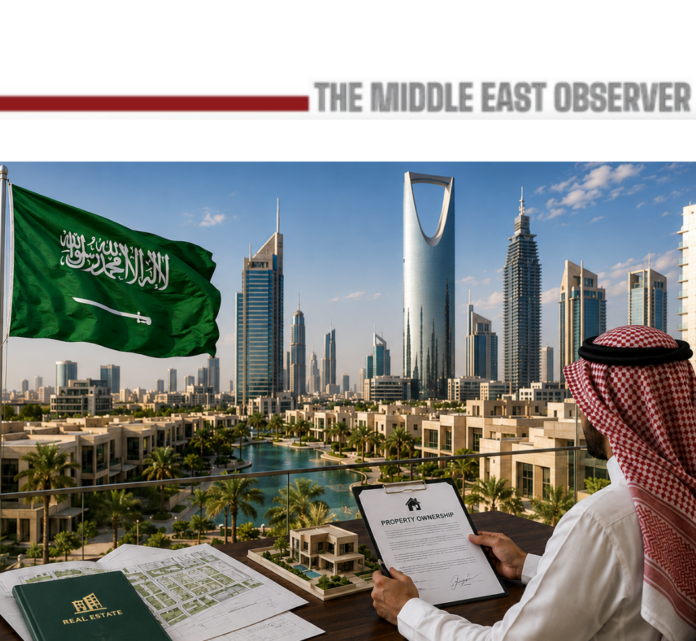
Saudi Arabia has completed the regulatory framework for foreign ownership of real estate after the Council of Ministers approved the executive regulations governing property ownership by non-Saudis, a move designed to attract international capital, deepen the property market and support the Kingdom’s long-term economic diversification agenda.
The decision represents the final stage in implementing the new law on foreign real estate ownership, which entered into force on 22 January 2026. Alongside the regulations, the Cabinet approved the geographical areas where non-Saudis will be permitted to own property, although the government has not yet publicly disclosed the full list of designated zones.
The reform forms part of Saudi Arabia’s broader Vision 2030 strategy aimed at increasing foreign direct investment, expanding private-sector participation and transforming the Kingdom into a leading global business, tourism and investment destination.
Saudi authorities have described the new framework as a means of improving the efficiency and transparency of the real estate sector while creating a more attractive environment for international investors and long-term residents.
Under the regulations, foreign individuals, companies and certain non-profit entities will be able to acquire ownership rights in approved locations, subject to specific conditions and regulatory requirements. The framework also establishes clearer procedures governing property transactions, registration, compliance and oversight.
The reforms are expected to support demand across multiple segments of the market, including residential developments, commercial real estate, hospitality projects, industrial zones and mixed-use urban communities. Industry analysts believe the measures could unlock significant new investment opportunities, particularly in major economic centres and strategic development projects linked to the Kingdom’s economic transformation plans.
Special Framework for Holy Cities
While the regulations broaden access to the Saudi property market, Makkah and Madinah remain subject to special provisions reflecting their unique religious significance and strategic importance.
Earlier drafts of the executive regulations indicated that foreign ownership in the two holy cities would be governed by additional controls and eligibility requirements. The government has sought to balance investment opportunities with the preservation of the cities’ special status while supporting ongoing development projects and infrastructure expansion.
Supporting a Growing Real Estate Market
The timing of the reform coincides with unprecedented levels of investment in Saudi Arabia’s property sector. The Kingdom is advancing hundreds of billions of dollars worth of projects ranging from residential communities and tourism destinations to logistics hubs, economic zones and large-scale urban developments.
Real estate has become one of the key pillars of Vision 2030, supported by rapid population growth, rising tourism arrivals, increasing demand for housing and the government’s efforts to attract multinational companies to establish regional headquarters in Saudi Arabia.
The new ownership framework is also expected to complement initiatives such as premium residency programmes, which aim to attract skilled professionals, entrepreneurs and high-net-worth individuals seeking long-term opportunities in the Kingdom.
A Market Measured in Trillions
The reform comes as Saudi Arabia oversees one of the world’s largest real estate development pipelines. Industry estimates suggest that projects announced or under development under Vision 2030 exceed $1 trillion in value, spanning residential communities, tourism destinations, business districts, logistics hubs and infrastructure assets. The property sector has become an increasingly important contributor to non-oil economic growth, supported by urbanisation, population expansion and government efforts to raise home ownership rates while accommodating a growing expatriate workforce.
Demand fundamentals remain strong. Riyadh is targeting substantial population growth over the coming decade as multinational corporations, technology firms and regional headquarters continue expanding their presence in the Kingdom. Combined with rising tourism flows and large-scale investment programmes, these trends are expected to sustain demand across residential, commercial and hospitality segments.
Likely Beneficiaries of the Reform
Market participants expect the new framework to benefit a broad range of sectors. Residential developers could gain access to a wider pool of international buyers, while hospitality operators may benefit from increased investment in tourism-related assets. Real Estate Investment Trusts (REITs), commercial property owners and developers of mixed-use projects are also expected to attract greater institutional interest.
Particular attention is likely to focus on Riyadh, Jeddah and the Kingdom’s major development initiatives, including special economic zones, Red Sea tourism projects and large-scale urban transformation programmes. International investors seeking exposure to Saudi Arabia’s economic expansion may increasingly view real estate as a strategic long-term asset class.
Opportunities Accompanied by Risks
Despite the positive outlook, analysts caution that the reform’s success will depend on careful implementation and regulatory clarity. Greater foreign participation could contribute to higher property prices in premium districts if supply fails to keep pace with demand, while developers may face increasing competition for prime land and assets.
Investors will also closely monitor how ownership restrictions, transaction procedures and compliance requirements are applied in practice. As with any major market liberalisation, balancing foreign capital inflows with affordability for domestic buyers will remain an important policy challenge.
Regional Competition for Global Capital
The move places Saudi Arabia among a growing number of Gulf countries that have liberalised property ownership rules to attract international investors. Over the past two decades, countries including the United Arab Emirates, Qatar and Bahrain have successfully used foreign ownership frameworks to stimulate investment, deepen their property markets and support broader economic diversification.
Saudi Arabia’s significantly larger domestic market, combined with its ambitious pipeline of giga-projects and infrastructure investments, could provide a substantial competitive advantage as it seeks to attract a greater share of global property capital.
Investors Await the Geographic Map
A key unanswered question remains the precise geographical areas approved for foreign ownership. While market participants expect major economic centres such as Riyadh and Jeddah to feature prominently, attention is also focused on emerging investment destinations including special economic zones, tourism developments and strategic growth corridors linked to Vision 2030.
The publication of these zones is likely to shape investment strategies over the coming months and determine where foreign capital is concentrated. For developers, financial institutions and international investors, the geographical framework may prove as important as the law itself in determining the reform’s commercial impact.
The approval of the executive regulations marks one of the most significant liberalisations of Saudi Arabia’s property market in modern history and reflects the Kingdom’s broader shift towards a more open and globally integrated economy. Yet the ultimate test will not be the legislation itself, but whether it succeeds in attracting sustained international capital, deepening market liquidity and supporting long-term economic diversification. As investors await details of the approved ownership zones, the scale of foreign participation in the years ahead will become a key measure of the reform’s success and of Saudi Arabia’s ability to position itself as a leading global real estate investment destination.
Related news:
Saudi Arabia Seeks Private Capital for Major Makkah Development
Egypt Bets EGP 12bn on Vaccine Hub to Cut Imports and Expand Regional Reach
Read also:
Aydhab: Egypt’s Lost Red Sea City of Pilgrims, Gold, Porcelain and Forgotten Empires