
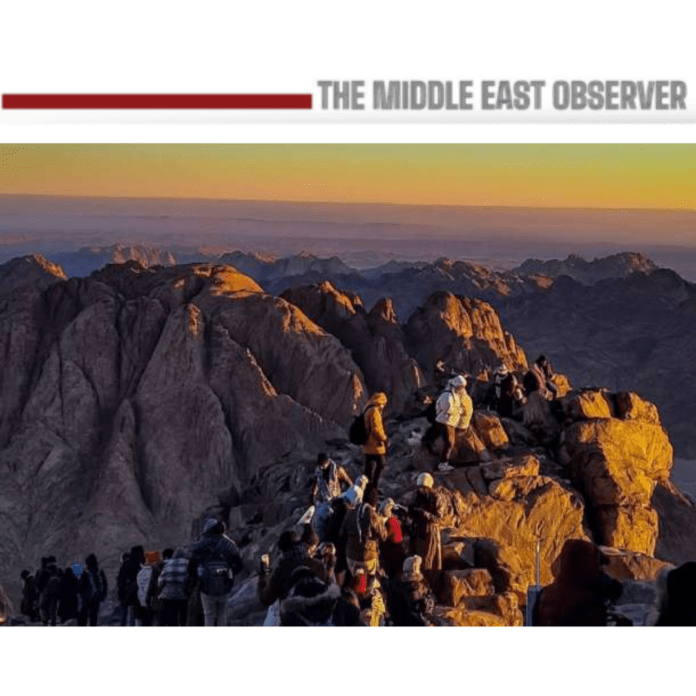
Far from conventional tourism routes, a rediscovered desert corridor offers a rare and immersive journey through time—tracing the ancient Roman path from Saint Catherine’s Monastery toward Jerusalem across the vast Sinai landscape. Known among explorers as the “Truth Road,” this route unfolds not as a single destination, but as a sequence of living landscapes shaped over millennia—carrying within it historical treasures, enduring civilizations, and a profound journey of spiritual reflection and renewal.
The journey begins in the shadow of Saint Catherine’s Monastery, where history is not preserved in museums, but embedded in stone and silence. From there, the path moves eastward into the vast Sinai desert—unchanged in its essence for thousands of years—where geography itself becomes the narrative.
Along the route lies the historic Okda Well, a vital water source that once sustained ancient caravans crossing this unforgiving terrain. Here, the logic of survival becomes clear: every step across Sinai was dictated by access to water, and every well represented life itself.
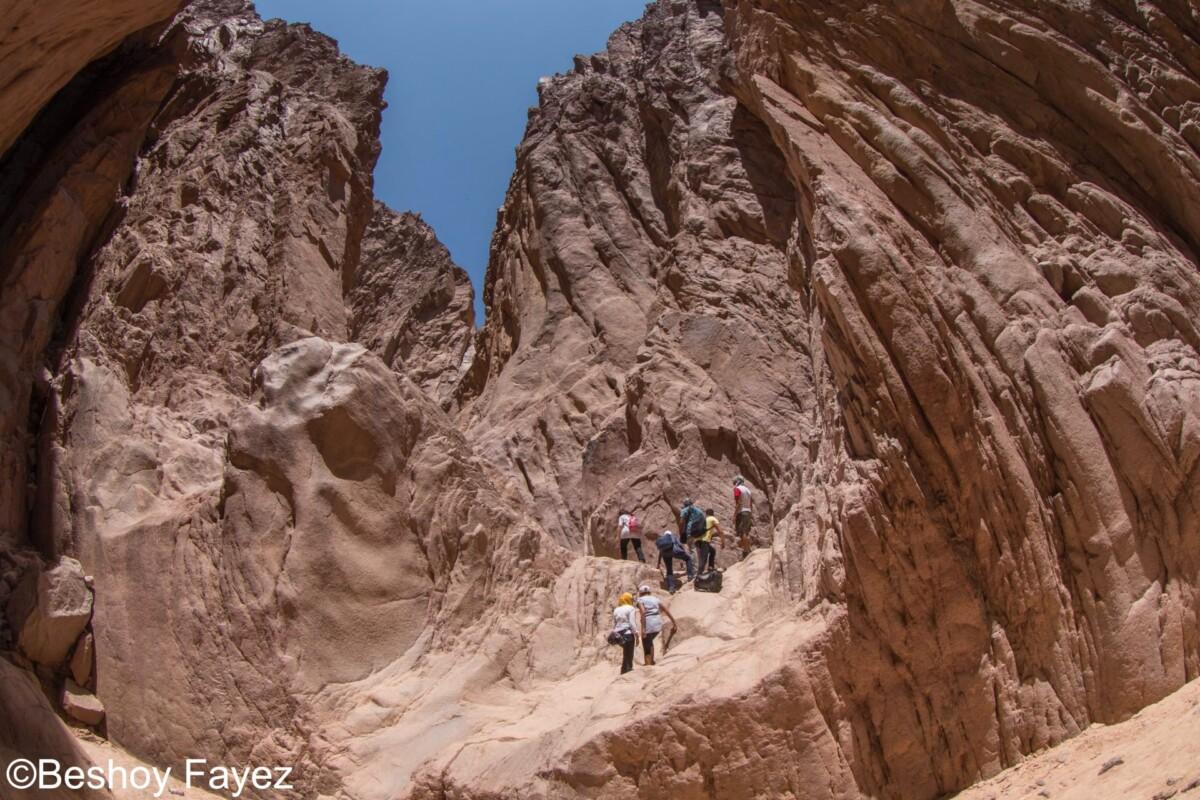
Moving deeper into the desert, the terrain shifts dramatically into the striking formations of the White Canyon. Narrow passages carved through pale sandstone create a surreal hiking experience, where light and shadow reveal layers of geological history. These formations, shaped over thousands of years, stand as natural archives—unchanged, untouched, and deeply connected to the route’s ancient continuity.
Beyond the canyon lies Ein Khudra Oasis, a sudden emergence of life in the desert. Palm trees, fresh water, and vegetation form a stark contrast to the surrounding arid expanse. Historically, this oasis served as a critical stopping point for travelers, and today it remains a place of stillness—where the desert briefly breathes.
Further along the route, the landscape introduces one of its most iconic formations: the rocky “dinosaur” of El-Makhroum. This naturally sculpted structure rises from the desert like a relic of another era, reinforcing the sense that Sinai is not merely crossed—but experienced as a geological story unfolding in real time.
Throughout the journey, the presence of camels remains central. As The Middle East Observer observes, these animals are not symbolic—they are essential, representing the most enduring means of navigating such terrain. Their slow, steady movement and remarkable endurance mirror the rhythm of the desert itself, just as they have for centuries.
Scattered along the path are ancient mountains, rocks, and wind-sculpted stones—natural formations shaped over millennia by elemental forces. These geological features offer what can only be described as timeless treasures, reinforcing a broader realization: this is a route not redesigned by modernity, but preserved by nature.
More than a tourism experience, the journey reveals a corridor where civilizations once moved, where faith intersected with survival, and where the land itself has remained constant while history passed through it.
The Middle East Observer concludes that the Sinai route represents a rare proposition in global tourism—an authentic, unaltered passage through time, where every step retraces a path that has endured across centuries. What distinguishes this corridor is not only its historical and spiritual depth, but its position as an untapped, first-mover investment opportunity in experiential and eco-cultural tourism.
For early investors, the route offers a unique advantage: the ability to shape and define a destination before it reaches global saturation. Unlike traditional tourism markets, the Sinai corridor remains largely uncommercialized, allowing for the development of a high-value, low-impact tourism ecosystem—built around guided expeditions, eco-lodges, cultural immersion hubs, and heritage storytelling experiences that preserve authenticity while generating sustainable returns.
A consortium-driven model presents the most effective pathway forward—bringing together investors, operators, and cultural stakeholders to develop a controlled, premium tourism circuit along key locations such as Saint Catherine’s Monastery, the White Canyon, and Ein Khudra Oasis. Such a structure enables shared infrastructure investment, risk distribution, and the creation of a unified brand positioning the route as one of the world’s most exclusive desert journeys.
As The Middle East Observer observes, the value proposition lies not in mass tourism, but in scarcity and narrative—targeting high-end global travelers seeking authenticity, spirituality, and untouched landscapes. In this context, Sinai’s “Truth Road” is not merely a route; it is a platform for a new category of destination development, where first entrants stand to capture disproportionate long-term value by anchoring a globally distinctive tourism asset at its inception.
