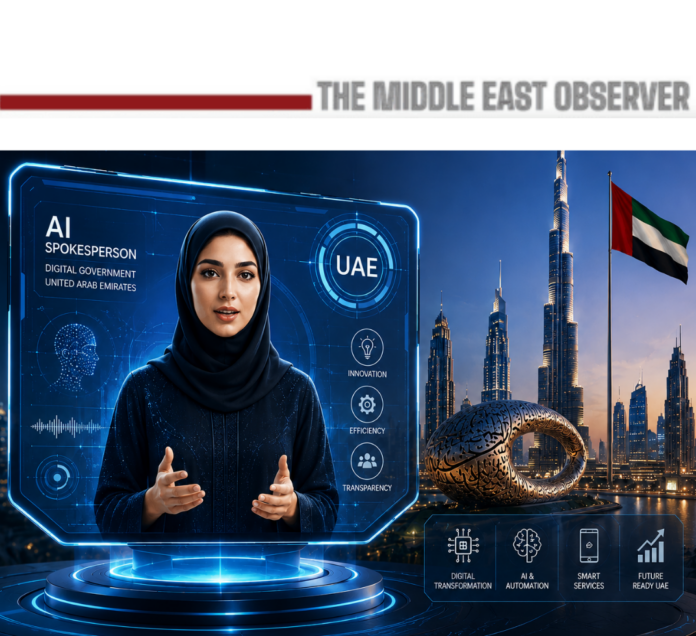
Zayed” to represent Presidential Court’s International Affairs Office as Abu Dhabi deepens AI integration
The United Arab Emirates has introduced “Zayed”, an artificial intelligence-generated spokesperson designed to represent the International Affairs Office at the UAE Presidential Court, marking one of the most prominent uses of generative AI in government communications globally.
Named after the UAE’s founding father, Sheikh Zayed bin Sultan Al Nahyan, the digital figure will communicate the office’s initiatives, policy priorities and international engagements through AI-generated content aimed at both domestic and international audiences.
The launch forms part of the UAE’s broader strategy to integrate artificial intelligence across government services and strengthen its position as a global hub for emerging technologies. Officials say the initiative is intended to enhance public engagement, particularly among younger and digitally connected audiences, while providing a scalable platform for government communications.
AI at the Centre of Economic Diversification
The initiative reflects the UAE’s long-term efforts to position artificial intelligence as a pillar of economic diversification and future growth. Over the past decade, the country has invested heavily in digital infrastructure, advanced technologies and AI research as it seeks to reduce dependence on hydrocarbons and develop new high-value sectors capable of driving long-term competitiveness.
Artificial intelligence has become a central component of the UAE’s economic strategy, supporting ambitions to attract global technology companies, investment capital and highly skilled talent while accelerating the development of a knowledge-based economy.
A New Model for Government Communications
Beyond its technological novelty, Zayed highlights how governments are increasingly exploring AI not only as an administrative tool but also as a strategic communications asset. AI-generated representatives have the potential to deliver consistent messaging across multiple platforms, languages and time zones while expanding outreach at a fraction of the cost of traditional communication models.
Supporters argue that such systems can improve accessibility and engagement, while critics note that governments will need to address questions surrounding transparency, accountability and public trust as AI becomes more deeply embedded in official communications.
Among the Earliest Government Adopters
While governments around the world are experimenting with artificial intelligence in public services, customer support and administrative functions, few have deployed AI-generated figures as official representatives for government entities.
The UAE’s decision places it among the earliest adopters of generative AI in public-sector communications and reinforces its reputation as a testing ground for emerging technologies. The move follows a series of initiatives aimed at expanding the use of AI across federal institutions and integrating intelligent systems into policymaking, service delivery and public administration.
Strategic Communications in a Digital Age
The launch also reflects a broader shift in how governments engage with increasingly digital societies. As audiences consume information across social media, digital platforms and AI-powered channels, public institutions are seeking new ways to communicate more effectively while maintaining control over official messaging.
For the UAE, the deployment of an AI-generated spokesperson is not merely a technology experiment. It represents an effort to combine digital innovation with strategic communications, positioning artificial intelligence as a tool for governance, diplomacy and public engagement.
As governments worldwide explore the potential of generative AI, the UAE’s initiative may offer an early indication of how digital representatives could reshape public-sector communications in the coming decade. The success of the project will likely be measured not only by technological performance, but by its ability to build trust, improve engagement and demonstrate how artificial intelligence can support modern governance.
Related news:
MCIT Backs $400 Million Data Centre Investment to Boost Digital Hub Ambitions
Egypt Targets AI and Cloud Investment with National Data Centre Strategy
Read also:
Egypt Launches Trade Intelligence Platform to Drive $100bn Export Ambition
UAE, Qatar Deepen Asia Trade Ties with South Korea in Strategic Shift