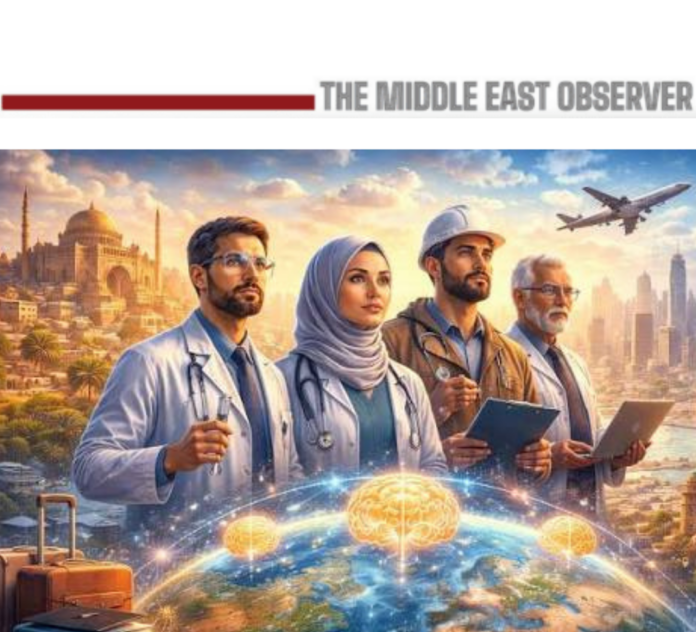
Recent figures released by Egypt’s Central Agency for Public Mobilization and Statistics (CAPMAS) reveal that the total number of Egyptians living abroad has reached approximately 9.5 million. Holders of higher qualifications—including doctors, engineers, scientists, and other professionals—represent the largest segment of migrants. Arab countries remain the primary destination, accounting for 63% of Egyptian migrants, followed by Europe and North America.
Brain Drain: A Growing Challenge
Brain drain, or the migration of highly skilled professionals, refers to the movement of scientific, medical, engineering, and technical talent from Arab countries to more developed nations in search of better living standards and career opportunities. Estimates suggest that Arab countries collectively lose nearly $2 billion annually as a result of this phenomenon, which represents roughly one-third of the total migration of skilled professionals from developing countries worldwide.
The issue is not confined to the Arab world. According to UNESCO, developing countries continue to lose a significant share of their highly educated workforce to advanced economies, creating persistent gaps in research, innovation, healthcare, and technical expertise.
Why Does Brain Drain Persist?
The migration of Arab talent is driven by a combination of push factors in their home countries and pull factors in developed economies.
Economic and Living Conditions
Low salaries, rising inflation, and declining purchasing power often make it difficult for highly qualified professionals to achieve a satisfactory standard of living despite years of education and training.
Work and Research Environment
Limited funding for scientific research, inadequate laboratory facilities, and bureaucratic obstacles frequently hinder innovation and professional growth, encouraging talented individuals to seek opportunities abroad.
Political and Social Instability
Regional conflicts, political uncertainty, and concerns about long-term stability have prompted many skilled professionals to pursue careers in safer and more predictable environments.
Lack of Equal Opportunities
The prevalence of nepotism and insufficient merit-based advancement can discourage ambitious young professionals, who often feel that their talents and efforts are not adequately recognized or rewarded.
The Attraction of Developed Countries
Western nations continue to attract skilled workers by offering competitive salaries, comprehensive healthcare and social protection systems, advanced infrastructure, and research ecosystems that foster innovation and creativity.
The Economic Impact on Arab Countries
The consequences of brain drain extend far beyond the departure of individual professionals. Arab countries effectively bear the cost of educating and training highly skilled individuals, only for the benefits of that investment to be realized elsewhere.
Loss of Human Capital
The departure of scientists, engineers, doctors, and other specialists weakens national competitiveness and limits the ability of countries to implement ambitious development projects.
Reduced Productivity and Innovation
The migration of experts contributes to shortages in critical sectors such as healthcare, education, scientific research, and technology, slowing economic modernization and digital transformation.
Waste of Public Investment
Governments invest substantial resources in education and training, yet often receive limited economic returns when graduates choose to build their careers abroad. Studies by international development institutions estimate that the cost of educating a physician, engineer, or scientific researcher from primary school through university can amount to tens of thousands of dollars. When thousands of highly qualified professionals emigrate, the cumulative value of this lost investment runs into billions, while host countries gain a fully trained workforce without bearing the cost of education and preparation.
The Positive Role of Remittances
On the other hand, remittances sent by expatriates provide an important source of foreign currency and support household incomes. While these transfers contribute positively to national economies, they cannot fully compensate for the loss of expertise, innovation, and institutional capacity resulting from the departure of highly skilled professionals. Remittances are essentially a financial transfer, whereas human capital is a long-term strategic asset that drives productivity, research, entrepreneurship, and national competitiveness.
How Can This Challenge Be Addressed?
Recognizing the seriousness of the issue, several Arab countries have begun implementing policies aimed at retaining talent and encouraging expatriate professionals to return.
Supporting Scientific Research
Increasing investment in research and development, establishing centers of excellence, and creating world-class research facilities can provide talented individuals with greater opportunities to innovate and contribute at home.
Government Initiatives to Attract Talent
Targeted programmes, competitive research grants, and incentives for returning professionals can help reconnect expatriate experts with national development priorities. Several countries have already made progress in this area. The Kingdom of Saudi Arabia has launched a series of initiatives under its Vision 2030 programme to attract leading scientists, researchers, and innovators from around the world, while the United Arab Emirates has introduced long-term residency schemes and specialized programmes designed to attract and retain highly skilled professionals in strategic sectors such as technology, healthcare, and advanced research.
Improving the Business Environment
Creating a more dynamic economic environment through investment incentives, support for entrepreneurship, and tax benefits for small and medium-sized enterprises can generate attractive employment opportunities for young professionals and graduates.
A Strategic National Priority
Brain drain is not merely a migration issue; it is a development challenge with significant economic, scientific, and social implications. Addressing it requires comprehensive reforms that improve living standards, strengthen research and innovation ecosystems, promote merit-based opportunities, and create an environment in which talented individuals can build successful careers without feeling compelled to seek opportunities elsewhere.
As the economist and development expert Joseph Stiglitz once observed, a country’s most valuable resource is not its natural wealth but the skills, knowledge, and creativity of its people. The real question facing Arab economies today is therefore not how to manage migration, but how to create conditions that encourage their brightest minds to stay, contribute, and build the future at home.
If governments, universities, and the private sector fail to act decisively, the region risks continuing to finance the prosperity of other economies with its own human capital. The challenge is clear: will Arab countries succeed in transforming brain drain into brain gain, or will they continue to lose the very talent needed to achieve sustainable development and global competitiveness?