
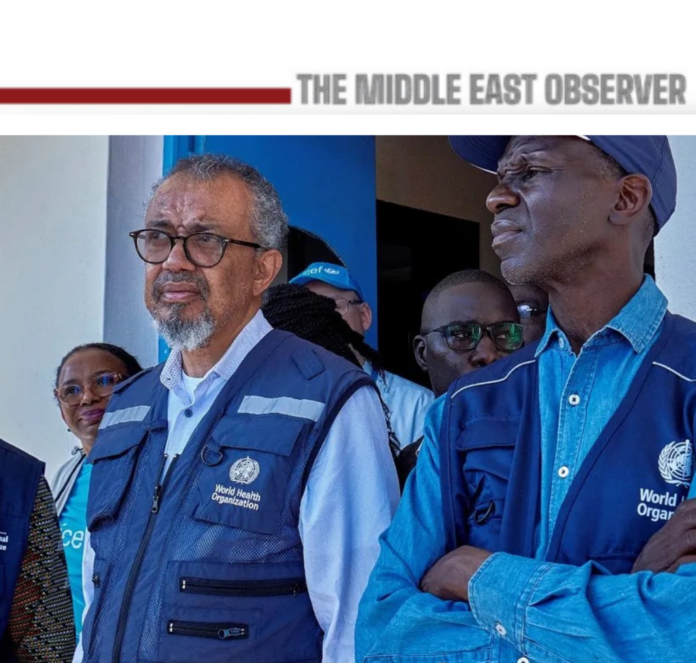
The World Health Organization (WHO) and the Africa Centres for Disease Control and Prevention (Africa CDC) have launched a $518 million continental response plan to contain a rapidly expanding Ebola outbreak centred in the Democratic Republic of Congo (DRC) and Uganda, amid growing concerns over cross-border transmission, economic disruption and strained public-health systems.
The six-month programme aims to strengthen surveillance, laboratory testing, border screening and treatment capacity across Africa following the emergence of the rare Bundibugyo strain of Ebola, for which no approved vaccine or treatment currently exists. WHO declared the outbreak a Public Health Emergency of International Concern (PHEIC) in May after cases spread from eastern Congo into neighbouring Uganda.
Health officials warn that ongoing conflict, population displacement and weak healthcare infrastructure in eastern Congo are complicating containment efforts. The outbreak’s epicentre lies in one of the world’s most important critical-minerals regions, producing cobalt, copper, tin, tantalum and tungsten used in batteries, electronics and renewable-energy technologies.
While no major supply-chain disruptions have yet emerged, the outbreak highlights how public-health crises can quickly evolve into broader economic risks. Investors and governments are increasingly monitoring the situation given the strategic importance of the region’s mining and transport corridors.
The response plan also comes amid concerns over declining international health funding, with African health officials warning that delayed financing often increases both the human and economic costs of outbreaks.
Precautions for Governments
Health authorities are urging countries to strengthen preparedness through:
- Enhanced border and airport screening.
- Rapid testing and disease-surveillance systems.
- Improved treatment and isolation facilities.
- Healthcare worker training.
- Regional information-sharing and coordination.
Experts caution that blanket border closures can be counterproductive by pushing travellers towards informal crossings that are harder to monitor.
Precautions for Individuals
WHO advises residents and travellers in affected areas to:
- Avoid direct contact with infected individuals or bodily fluids.
- Maintain strict hygiene and handwashing practices.
- Seek medical attention immediately if symptoms develop.
- Follow official health guidance and avoid misinformation.
Common symptoms include fever, fatigue, headache, vomiting and diarrhoea, with severe cases potentially leading to internal and external bleeding.
Health Security and Economic Resilience
The outbreak reinforces a lesson highlighted by COVID-19: health security has become an economic and national-security issue. Disease surveillance, laboratory capacity and emergency response systems are increasingly viewed as essential infrastructure for protecting trade, investment, labour mobility and supply-chain stability.
The WHO–Africa CDC initiative is therefore more than a humanitarian response. It is an effort to safeguard economic resilience in a region that plays a growing role in global mineral supply chains and international commerce.
The broader challenge for policymakers is whether prevention can be funded with the same urgency as crisis response. As recent outbreaks have repeatedly demonstrated, the cost of preparedness is often far lower than the economic and human consequences of delayed action.