
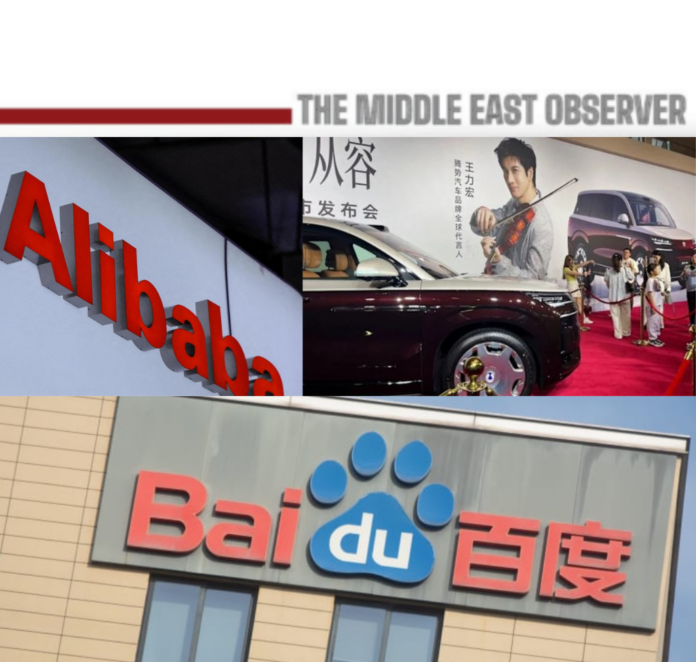
The U.S. Department of Defense has expanded its list of companies it identifies as linked to China’s military-industrial ecosystem, adding major technology and industrial groups including Alibaba, Baidu and electric-vehicle manufacturer BYD in a move that underscores the growing overlap between commercial innovation and national-security competition.
The updated “Chinese Military Companies” list, published by the Pentagon, does not impose immediate sanctions on the companies but restricts the U.S. Department of Defense from contracting with designated entities and could expose them to greater regulatory scrutiny in the future.
Alibaba, Baidu and BYD are among China’s most internationally prominent technology and industrial groups, with businesses spanning cloud computing, artificial intelligence, autonomous driving, electric vehicles and advanced battery manufacturing. Their inclusion signals a significant broadening of Washington’s focus beyond traditional defense industries toward technologies increasingly viewed as strategically important to economic and military competitiveness.
Technology Becomes a Security Battleground
Unlike previous rounds of restrictions that largely targeted defense contractors and aerospace groups, the latest additions include some of China’s most influential commercial technology companies.
Alibaba is one of China’s largest cloud-computing and digital-commerce groups, while Baidu is a leading artificial-intelligence developer and autonomous-driving technology provider. BYD has emerged as one of the world’s largest electric-vehicle manufacturers and a key player in global battery supply chains.
The inclusion of such firms highlights how U.S. concerns have expanded beyond traditional military industries to encompass sectors considered critical to future technological leadership, including artificial intelligence, advanced manufacturing, robotics, semiconductors, batteries and data infrastructure.
Beyond Semiconductors
The latest additions suggest Washington’s focus is shifting from semiconductors alone toward a wider range of strategic industries. Electric vehicles, batteries, artificial intelligence, cloud computing and autonomous systems are increasingly viewed by policymakers as technologies with both commercial and military applications, broadening the scope of future regulatory scrutiny.
The Pentagon argues that China‘s military-civil fusion strategy enables civilian technological advances to contribute to military modernization and strategic capabilities, making advanced commercial technology companies an increasingly important part of the national-security debate.
Companies Reject Allegations
The Pentagon’s designation does not mean the listed companies are owned by the Chinese military or directly manufacture military equipment. Rather, the U.S. government argues that they operate within an ecosystem that supports China’s broader military-civil fusion objectives.
The companies have rejected the characterization. Alibaba, Baidu and BYD have maintained that they are commercial enterprises operating independently of China’s military establishment, while Beijing has accused Washington of politicizing economic and technological competition.
China’s Foreign Ministry criticized the decision, arguing that the U.S. is stretching national-security concepts to suppress Chinese companies and constrain their international growth.
A Growing Policy Tool
The Pentagon’s list stems from U.S. legislation requiring the Defense Department to identify Chinese companies believed to support military-civil fusion efforts. Over recent years, the list has expanded steadily as Washington has widened its definition of technologies considered strategically sensitive.
Although inclusion on the list does not automatically trigger financial sanctions, it can affect corporate reputations, government procurement opportunities and future investment decisions, while increasing the likelihood of additional regulatory scrutiny.
Implications for Global Investors
The development is likely to be closely monitored by international investors, including Gulf sovereign wealth funds that have expanded exposure to Chinese technology, electric-vehicle and advanced-manufacturing sectors in recent years.
Although the immediate commercial impact remains limited, analysts view the move as part of a broader tightening of U.S.-China technological competition that could influence future capital flows, investment strategies and supply-chain decisions.
For global businesses, the development signals that the dividing line between commercial technology and national security is becoming increasingly blurred. Industries once viewed primarily through a commercial lens—including artificial intelligence, cloud computing, electric vehicles and battery manufacturing—are now central to geopolitical competition between the world’s two largest economies.
The latest Pentagon action suggests that future economic rivalry between Washington and Beijing will be shaped not only by trade and investment flows, but also by the strategic value governments increasingly assign to advanced technologies and the companies developing them.
Related news:
From Iron Man Dreams to AI Reality: The Dawn of the Hyper-Enabled Operator in Modern Warfare
Anduril Enhances Army’s IVAS Headsets with Advanced AI Technology
Read also:
Egypt’s Foreign Reserves Reach Record $53.1bn as Investor Confidence Improves
Putin Signals Ukraine Conflict Could Be Entering Final Phase