
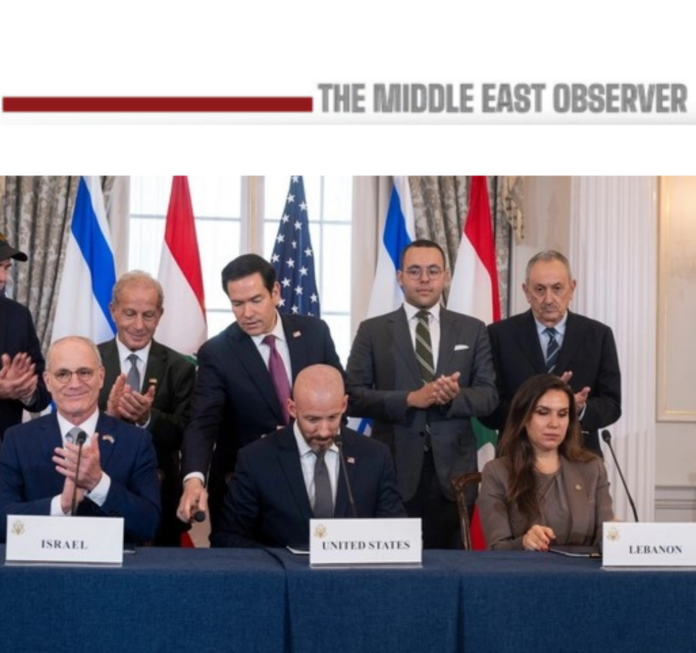
The agreement reached between Lebanon and Israel under American auspices does not appear to be a fair one. It may well trigger internal confrontations in Lebanon that could escalate into civil war.
The agreement contains 14 articles, most of which are drafted in a deliberately vague and generalized manner. However, what stands out more than anything else is a cluster of formulations that, in my view, could bring down the Lebanese government.
First: The Use of “Redeployment” Instead of “Withdrawal”
The text uses the term “progressive redeployment” rather than “full and complete withdrawal”. This effectively could legitimize a prolonged Israeli military presence, along the lines of what happened in the West Bank after the Oslo Accords. By using “progressive redeployment” instead of an unequivocal withdrawal, the text appears to grant Israel military flexibility to reposition and entrench itself in strategic points inside Lebanese territory under the pretext of security needs. This mirrors the language of the Oslo Accords (Areas A, B, and C), which were used to justify continued Israeli security control and the non-withdrawal from the West Bank. That framework opened the door to the seizure of large swathes of land for illegal Israeli settlements, the fragmentation of the West Bank, and the practical impossibility of establishing a viable Palestinian state. A similar outcome could emerge in Lebanon, especially after the agreement requires the weakening or elimination of armed resistance. The agreement does not impose a binding timetable for Israeli withdrawal. Instead, it links “progressive redeployment” to the complete disarmament of Hezbollah, a condition that is nearly impossible to fulfill, thereby giving Israel a continuing justification to remain.
Israeli Prime Minister Benjamin Netanyahu described the arrangement as a “pilot program” and stated that the Israeli military would prepare for a “lengthy stay” in the security zone in the south. In doing so, the agreement reproduces the model of the Oslo interim arrangements, which morphed into a permanent reality. The American “verification” mechanism grants Washington and Israel broad discretionary authority to assess Lebanon’s compliance with disarmament, allowing them to suspend any withdrawal based on alleged security infractions.
Second: Restricting the Right of Self-Defense to the State Alone
The agreement restricts the right to defend against occupation or aggression to the Lebanese state alone, a state that does not currently possess a military capable of repelling a large-scale Israeli assault. This effectively amounts to acquiescence to occupation indefinitely. This is a major weakness. Articles 6 and 7 prohibit any armed action outside the state framework, stripping Lebanon of any credible deterrent. The Lebanese army lacks air defense systems or any meaningful deterrent capability. The United States and European countries refuse to supply it with appropriate weapons, fearing they might eventually be used against Israel. Thus, Lebanon’s security becomes entirely dependent on Israeli commitments—which, as past agreements with the Palestinians suggest, have often proved unreliable—and on international will, which has been conspicuously absent whenever Israel is concerned, as demonstrated by the experience of Gaza and, before that, the Oslo Accords.
Third: Waiving the Prosecution of Israeli War Criminals
Article 13 of the agreement includes a Lebanese waiver of the right to prosecute Israeli war criminals. It stipulates the cessation of “all hostile or negative actions in international political or legal forums.”
Legal experts argue that this article prevents Lebanon from granting the International Criminal Court jurisdiction to investigate alleged Israeli war crimes and could effectively eliminate any realistic prospect of UN fact-finding missions. The Lebanese National Human Rights Institution has described this as a renunciation of the victims’ right to justice, as it effectively means the Lebanese government accepts the destruction of homes in the south and the erasure of southern Lebanese families from civil records.
Ultimately, the legal and political problem with this agreement lies in the gap between its wording and Lebanese reality, and whether the implementation guarantees actually protect Lebanese sovereignty from the text’s loopholes. The agreement opens the door to unrest and clashes—which we have already begun to witness in Lebanon—and potentially to civil war. This may represent the greatest danger that most analysts identify. The agreement obliges the Lebanese government (in Articles 4 and 9) to completely disarm “all non-state armed groups,” but it provides no clear or implementable mechanism to achieve this. This requirement far exceeds the Lebanese army’s current logistical and military capabilities, placing it in direct confrontation with Hezbollah and the complex social and military environment it belongs to. This is a scenario that the Lebanese army commander himself has warned against, fearing a slide into civil war. Hezbollah has rejected the agreement, calling it humiliating, and its parliamentary bloc has warned that pressure on the party could push the country toward internal conflict. Popular protests erupted in Beirut immediately after the signing, reflecting the intensity of polarization. The implementation details of disarmament have been postponed to a “Security Annex” that has not yet been disclosed or agreed upon, making the provision a commitment without a roadmap—what several observers have described as “a recipe for disaster.”
The agreement thus presents an extremely difficult equation for Lebanon. It imposes near-impossible obligations (disarming Hezbollah) in exchange for non-binding Israeli promises (“redeployment,” not withdrawal). It strips Lebanon of its legal tools (Article 13) and military deterrent (restricting the right of self-defense), all in the absence of genuine guarantees for its sovereignty. This makes Lebanon vulnerable to either permanent occupation or internal violence.
Some might argue that the Lebanese government could have requested American guarantees. But reality tells us that American guarantees are rarely enforced when it comes to Israel, under various pretexts. The historical record—from the guarantees given to Egypt after Camp David, to those given to the Palestinians in Oslo, to those accompanying Israel’s 2000 withdrawal from south Lebanon—shows that Washington consistently refrains from holding Israel accountable.
What the Agreement Gives to Israel and the US
In return, the agreement gives the Israeli prime minister the opportunity to claim a victory—however limited—in the war against Hezbollah and Iran. It allows him to court settler organizations that have repeatedly expressed their desire to begin settlement in southern Lebanon. And it gives President Trump—provided Iran remains silent—the chance to claim that he has succeeded in decoupling the Iranian arena from the Lebanese arena and cutting off some of Iran’s arms.
The Arab Role: Conditional on American Pressure
Although the agreement refers to Arab parties that might contribute to Lebanon’s reconstruction, these parties will not actually move except under American pressure. This was evident following similar prior commitments made at Paris I and II (2001–2002), where they pledged $2.4 billion for Lebanon’s reconstruction but delivered virtually nothing—and failed to follow through even after the Israeli withdrawal from Lebanon in 2000.
The Deeper Possible Solution: Beyond Sectarianism
Perhaps there is no Lebanese solution to these internal problems except through revisiting the Taif Agreement and forming a government based on direct representation of Lebanese citizens rather than on a sectarian basis. The sectarian foundation always opens the door to branding some as traitors—a dynamic that poisons any national consensus. However, this would first require agreement on forming a joint committee to redraft the Lebanese constitution away from sectarian foundations—a highly unlikely prospect amid the current tensions.
The agreement represents a catastrophic trade-off for Lebanon: impossible obligations in exchange for uncertain promises, legal disarmament in the face of military occupation, and reconstruction pledges that history suggests may never fully materialize. It does not resolve Lebanon’s crisis—it deepens it by placing the burden of implementation on a fractured state that lacks the capacity, the legitimacy, or the social consensus to carry it out. The Lebanese government is now caught between a bad agreement that, in my view, risks legitimizing a prolonged Israeli military presence and an internal explosion that could tear the country apart. The only way out—however distant—lies not in better negotiations, but in a fundamental restructuring of the Lebanese state itself, away from the sectarian logic that has made it perpetually vulnerable to external domination and internal paralysis.
Related news:
Lebanon’s Stability May Depend on a Peaceful Integration Formula for Hezbollah
South Lebanon: The War of the ‘Invisible Bee’ -From Tank Hunting to Soldiers’ Attrition”
Read also:
The Translation Machine: How Language is Becoming Currency in Egypt’s Digital Economy
The US-EU Trade Dispute Has Shifted from Goods to the Digital Economy