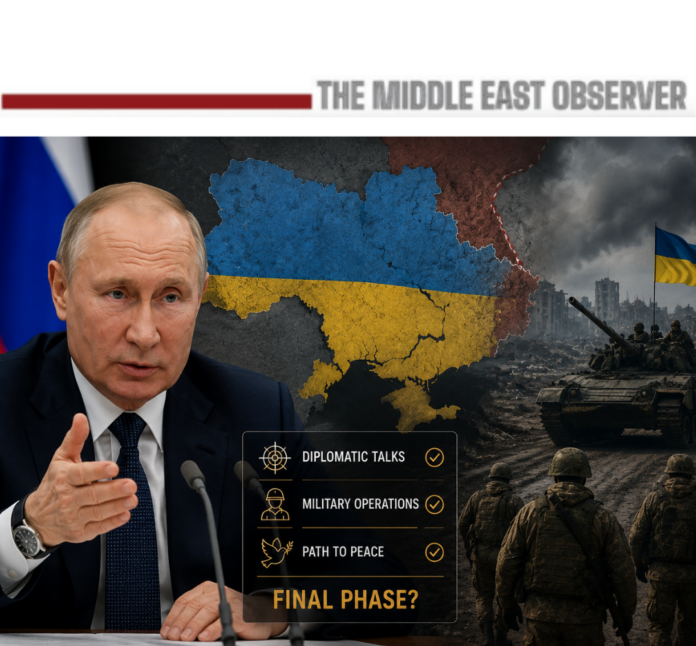
Russian President Vladimir Putin said he believes the war in Ukraine may be approaching its final stage, in remarks delivered shortly after Moscow’s most scaled-back Victory Day parade in recent years.
“I think that the matter is coming to an end,” Putin said in comments referring to the conflict, while also signaling willingness to discuss broader European security arrangements. The Russian president added that he would be prepared to meet Ukrainian President Volodymyr Zelenskyy in a third country once the conditions for a final peace agreement had been settled.
Putin’s remarks came amid a temporary US-brokered three-day ceasefire announced around the Victory Day commemorations in Moscow.
Despite intermittent offensives, the battlefield situation increasingly resembles a prolonged strategic stalemate entering the fifth year of the war. Russian advances have slowed significantly in recent months, with Moscow still unable to secure full control of the Donbas region despite occupying nearly one-fifth of Ukrainian territory. Both armies continue to sustain heavy casualties while targeting each other’s energy and logistical infrastructure.
Putin further suggested openness to discussions with Europe over a future continental security framework, while naming former German Chancellor Gerhard Schröder as his preferred interlocutor — a proposal likely to face skepticism across Ukraine and much of the European Union due to Schröder’s longstanding ties to Moscow and Russian energy projects, including the Nord Stream pipelines.
Separately, European Council President António Costa stated this week that there may be room for future negotiations with Russia concerning Europe’s broader security architecture.
As The Middle East Observer notes, the latest remarks may suggest that Moscow and Kyiv are increasingly acknowledging the realities of a prolonged military stalemate, particularly regarding territorial realities and future security guarantees. After more than four years of war, both sides increasingly appear constrained by a costly military and political deadlock that has imposed mounting economic, strategic, and domestic pressures.
The prolonged conflict has significantly affected global energy markets, defense expenditures, European industrial competitiveness, and international trade flows, while sanctions and geopolitical fragmentation continue to weigh on economic stability across multiple regions.
Against this backdrop, recent diplomatic positioning appears to reflect growing recognition among major powers that some form of negotiated de-escalation is becoming increasingly necessary. Although substantial differences between Moscow and Kyiv remain unresolved — and key aspects of any potential framework remain undisclosed — the prospect of reducing hostilities after years of conflict is nevertheless widely viewed internationally as a positive development that could help ease geopolitical tensions and reduce pressures on global energy, trade, and financial markets.