Bilateral trade has doubled to €124 billion since 2015 as Brussels and Seoul deepen cooperation on semiconductors, digital trade and supply-chain resilience
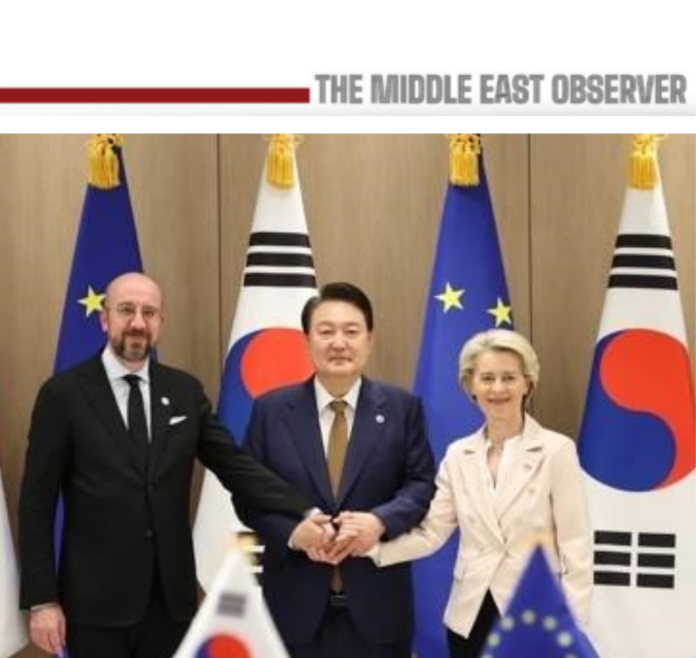
Economic security emerged as the defining theme of the 11th European Union–South Korea Summit in Brussels, where leaders celebrated the conclusion of a landmark Digital Trade Agreement while expanding cooperation on semiconductors, critical technologies and strategic supply chains increasingly exposed to geopolitical tensions.
European Commission President Ursula von der Leyen, European Council President António Costa and South Korean President Lee Jae-myung used the summit to reaffirm a partnership that has evolved far beyond traditional trade. Since 2015, bilateral goods trade has doubled to approximately €124 billion, making South Korea one of the European Union’s most important economic partners in the Indo-Pacific.
The summit highlighted a broader shift underway across the global economy. As geopolitical rivalries reshape investment decisions and industrial policies, Brussels and Seoul are increasingly positioning themselves as trusted partners seeking to reduce strategic vulnerabilities while preserving open trade and technological cooperation.
Digital Trade Expands a Decade of Economic Integration
The newly concluded Digital Trade Agreement represents the most significant upgrade to EU-South Korea economic relations since the implementation of their landmark Free Trade Agreement in 2011.
The agreement is designed to facilitate cross-border data flows, reduce regulatory barriers and provide greater legal certainty for companies operating across both markets. It also introduces rules covering digital transactions, consumer protection and restrictions on mandatory source-code transfers while maintaining existing standards on privacy and data protection.
For European businesses, the agreement improves access to one of Asia’s most digitally advanced economies. For South Korean companies, it strengthens integration with a market of more than 440 million consumers and supports expansion across technology-intensive sectors.
Yet the agreement’s significance extends beyond digital commerce. Officials on both sides increasingly view economic connectivity as a strategic asset in an era where trade, technology and national security have become closely intertwined.
Semiconductors Move to the Centre of Industrial Strategy
While the Digital Trade Agreement provided the headline, semiconductors and supply-chain resilience emerged as the summit’s central strategic focus.
South Korea occupies a pivotal position in global semiconductor supply chains through technology leaders such as Samsung Electronics and SK hynix. At a time when governments are seeking to secure access to advanced chips, memory technologies and next-generation electronics, cooperation with Seoul has become increasingly important for Europe’s industrial ambitions.
South Korean investment has also become a growing component of Europe’s manufacturing strategy. Korean companies have expanded investments across battery production, electric vehicles, semiconductor technologies and green-energy supply chains, sectors viewed by Brussels as essential to future competitiveness.
The urgency of this cooperation has increased following disruptions to global supply chains and restrictions on exports of strategic materials. China’s controls on rare-earth exports and materials linked to advanced manufacturing have reinforced concerns in both Europe and Asia about excessive dependence on concentrated supply chains.
Against this backdrop, the two sides agreed to establish a high-level dialogue on supply-chain resilience, a move many analysts view as one of the summit’s most consequential outcomes.
Security Cooperation Broadens the Partnership’s Reach
The summit also reinforced the growing security dimension of EU-South Korea relations.
Building on the Security and Defence Partnership signed in 2024, discussions focused on maritime security, cyber threats, foreign information manipulation and critical infrastructure protection. Although a proposed security-of-information agreement was not finalised, both sides signalled their intention to conclude it in the near future to facilitate the secure exchange of classified information and support deeper industrial and research cooperation.
Russia’s war in Ukraine and North Korea’s expanding military cooperation with Moscow also featured prominently in discussions. The joint statement issued after the summit condemned military collaboration between Russia and North Korea and reiterated support for international non-proliferation efforts.
For South Korea, closer ties with the European Union provide an opportunity to diversify diplomatic and economic engagement beyond traditional security partnerships. For Brussels, the relationship strengthens cooperation with one of the Indo-Pacific’s most technologically advanced democracies at a time when strategic competition is increasingly shaping global economic relations.
Why the Middle East Is Watching
The implications of the partnership extend beyond Europe and East Asia.
The growing alignment between Brussels and Seoul is likely to influence investment flows into sectors increasingly important to the Middle East, including hydrogen, batteries, electric vehicles, semiconductors and critical-mineral supply chains. Gulf countries are pursuing major industrial diversification programmes linked to many of the same technologies that underpin EU-South Korea cooperation.
At the same time, African critical minerals, Gulf logistics corridors and Middle Eastern manufacturing hubs are becoming increasingly integrated into global supply chains serving European and Asian markets. As a result, deeper EU-South Korea cooperation could have indirect consequences for investment decisions and industrial development across the wider MENA region.
The broader significance of the summit lies in the emergence of a new model of international partnership. What began as a successful trade relationship has evolved into a strategic alliance spanning digital commerce, semiconductors, critical technologies, supply-chain resilience and defence cooperation. In an era defined by economic fragmentation and geopolitical rivalry, Brussels and Seoul appear to be betting that trusted partnerships will become as important as markets themselves.
Related news:
Europe Wants More Than Regulation. It Wants Its Own Tech Ecosystem.
AI Becomes Europe’s New Weapon in Africa’s Critical Minerals Race
Read also:
Heritage and Innovation Link Egypt and South Korea
East Africa Eyes Joint Refinery as Dangote Signals Investment