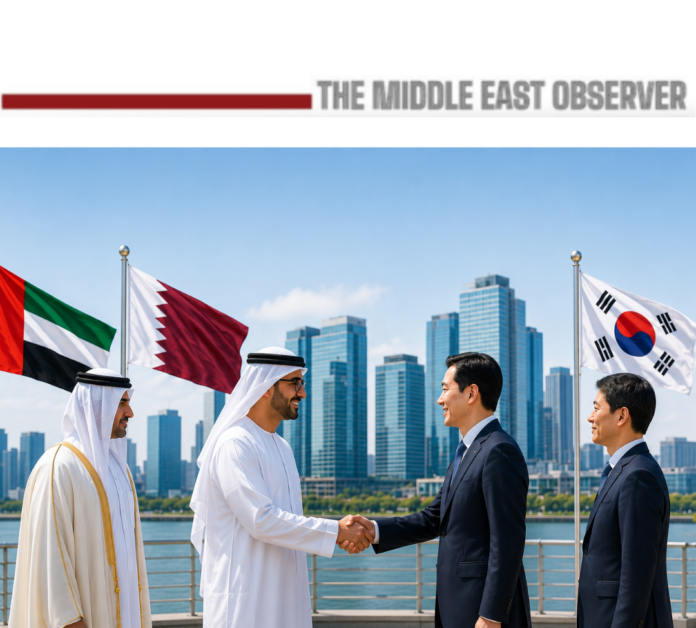
Gulf economies are accelerating their strategic pivot toward Asia, as the United Arab Emirates and Qatar expand trade and investment ties with South Korea through new agreements and high-level economic engagements, according to official statements and international media reports.
The UAE signed a Comprehensive Economic Partnership Agreement (CEPA) with South Korea, marking the first such trade pact between Seoul and a country in the Gulf Cooperation Council region. The agreement eliminates or reduces tariffs on more than 90% of traded goods, aiming to enhance market access, boost bilateral trade flows, and strengthen cooperation across key sectors including technology, logistics, and manufacturing.
Officials noted that non-oil trade between the UAE and South Korea reached approximately $6.9 billion in 2025, with expectations for significant growth following the agreement. UAE Minister of State for Foreign Trade Thani bin Ahmed Al Zeyoudi said the deal would open new opportunities for exporters and reinforce long-term economic collaboration.
The agreement comes amid broader geopolitical and supply chain shifts, with the UAE positioning itself as a central hub linking Asia with the Middle East and beyond. The move also follows the country’s evolving energy and trade strategy, reflecting a diversification drive beyond traditional oil frameworks.
In parallel, Qatar has intensified its own outreach to South Korea, with Minister of State for Foreign Trade Ahmed bin Mohammed Al Sayed leading a high-level delegation to Seoul. Discussions have focused on expanding cooperation in advanced sectors such as artificial intelligence, semiconductors, biotechnology, and advanced manufacturing, highlighting the growing scope of Gulf–Asia economic integration.
These developments underscore a broader regional effort to establish a structural trade corridor between the Gulf and Asia, driven by shifting global supply chains and the need for diversified economic partnerships.
As The Middle East Observer notes, the emerging Gulf–Asia trade axis reflects a strategic recalibration in global commerce, with the UAE and Qatar positioning themselves at the forefront of new trade routes that link energy, technology, and manufacturing flows between two of the world’s most dynamic economic regions.