
Egypt is preparing a national strategy for data centres and cloud computing as the government seeks to position the country as a regional hub for digital infrastructure, artificial intelligence and technology investment.
The initiative, launched under directives from President Abdel Fattah El-Sisi, brings together the Ministries of Communications and Information Technology, Electricity and Renewable Energy, and Investment and Foreign Trade to develop a unified framework for the sector.
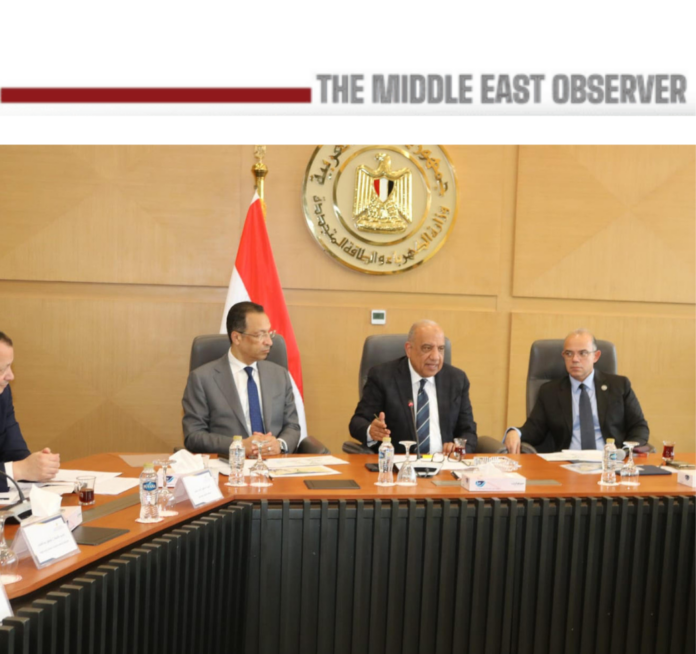
During a joint ministerial meeting in the New Administrative Capital, officials agreed to prepare an investment map identifying suitable locations for large-scale data centres, including details on power availability, renewable-energy resources, telecommunications infrastructure, incentives and regulatory procedures.
The strategy comes as global spending on AI infrastructure accelerates. Industry forecasts indicate that investment in data centres, cloud infrastructure and AI computing facilities is expected to reach hundreds of billions of dollars annually over the coming decade as technology companies race to deploy increasingly powerful artificial-intelligence models. The rapid expansion of generative AI applications is driving unprecedented demand for computing capacity, data storage and reliable power supplies, transforming data centres into one of the world’s fastest-growing infrastructure asset classes.
Renewable Energy at the Core of the Strategy
Electricity Minister Mahmoud Esmat said the strategy would leverage Egypt’s expanding renewable-energy capacity, with the country targeting renewables to account for 45% of its energy mix within the next two years. Long-term power agreements are also being considered to support energy-intensive data-centre and AI-computing operations.
Renewable energy is becoming a decisive factor in the global competition for hyperscale data-centre investments. Large AI facilities consume enormous amounts of electricity, prompting technology companies and cloud-service providers to prioritise locations that can offer abundant, reliable and competitively priced clean energy. Egypt’s renewable-energy expansion could therefore strengthen its attractiveness to investors seeking to meet sustainability commitments while maintaining competitive operating costs.
Building on Egypt’s Digital Infrastructure Advantages
Communications Minister Raafat Hindi described data centres as a cornerstone of Egypt’s digital sovereignty agenda, highlighting the country’s extensive submarine cable network and strategic location linking Europe, Asia and Africa. He added that expanding cloud-computing capacity would support digital exports and the localisation of advanced technologies.
The government’s initiative builds on a series of recent investments aimed at expanding Egypt’s digital infrastructure. Earlier this month, Hassan Allam Digital Infrastructure and Data Center Solutions signed a licence agreement with the National Telecommunications Regulatory Authority to establish and operate advanced data centres and cloud-computing services, with planned first-phase investments of approximately $400m. The project is expected to serve government entities, financial institutions and multinational companies while supporting growing demand for cloud-hosting services.
Investment Minister Mohamed Farid said Egypt’s commercial representation offices and the General Authority for Investment and Free Zones (GAFI) would spearhead an international promotion campaign targeting global technology companies, hyperscale operators and cloud-service providers.
Competition Intensifies for AI Infrastructure Investment
The initiative reflects intensifying competition among emerging and developed economies to attract hyperscale data-centre investments as demand for AI computing power accelerates worldwide. Countries including Saudi Arabia, the UAE, India and Malaysia are investing heavily in energy infrastructure, digital connectivity and regulatory frameworks designed to attract global technology companies and AI workloads.
For Egypt, the strategy seeks to combine renewable energy, extensive submarine cable connectivity and targeted investment incentives to secure a larger share of the rapidly expanding digital infrastructure market. The planned investment map, together with a national framework for data centres and cloud computing, is intended to simplify investment decisions and accelerate project implementation.
As artificial intelligence reshapes global demand for computing power, the ability to provide reliable energy, international connectivity and investment-friendly operating conditions is increasingly becoming a key determinant of economic competitiveness. Egypt’s latest initiative signals an ambition not only to host data centres, but to position itself at the centre of the emerging AI infrastructure economy connecting Africa, the Middle East and Europe.
Related news:
MCIT Backs $400 Million Data Centre Investment to Boost Digital Hub Ambitions
WE and AASTMT inaugurate Cybersecurity Innovation Lab in Smart Village
Read also:
AI’s New Arms Race Is Being Funded by Stock, Not Money
Fitch Sees Brent at $70 as Hormuz Reopening Reshapes Oil Outlook