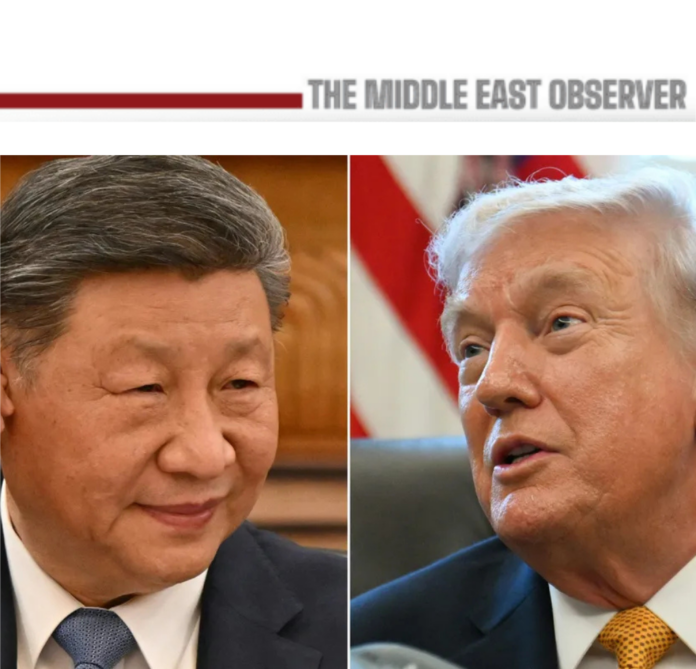
There is a widespread and oversimplified notion that the United States moves in the Middle East solely “driven by Israel’s interests”. This idea, despite its prevalence, overlooks a fundamental reality: Washington is a superpower with its own direct and distinct strategic agenda in confronting Iran. The United States is not merely fighting a proxy war; it views the Iranian regime as a direct threat to the pillars of its global influence. Yet the true dimensions of this hostility extend far beyond the narrow confines of regional conflict, converging with the unspoken great-power rivalry between Washington and Beijing over the future of the international order. At the heart of this confrontation, Iranian oil becomes not just an energy resource, but a geopolitical weapon par excellence, and an American tool to strangle China and break the backbone of its oil import-dependent economy.
First: Direct American Interests in Confronting Iran
Washington recognizes that Iran poses a threat to three fundamental pillars of its global strategy:
1- Control over Energy Sources and the Global Economy: Despite the United States becoming the world’s largest producer of oil and gas thanks to the shale revolution, its determination to control the rhythm of global oil markets has not diminished. Iran geographically controls the Strait of Hormuz, the strategic corridor through which approximately 20% of global oil supplies pass. Any threat to this strait would trigger a catastrophic spike in fuel prices, fueling inflation and striking the American and Western economies at their core. Thus, controlling Iran, or at least keeping it under constant pressure, is necessary to maintain energy market stability in America’s favor.
2. The Network of Regional Alliances and Military Bases: The United States maintains an extensive network of military bases and troops in the Gulf, Iraq, Syria, and Jordan. In contrast, Iranian pressures through what is known as the “Axis of Resistance” do not target Israel alone, but aim to expel American influence from the region. Attacks on American forces in Iraq and Syria are not merely acts of solidarity with the Palestinians; they are direct messages that touch American national security and the United States’ status as a dominant superpower. Any breach of American deterrence in the face of Iran’s “proxies” means the collapse of the superpower’s prestige, something Washington cannot overlook.
3. The Credibility of Deterrence and Preventing Nuclear Proliferation: The United States adheres to a consistent doctrine, regardless of the administration in power, that prevents the emergence of new nuclear powers in vital spheres of influence. There is no doubt that Iran acquiring a nuclear weapon would mean the collapse of the American deterrence system in the Middle East, and could push other regional states (such as Saudi Arabia and Turkey) toward nuclear pursuit, causing Washington to lose its ability to manage the game in the region. Here, American and Israeli interests converge on the goal of “weakening Tehran” and destroying its nuclear program, but Washington’s motives stem from calculations of global hegemony, while Israel’s motives arise from existential and direct local security concerns.
Second: The Hidden Conflict with China
The problem cannot be focused solely on the regional situation in the Middle East. There is another dimension concerning the undeclared international conflict between the United States and China, where Iran and Venezuela are merely secondary arenas in this global struggle. Here, the desire to strangle China intersects with complex American calculations. China is Washington’s greatest preoccupation. Given Beijing’s massive reliance on seaborne oil imports, particularly from Iran, this dependence constitutes a fundamental vulnerability of the Chinese economy. From a geopolitical perspective, American control over energy corridors, or the ability to choke Iranian exports, means Washington holds the keys to manipulating the Chinese economy in the event of a direct conflict-over Taiwan, for example, or over economic dominance in Asia. For this very reason, China rushed to sign a 25-year comprehensive strategic partnership agreement with Iran, and made Iran a key component of the Belt and Road Initiative, to ensure safe land and maritime routes away from American hegemony. Beijing understands that cheap Iranian oil is the lifeline of its industries, and that losing it under the pressure of American sanctions would be catastrophic for its economic growth.
In earlier periods, during the Iraq War for example, America sought direct control over oil flows or regime change to ensure oil flowed to Western companies. Today, however, the American strategy has shifted to “sanctions and deprivation.” The US seeks to prevent Iran from monetizing its oil and converting it into political leverage, and to prevent China from acquiring it at preferential prices outside the dollar-dominated global financial system. Furthermore, Washington is bent on enforcing the petrodollar, precisely as Tehran and Beijing work together to replace it with the petro Yuan- an existential threat to America’s monetary hegemony, and a key hidden driver behind the escalation and sanction regime. Washington recognizes that controlling Iran in a way that completely subordinates China is a nearly impossible military and economic task. Iran is not an isolated island; any American attempt at violent control over energy sources there could lead to the complete destruction of oil facilities across the Gulf, and the closure of the Strait of Hormuz, harming America’s allies (like Japan, South Korea, and Europe) before hurting China, which possesses massive reserves and overland routes with Russia and Central Asia. Hence, Washington resorts to what can be called “oil bullying” in multiple forms.
There are documented public statements by President Trump regarding America’s pursuit of seizing Iranian oil. Trump explicitly stated that American forces were “pulling millions of barrels of Iranian oil” at night via tankers, boasting that Tehran itself was initially unaware, and previously threatened to impose “complete control” over Iran’s oil and gas infrastructure, such as Kharg Island. These direct statements reveal that the line between “geopolitical sanctions” and “crude physical control” completely dissolves when military confrontations escalate. This strategy is not new, but recurs in different forms. Previously, Trump famously stated regarding Iraq that America’s biggest mistake was that it “didn’t take the oil” to cover the war costs. Practically, for a long time, America did not loot Iraqi oil in the traditional sense, but rather placed its revenues under the custody of the Federal Reserve Bank of New York, granting Washington a financial tool to control Iraqi political and economic decision-making. In Syria, the famous American phrase “We’re keeping the oil” was a clear declaration of control over oil fields east of the Euphrates to deprive the Syrian regime of them. In Venezuela, sanctions and the seizure of foreign assets of the state oil company were used to subdue the Caracas regime.
The bottom line is that Washington uses “oil bullying” (whether through direct confiscation, military control over corridors, or depriving others of sales) as a tool to manage the global economy. It does not loot to consume, but controls to determine the fate of countries dependent on this oil, chief among them China. Nonetheless, “smuggled” and “cheap” Iraqi, Syrian, and Venezuelan oil finds its way into American hands- backed by intelligence agencies- to fund special operations and keep the region in a state of permanent flux.
Third: The Domestic Dimension
The picture would not be complete without examining the internal influences within the United States itself. The conflict with Iran is not merely a chess game between diplomats and strategists at the Pentagon; it is also a fertile ground for massive commercial interests with long arms in Washington. The American oil lobby, represented by major energy companies such as ExxonMobil and Chevron, is not only concerned with rising oil prices but with “stabilizing a financial system” that ensures oil continues to be priced in dollars and keeps major competitors (like Iran, Russia, and China) out of the supply-control equation. Maintaining tightened sanctions means depriving Iran of the liquidity it would have used to develop its own oil sector, keeping Iranian oil off global markets and ensuring American companies retain the upper hand in pricing crude. This explains the American administration’s hesitation regarding the release of frozen Iranian assets. As for the military-industrial lobby—represented by the Pentagon and weapons manufacturers, led by Lockheed Martin and Raytheon- it sees in the constant tension with Iran a golden opportunity to justify astronomical military budgets, and renew arms contracts with regional allies (such as Saudi Arabia, the UAE, and Israel), which generate billions of dollars annually. The more heated the rhetoric around the “Iranian threat”, the easier it becomes for these companies to push Congress to approve new weapons deals and develop advanced defense systems to counter Iranian missiles and drones. Perhaps the recent escalation between the United States and Iran during and after the Supreme Leader’s funeral was primarily aimed at pressuring Gulf states to accept a new protection equation at a staggering cost. It is self-evident that the United States knew that any attempt to alter tanker routes in the Arabian Gulf would be met with resistance from Iran, which would consider it a breach of the agreement between the two parties. It is also self-evident that it knew that bombing sites in Iran would be met with strikes on bases and sites in the Gulf. Perhaps decision-makers in Washington believe the time may be right to force Gulf states into a new equation where they bear massive budgets in exchange for protection—which would effectively consist of ceasing the bombardment of Iran. Thus, American foreign policy is not merely a response to objective threats, but also feeds on a “war economy” that thrives under polarization and tension. This partially explains the apparent contradiction in American behavior: while Washington declares its pursuit of negotiations with Tehran, we simultaneously see it tightening sanctions, reinforcing its military presence, violating the framework agreement, and bombing Iran—not only to pressure the Iranian regime, but also to satisfy domestic pressure groups that wield significant influence in decision-making and reap enormous profits from the continuation of the crisis, not from its resolution.
In sum, it can be said that Iranian oil has transformed from a mere energy resource into a central tool in the American-Chinese struggle for global hegemony. The United States, which no longer urgently needs Gulf oil for domestic consumption, uses its control over the global financial system, its military bases, and its sanctions network as means to deprive China of its most vital oil lifeline, while simultaneously ensuring the dollar remains the sole pricing currency for oil, thereby preserving the throne of American economic hegemony. But this game is not without risks. Excessive escalation could lead to the closure of the Strait of Hormuz, the collapse of global energy markets, and force China and Russia to accelerate the development of financial and oil alternatives outside the dollar—the very scenario Washington fears most. Nevertheless, Iran remains Washington’s most effective leverage card against China, and Iranian oil is the weapon quietly used behind the scenes to strangle America’s strongest competitor for a new world order.
At the same time, global strategic interests intersect with the domestic commercial interests of oil and military lobbies to form the true engine of American policy in the Middle East. It is a struggle over who holds the safety valve of the global economy, and throughout this conflict, Iranian oil remains the spark that may ignite- or extinguish- the century’s battle between Washington and Beijing.
Related news:
Read also: