
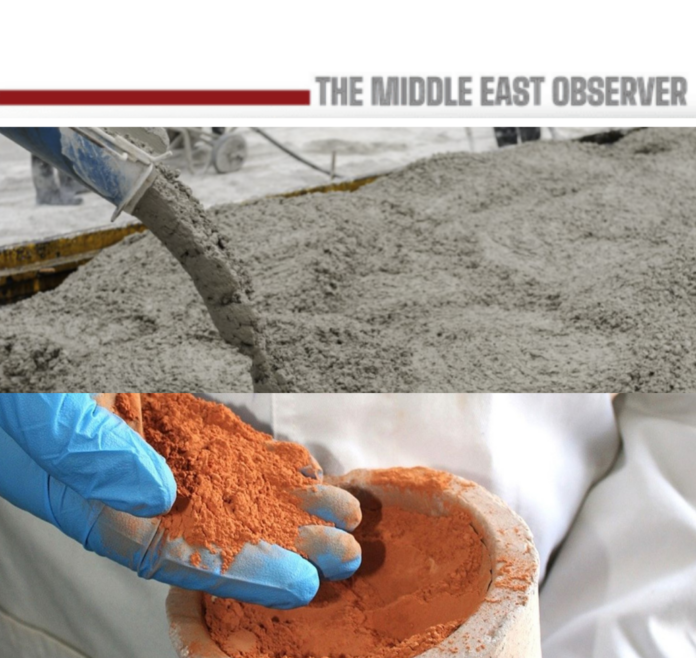
Decarbonisation took another step forward in the global cement industry this week after French green-construction materials producer Hoffmann Green Cement Technologies launched H-CLAY, a new technology that enables clay to be processed without calcination and incorporated into 0%-clinker cement formulations.
The innovation arrives at a pivotal moment for the construction sector. Cement production accounts for an estimated 7-8% of global carbon dioxide emissions, making it one of the world’s most difficult industries to decarbonise. At the same time, tightening environmental regulations, rising carbon costs and growing demand for sustainable infrastructure are increasing pressure on manufacturers to find alternatives to traditional cement production methods.
Hoffmann Green says H-CLAY allows various types of clay to be transformed into a cement co-product through a cold-processing technique that avoids the high-temperature calcination process traditionally required to produce clinker, the most carbon-intensive component of conventional cement.
Tackling Cement’s Largest Carbon Source
For more than a century, cement production has relied on clinker manufactured in kilns operating at temperatures above 1,400°C. The process generates substantial carbon emissions both from fuel consumption and from the chemical transformation of limestone during production.
Many producers have attempted to reduce emissions through supplementary cementitious materials such as blast-furnace slag, fly ash and calcined clay. However, supplies of some of these materials are becoming increasingly constrained as industrial processes evolve and coal-fired power generation declines.
H-CLAY seeks to address this challenge by creating a new pathway for utilising abundant clay resources without calcination or flash-calcination, potentially reducing both energy consumption and emissions.
According to co-founders Julien Blanchard and David Hoffmann, the technology represents the latest stage in the company’s strategy of commercialising high-performance clinker-free cement capable of meeting mainstream construction requirements while significantly lowering carbon footprints.
European Climate Rules Accelerate Innovation
The launch also reflects growing regulatory pressure across Europe.
The European Union’s Green Deal, Carbon Border Adjustment Mechanism (CBAM) and increasingly stringent embodied-carbon requirements for buildings are pushing cement producers to reduce emissions across their value chains. As carbon pricing expands and environmental standards tighten, low-carbon materials are becoming a competitive necessity rather than a niche market segment.
Hoffmann Green has positioned itself among Europe’s pioneers in clinker-free cement production, operating industrial facilities in western France and developing technologies aimed at eliminating clinker entirely rather than simply reducing its proportion within cement formulations.
The company’s approach differs from many industry strategies that focus primarily on carbon capture and storage. Instead, it seeks to remove emissions at the production stage by redesigning the cement formula itself.
A Global Race for Low-Carbon Cement
Hoffmann Green’s announcement comes amid intensifying competition across the global cement industry.
Major producers including Holcim, Heidelberg Materials and Cemex are investing heavily in alternative binders, carbon-capture technologies, recycled materials and lower-clinker cement formulations. Meanwhile, initiatives such as Limestone Calcined Clay Cement (LC3) are gaining traction as cost-effective pathways to reducing emissions in emerging markets.
The emergence of multiple competing technologies reflects the scale of the challenge facing an industry responsible for producing more than four billion tonnes of cement annually. No single solution is expected to dominate, increasing the importance of innovations that can be deployed across different geographies and raw-material environments.
Emerging Markets May Be the Biggest Winners
Perhaps the most overlooked opportunity lies outside Europe.
Regions such as the Middle East, Africa, India and Southeast Asia account for a growing share of global infrastructure spending while also possessing abundant clay resources that could potentially support local production of lower-carbon cement.
For countries including Egypt, Saudi Arabia, Morocco and the UAE, where governments are investing heavily in housing, transport networks, industrial zones and renewable-energy projects, cold-processed clay technologies could reduce reliance on imported supplementary materials while helping meet increasingly ambitious sustainability targets.
The economic implications are significant. Lower-carbon cement could help developers manage future carbon costs, support compliance with green-building standards and enhance the competitiveness of domestic construction-material industries.
As infrastructure investment accelerates across emerging economies, the ability to produce clinker-free cement using locally available resources may prove as strategically important as the technology itself.
The broader significance of H-CLAY therefore extends beyond a single product launch. It highlights how the future of cement may increasingly depend not on capturing carbon after production, but on redesigning the manufacturing process to avoid generating those emissions in the first place.
Related news:
AI-Driven Concrete: Revolutionizing Roads and Reducing Carbon Footprint
Innovative Partnership Paves Way for Low-Carbon Concrete Production in Saudi Arabia
Read also:
Alkan Joins Egypt’s Drive to Build a Regional Auto Hub
Scenic Eyes Egypt’s Water Tourism Expansion Amid Luxury Cruise Push
