
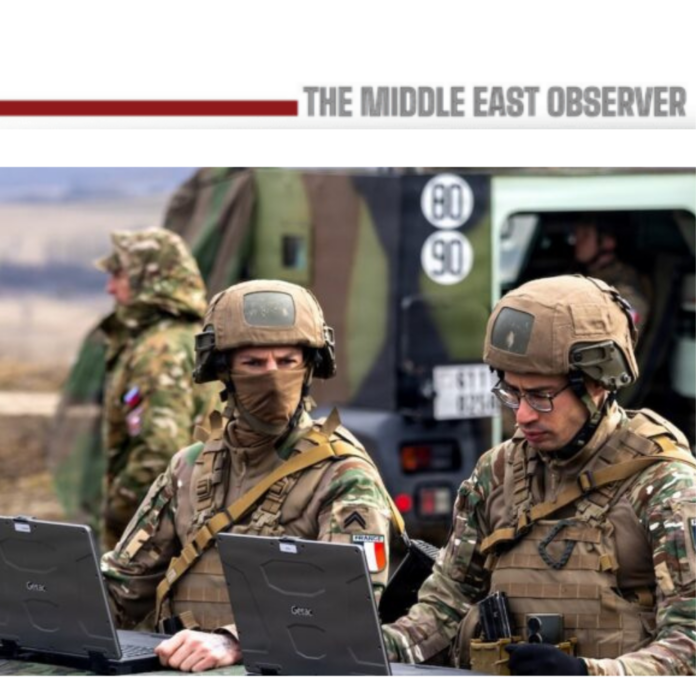
Technological sovereignty moved from policy ambition to battlefield testing this week as France began deploying Arcadia, a European-developed artificial intelligence command-and-control platform, during a major NATO interoperability exercise in Poland.
The system, developed by a consortium of leading French technology and defence companies including Mistral AI, Safran, Thales and Airbus, is being positioned as Europe’s answer to Maven, the AI-enabled battlefield platform developed by US defence technology company Palantir and increasingly used across NATO operations.
Arcadia’s debut comes amid growing concerns among European governments about dependence on non-European defence technologies. While the transatlantic alliance remains central to European security, policymakers across the continent are increasingly seeking greater control over critical digital infrastructure, military data and next-generation defence technologies.
From Battlefield AI to Strategic Autonomy
The NATO Coalition Warrior Interoperability Exercise, running in Poland from 8 to 26 June, marks Arcadia’s most significant operational test to date.
AI-enabled battlefield systems are designed to process vast volumes of intelligence, surveillance and operational data, helping military commanders identify targets, coordinate forces and make decisions more rapidly in complex combat environments.
NATO adopted Maven Smart System in 2025, building on the Pentagon’s Project Maven initiative. The platform quickly demonstrated the growing role artificial intelligence is expected to play in future military operations.
However, Arcadia’s emergence reflects a broader debate taking place across Europe. Rather than focusing solely on military capability, governments are increasingly questioning who controls the underlying algorithms, data infrastructure and operational systems that modern armed forces rely upon.
French military officials have openly framed Arcadia as a strategic alternative rather than simply another technology platform. According to General Patrick Justel, deputy chief of staff of the French Army, the objective is to ensure European countries have meaningful choices in critical defence technologies rather than relying exclusively on external providers.
Europe’s Expanding Defence-Tech Market
Arcadia‘s launch also comes as Europe enters one of the largest defence modernisation cycles in decades.
Since Russia’s invasion of Ukraine, European governments have sharply increased military spending, with NATO members committing hundreds of billions of euros to modernise armed forces, strengthen deterrence capabilities and develop advanced digital warfare systems. Artificial intelligence, battlefield networking, autonomous systems and military cloud infrastructure are increasingly becoming core elements of defence procurement strategies.
For European policymakers, Arcadia therefore represents more than a battlefield tool. It is part of a wider effort to capture a greater share of future defence-technology spending and build a sovereign defence-tech ecosystem capable of competing with American and Chinese platforms.
A Wider European Shift Away from Dependency
France is not alone in reassessing technological dependencies.
The Netherlands has publicly stated its objective of developing a fully fledged alternative to Palantir-supported systems within two years, while Germany has signalled reluctance to expand reliance on external providers for sensitive defence databases and military data-management systems.
These concerns extend beyond defence procurement. They reflect a wider European movement that has emerged across artificial intelligence, cloud computing, semiconductors and cybersecurity, where governments increasingly view technological capabilities as strategic assets comparable to energy security or industrial capacity.
The significance of Arcadia therefore lies not only in its military applications but also in its symbolism. It represents one of the clearest examples yet of Europe’s effort to build sovereign AI capabilities in sectors where dependence on foreign technology is increasingly viewed as a strategic vulnerability.
Building Europe’s Defence AI Ecosystem
Perhaps the most overlooked aspect of Arcadia is its industrial significance.
The platform forms part of a broader effort to establish a European defence-technology stack encompassing artificial intelligence, secure cloud infrastructure, battlefield software, cyber defence, advanced sensors and military communications networks. Rather than focusing on a single application, policymakers increasingly seek to create an ecosystem capable of developing, controlling and securing the digital technologies that will define future warfare.
Europe’s defence technology sector has historically been fragmented, with national champions often operating independently. The development of AI-powered command platforms creates opportunities for deeper collaboration between software developers, aerospace manufacturers, cybersecurity firms and defence contractors across the continent.
Companies such as Mistral AI, which has emerged as one of Europe’s most prominent artificial intelligence firms, could benefit from growing government efforts to establish domestic alternatives to US technology providers. Defence applications may also accelerate investment in edge computing, secure communications, autonomous systems and battlefield networking.
Arcadia’s decentralised architecture reflects this strategic thinking. Unlike more centralised systems, it connects command centres through distributed networks capable of continuing operations even when parts of the communications infrastructure are disrupted. French officials argue that such resilience could prove increasingly important in future conflicts where cyberattacks, electronic warfare and communications disruption become central elements of military strategy.
For Europe, the challenge extends beyond creating an alternative to a single platform. The broader objective is to ensure that the continent retains control over the software, data and computational capabilities that will increasingly determine military effectiveness in the age of artificial intelligence.
As warfare becomes more data-driven, the competition among nations may increasingly revolve not around tanks and aircraft alone, but around algorithms, computing power and digital infrastructure. Arcadia’s battlefield debut suggests Europe intends to play a far larger role in that contest.
Related news:
AI Warfare Is Rewriting the Logic of Military Power
Google DeepMind Staff Push Unionization Over Military AI Concerns
Read also:
Archaeologists Uncover an Industrial Hub in the Heart of Sinai
Oman’s Economic Upswing Deepens as Duqm Emerges as Regional Investment Magnet