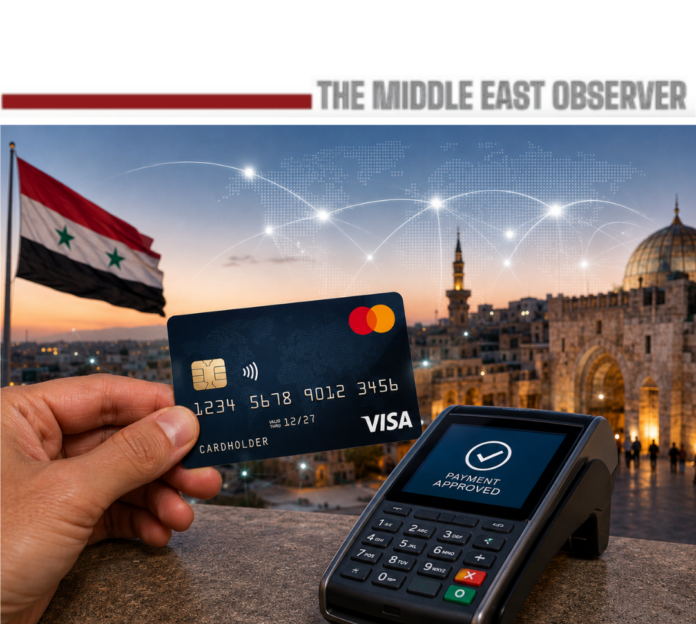
Syria is witnessing a cautious expansion of electronic payment services after the Central Bank of Syria authorized local financial institutions and payment companies to reconnect with global card networks including Visa and Mastercard for the first time in more than 15 years. The move comes amid broader efforts to modernise Syria’s financial infrastructure and reconnect the country with international banking and commercial systems following years of sanctions and economic isolation.
The development also coincides with the European Union’s recent decision to ease selected sanctions imposed on Syria, particularly restrictions affecting banking channels, transport, energy cooperation, and commercial activity. European officials stated that the measures are intended to support economic stabilisation, humanitarian recovery, and Syria’s phased reintegration into regional financial systems, while maintaining targeted restrictions on designated individuals and entities. The easing of sanctions is increasingly viewed as a key factor enabling international payment networks and regional financial institutions to cautiously re-enter the Syrian market.
Recent reports confirmed that Syria successfully conducted initial trial electronic payment transactions through Visa and Mastercard networks during May 2026, while regional and local payment providers have begun expanding merchant payment systems, card services, and digital transaction capabilities across the country.
The reopening of Syria’s electronic payment ecosystem is expected to support retail commerce, tourism, remittances, and cross-border business activity by reducing reliance on cash transactions and improving transaction efficiency for businesses and consumers. Officials stated that the reforms aim to facilitate payments for Syrians abroad, foreign visitors, humanitarian organisations, importers, airlines, and companies seeking to operate within the Syrian market. Qatar National Bank has already launched international card acceptance services inside Syria, while local firms including Paymera and Bimera are integrating QR payment systems, point-of-sale infrastructure, and digital wallet services linked to global networks.
Analysts note that the return of global payment providers could gradually improve liquidity circulation, strengthen formal banking activity, and encourage segments of the informal cash economy to shift toward regulated financial channels. The easing of European sanctions may further accelerate foreign commercial engagement, remittance flows, tourism activity, and regional investment interest if additional banking restrictions continue to soften over the coming months.
However, specialists caution that Syria’s financial recovery will likely remain measured due to infrastructure challenges, banking sector constraints, weak consumer purchasing power, and the continued presence of compliance risks associated with remaining international sanctions frameworks.
As The Middle East Observer notes, the re-entry of Visa, Mastercard, and digital payment providers into Syria represents more than a technological upgrade, signaling an early indicator of wider financial reintegration efforts that could reshape retail commerce, remittance flows, and private-sector activity. Combined with the European Union’s sanctions easing measures, the developments may mark the beginning of a broader reopening phase for Syria’s financial and commercial economy after years of isolation from global payment and banking systems.