
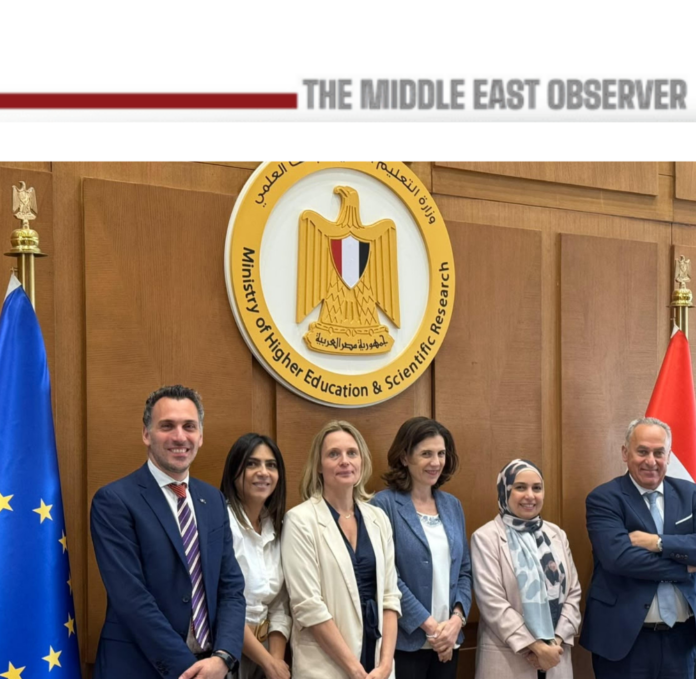
Egypt’s recent launch of a dedicated national initiative to support participation in the European Union’s Horizon Europe programme marks a significant shift in the country’s innovation strategy. Rather than focusing solely on academic research, the initiative aims to help Egyptian companies, startups and research institutions compete for a share of the €14 billion available under the 2026–2027 Horizon Europe Work Programme—one of the world’s largest public funding programmes for research and innovation.
Importantly, the €14 billion is not a funding package allocated to Egypt. Instead, it represents the total budget available through competitive European funding calls open to eligible organisations across EU Member States and Associated Countries, including Egypt. The government’s new initiative is therefore designed to improve the ability of Egyptian organisations to compete successfully for those opportunities rather than providing direct financial support.
Why Europe funds Egyptian companies
Horizon Europe is built on the principle that many of today’s technological and societal challenges—including climate change, clean energy, digital transformation, healthcare, food security and advanced manufacturing—cannot be solved by one country alone. As an Associated Country to Horizon Europe, Egypt participates in many parts of the programme on terms broadly comparable to EU member states, enabling Egyptian organisations to contribute specialised expertise while becoming part of European research, industrial and innovation networks.
For Egyptian businesses, the programme offers considerably more than grant funding. It provides access to European partners, advanced technologies, international supply chains and long-term commercial relationships that can accelerate innovation and open new export markets.
What projects are funded?
Although Horizon Europe is widely associated with scientific research, the programme supports the entire innovation cycle—from laboratory research and prototype development to pilot production, demonstration projects and commercial deployment.
Priority sectors include artificial intelligence, digital technologies, advanced manufacturing, renewable energy, hydrogen, climate technologies, healthcare, biotechnology, agriculture, food systems, mobility, cybersecurity and space technologies.
Certain funding instruments also provide equity investment alongside grants, particularly for innovative startups seeking to commercialise breakthrough technologies and expand internationally.
Who can apply?
Participation extends well beyond universities. Eligible applicants include startups, small and medium-sized enterprises (SMEs), large corporations, research institutes, universities, technology centres, business incubators and innovation organisations.
Individuals generally do not apply independently. Instead, researchers and innovators participate through their employer, university, research institute or company, although a limited number of specialised European fellowships support individual researchers through host institutions.
How companies compete
For most Horizon Europe calls, companies do not submit applications independently. Instead, they join multinational consortia, typically bringing together at least three independent organisations from three eligible countries, including at least one European Union member state.
A consortium might include a French research institute, a German industrial manufacturer and an Egyptian artificial intelligence company, with each organisation contributing complementary expertise to a shared innovation project. This collaborative model encourages technology transfer, reduces development risks and strengthens the commercial potential of new products.
The process generally follows six stages:
- Identify a funding call aligned with the company’s technology or business strategy.
- Build an international consortium by partnering with European companies, universities or research organisations through brokerage events, innovation networks or existing commercial relationships.
- Develop a joint proposal detailing the project’s technical objectives, expected commercial impact, implementation plan, budget and long-term market potential.
- Submit the application electronically through the European Commission’s Funding and Tenders Portal, normally via the consortium coordinator.
- Undergo independent evaluation, where international experts assess proposals against three principal criteria: scientific and technological excellence, expected economic and societal impact, and the quality of project implementation.
- Implement the project following grant approval in collaboration with consortium partners.
Competition is rigorous. Depending on the funding call, only a relatively small proportion of proposals are selected for funding, making strong international partnerships, clear commercial strategies and robust technical proposals essential to success.
Opportunities beyond consortia
Not every programme requires multinational partnerships. The European Innovation Council (EIC) Accelerator allows highly innovative startups and SMEs developing breakthrough technologies to apply independently for a combination of grants and equity investment, providing a direct route to commercialisation for companies with strong growth potential.
Egypt’s strategic opportunity
The significance of Egypt’s new initiative extends well beyond helping companies prepare grant applications. It establishes, for the first time, a dedicated national support mechanism focused on proposal development, partner matchmaking, awareness programmes and technical capacity-building for private-sector applicants.
More importantly, it signals a broader policy shift from supporting research alone towards commercial innovation, technology transfer and industrial competitiveness. Egyptian companies are being encouraged not only to secure European funding, but also to become active participants in international research partnerships, advanced manufacturing networks and high-value technology supply chains.
For Egyptian businesses, Horizon Europe should therefore be viewed as far more than a source of grants. It is a gateway into Europe’s innovation ecosystem, where multinational companies, startups, universities and investors collaborate to develop the next generation of technologies. Success will ultimately be measured not only by the funding secured, but by the international partnerships, technological capabilities and export opportunities those collaborations create—helping position Egyptian companies within some of the world’s most advanced innovation and industrial networks.
Related news:
Communications and Investment Ministers sign protocol to expand Egypt’s technology export incentives
El-Sisi Advances Human Capital Strategy Through Health, Education, Research and Innovation
Read also:
QIA and Spain Launch $327m Fund to Back Technology and Green Transition
The Fragile Truce in Lebanon: Between Entrenching the Occupation and Resistance
