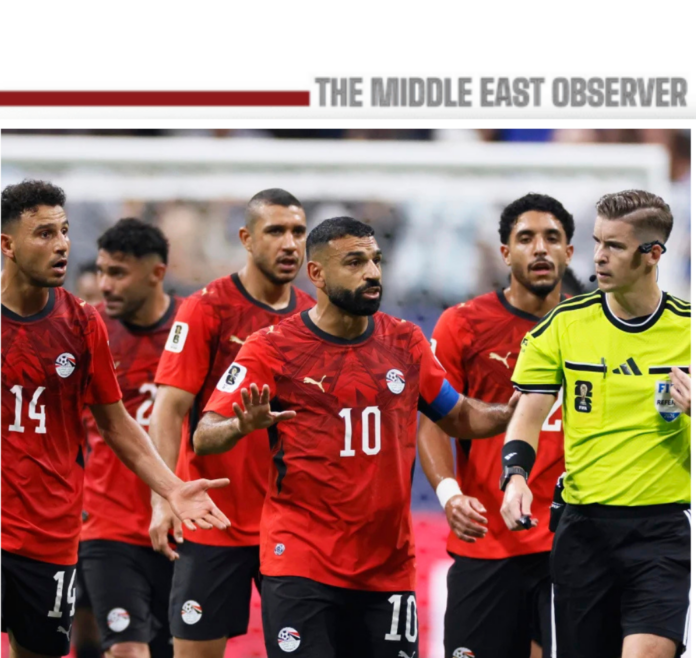
The dramatic FIFA World Cup Round of 16 encounter between Argentina and Egypt has become far more than just a football match. Argentina’s comeback from two goals down to secure a 3-2 victory has ignited one of the tournament’s fiercest debates, with criticism extending well beyond Egypt to encompass international media, former players, public figures, and millions of supporters questioning the consistency of refereeing and the application of Video Assistant Referee (VAR) technology.
While allegations that FIFA has deliberately favoured defending champions Argentina and Lionel Messi remain the central focus of public debate. The controversy has nevertheless exposed growing concerns over transparency, officiating consistency, and public confidence in football’s governing body.
Egypt appeared on course for one of the greatest upsets in World Cup history after establishing a 2-0 lead before Argentina mounted a late comeback with three goals in the closing stages.
The initial controversy arose while Egypt was leading the match, as multiple fouls were committed by Argentine players without any yellow cards being shown. The situation escalated to incidents of off-the-ball slapping, reportedly caught on camera, yet disregarded by both VAR and the referee. For many viewers, these incidents reinforced perceptions of favouritism towards the Argentine team and fuelled global concerns over the consistency of officiating.
However, the match was quickly overshadowed by three contentious officiating decisions.
The first case came when Mostafa Zico appeared to double Egypt’s advantage, only for VAR to intervene and identify an earlier foul during the attacking build-up, well before the final phase of the move, resulting in the goal being disallowed after a thorough VAR review that traced the sequence back to the earlier infringement.
The second case occurred when Egypt appealed for a penalty after Mohamed Salah went to ground inside the penalty area. The referee allowed play to continue, and VAR did not recommend an on-field review.
The third case involved an apparent foul by Alexis Mac Allister in the immediate build-up to Enzo Fernández’s stoppage-time winner. The attack that followed allowed Enzo Fernández to score Argentina’s third goal.
Critics argued that the decision to cancel Egypt’s goal contrasted sharply with the Salah penalty appeal. They contended that, had the two incidents been treated with equal scrutiny and Salah subsequently scored, the outcome could have shifted in Egypt’s favour.
Those decisions prompted furious protests from Egypt’s players and coaching staff, culminating in several yellow cards before and after the final whistle.
Egypt coach Hossam Hassan said his team was the victim of an “injustice” in its 3-2 World Cup Round of 16 defeat against Argentina, stating: “We haven’t seen respect or fair play. A penalty was ruled out. It was not even checked by VAR, and our second goal was, for whatever reason, disallowed.
“I want to put it in beautiful words and say, ‘Hard luck,’ but we have been treated unfairly and it has been an injustice.”
Shortly after Hassan’s statement, the Egyptian Football Association filed a formal complaint with FIFA following its controversial World Cup exit to Argentina, stating:
“The Egyptian Football Association cannot remain silent regarding the refereeing decisions witnessed during the match against Argentina, as well as the failure to make appropriate use of the video assistant referee system.
Several key incidents raised serious concerns and left profound questions about the consistency and fairness of decisions that directly influenced the course of the game.
A number of football experts and specialist analysts, both locally and internationally, have highlighted controversial and influential refereeing incidents during the match. This underlines the importance of maintaining the highest standards of integrity, fairness, and transparency in match officiating, particularly in a competition of the stature and significance of the World Cup.
The statement continued:
“Egyptian football has always respected the principles of fair play, sporting integrity, and respect for the game. These same principles require that all teams compete on equal terms and receive equal treatment. What occurred during the match has understandably generated widespread frustration among our players, staff, and supporters, who expected the highest standards of officiating on football’s biggest stage.
Defending the rights and interests of the Egyptian national team is not a matter that can be ignored, minimised, or treated as secondary. It is a responsibility that we carry with full conviction and determination. Every player who wears the Egyptian shirt, and every supporter who stands behind the team, deserves fairness, respect, and equal application of the Laws of the Game.”
For critics, the Egypt match represents the latest chapter in what they believe is a pattern of decisions favouring Argentina throughout the tournament. Their arguments generally centre on several recurring themes, including inconsistent VAR interventions. Critics argue that VAR intervened aggressively to overturn Egypt’s second goal but remained silent during incidents benefiting Argentina. They contend that identical or comparable incidents were treated differently, undermining the principle that VAR should apply the Laws of the Game consistently, regardless of the teams involved.
Attention has also returned to Argentina’s opening match, during which Lionel Messi avoided disciplinary action after an incident involving Algeria’s Aissa Mandi. Several television pundits argued that the challenge merited a red card, contrasting it with harsher punishments issued elsewhere in the tournament for similar offences.
Statistics have further fuelled the debate. Among the quarter-finalists, Argentina accumulated relatively few yellow cards despite ranking among the teams committing a comparatively high number of fouls, leading critics to question whether referees had adopted a more lenient disciplinary approach.
Additional criticism followed comments by FIFA President Gianni Infantino, who remarked that he had “suffered” while watching Argentina before clarifying that he had been speaking as a neutral football supporter. Although seemingly innocuous, critics argued that such comments were inappropriate given FIFA’s responsibility to maintain strict neutrality.
Questions were also raised regarding FIFA’s appointment of Argentine officials to oversee other knockout fixtures involving potential future Argentine opponents. Although referee appointments are made through established FIFA procedures, social media users interpreted the decision as further evidence supporting broader suspicions.
Yet, none of these episodes has produced any influence over the tournament’s progress. Nevertheless, critics argue that the incidents are likely to shape public perceptions for years to come.
Former England captain Alan Shearer was among the first prominent figures to question the consistency of the officiating. He argued that football cannot operate under two different standards within the same match. If one incident warrants an extensive VAR review, comparable incidents should receive the same scrutiny regardless of which team benefits. His criticism was directed less at individual decisions than at the apparent inconsistency in applying the same principles throughout the game.
The world’s opinions about (Egypt and Argentina)’s match:
Former Arsenal and England striker Ian Wright voiced similar concerns. He questioned why Egypt’s disallowed goal was subjected to such exhaustive examination while later Egyptian appeals appeared to receive considerably less attention. Supporters, he suggested, can accept difficult refereeing decisions; what they struggle to accept is inconsistency. At the highest level of the game, confidence depends not only on getting decisions right but also on applying the Laws of the Game equally.
Jamie Carragher also questioned the decision to overturn Egypt’s goal, arguing that comparable contact would rarely lead to a goal being disallowed in Europe’s leading domestic competitions. His comments reflected a wider concern that the threshold for VAR intervention appeared significantly higher when decisions favoured Argentina, reinforcing perceptions of inconsistency rather than transparency.
Former England goalkeeper Rob Green raised broader questions about the purpose of VAR itself. In his view, the technology was introduced to correct clear and obvious errors—not to invalidate goals because of marginal contact occurring well before the finish. When football becomes dominated by microscopic technical interpretations, he argued, supporters inevitably begin to lose confidence in both the referee and the technology designed to assist officials.
The controversy expanded beyond football when former World Chess Champion Garry Kasparov publicly criticised FIFA.
Kasparov described the Egypt match as evidence of what he called a “corrupt conspiracy to protect Messi”, arguing that identical incidents received entirely different VAR treatment. He maintained that supporters did not have to support VAR itself to demand that its application remain transparent and consistent. His intervention illustrated how the debate has transcended sport to become a wider discussion about governance, institutional credibility, and public trust.
Furthermore, New York City Mayor Zohran Mamdani attracted international attention when he publicly declared that “Egypt was robbed.”, the remark illustrated how rapidly the controversy had moved beyond the sporting arena into wider public debate. It also reflected the frustration expressed by many neutral observers who believed Egypt had not been treated equally during the decisive moments of the match.
Other newspapers and broadcasters described the match as one of the tournament’s most controversial fixtures, arguing that it had intensified longstanding questions about consistency, transparency, and accountability in the application of VAR. While opinions differed on specific decisions, many commentators agreed that FIFA now faces a growing challenge in convincing supporters that officiating standards are being applied uniformly in football’s biggest matches
FIFA has rejected allegations of bias and defended both the referee and the VAR officials, maintaining that every decision was made in accordance with the Laws of the Game. That position deserves to be acknowledged. At the same time, the scale of the international reaction suggests that public confidence cannot be restored through official assurances alone. FIFA’s leadership must also recognize that restoring public trust requires more than defending contentious decisions. It demands openness, institutional responsibility, and a willingness to demonstrate that no official—and no decision—is beyond scrutiny.
Despite the intensity of public reaction, independent analyses recognise that Egypt had legitimate grievances regarding several refereeing decisions, while others argue that, even had those decisions been different, the tactical substitutions Egypt required may have been stronger in defence than in attack. Some analysts also contend that, had Egypt’s second goal stood to establish a 3-0 lead, the psychological and tactical dynamics of the match could have changed significantly. They argue that such an advantage might have boosted Egypt’s confidence, altered Argentina’s approach, and potentially produced a different outcome.
Whether or not one agrees with Egypt’s complaints, the controversy highlights a broader issue confronting modern football. VAR was introduced to increase confidence in officiating by reducing obvious errors. Instead, its selective intervention has increasingly become a source of controversy, with supporters questioning why seemingly similar incidents receive different treatment. The resulting perception gap may ultimately prove as damaging as any individual refereeing decision. In elite sport, maintaining trust requires not only fairness but also the appearance of fairness.
As the tournament progresses, FIFA faces an increasingly important communications challenge. Rather than merely defending refereeing decisions, football’s governing body may need to improve transparency surrounding VAR protocols, referee communications, and post-match explanations. Several domestic competitions have already begun experimenting with greater openness, including the public release of VAR audio and enhanced referee briefings.
Regardless of whether Argentina ultimately retains the World Cup, the debate surrounding the Egypt match demonstrates that technological innovation alone cannot eliminate controversy. In the absence of clear, transparent, and consistently applied decision-making, every contentious incident risks becoming fertile ground for speculation.
For now, the widespread reaction illustrates a deeper reality: preserving confidence in the integrity of competition is becoming almost as important as the competition itself.
As for Egypt, captain Mohamed Salah entered the locker room, gathered all the players, and spoke with them. He said: “Hard luck, it’s over. It’s God’s decree, and what He willed has happened regarding what took place. Let’s build on this, and what’s coming will be good, God willing.”
The Egyptian team is scheduled to return to Egypt on Friday, where they are expected to be welcomed by President Abdel Fattah El-Sisi and supporters in recognition of their performance. Regardless of the result, the match is likely to remain one of the most debated fixtures in World Cup history.
Related news:
Egypt’s World Cup Awakening: Why One Victory Means Far More Than Three Points
Egypt Earns Global Respect After Holding Belgium in World Cup Opener
Read also:
NATO Ankara Summit Strengthens Collective Defence as Allies Accelerate Military Modernisation
France Returns to Syria with Broad Reconstruction Pact and Strategic Investment Agreements