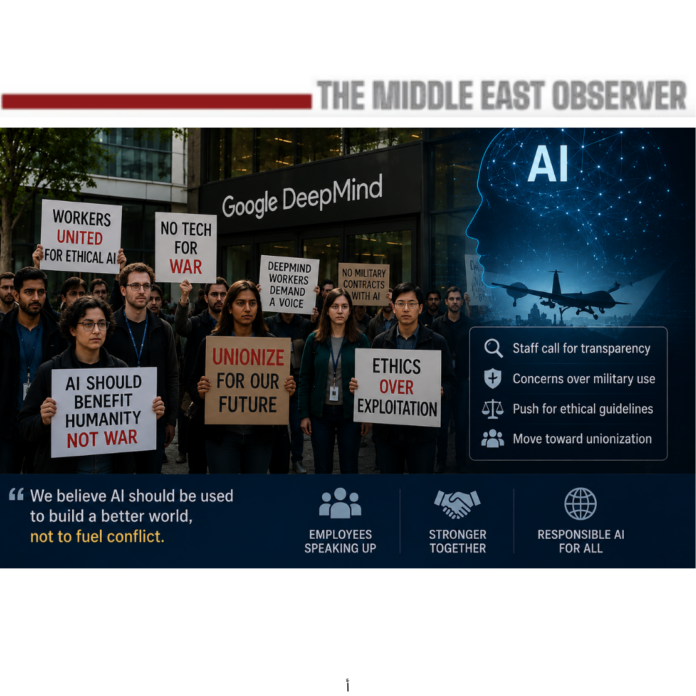
Employees at Google DeepMind in the United Kingdom have moved to organize a unionization effort amid growing internal opposition to the company’s involvement in military and defense-related artificial intelligence projects, including contracts linked to Israel and the Pentagon, according to international media reports and union representatives.
The initiative, supported through Britain’s Communication Workers Union and Unite the Union, reflects mounting tensions inside major technology companies over the expanding use of advanced AI systems in defense, surveillance, and military operations.
Reports from Wired, Fortune, and Business Insider indicated that participating employees voted overwhelmingly in favor of seeking formal union representation, with concerns centered on the ethical implications of AI deployment within military environments.
Much of the criticism has focused on Project Nimbus, the multibillion-dollar cloud computing and artificial intelligence agreement involving Google, Amazon, and the Israeli government. Employees have also reportedly raised objections to broader defense cooperation involving US military-linked AI development.
Workers involved in the campaign argued that advanced technologies could potentially contribute to surveillance systems, military targeting operations, and autonomous warfare applications. Some employees have called for stronger ethical safeguards governing how AI models and cloud infrastructure are deployed in conflict environments.
Google has previously defended its contracts by stating that its technologies are intended for government and commercial cloud services and are not designed for weapons systems or offensive military operations. The company has also emphasized that many projects comply with its published AI principles.
However, the latest organizing effort highlights a widening debate inside the global technology sector over the ethical boundaries and strategic role of artificial intelligence in geopolitics, defense policy, and national security infrastructure.
Industry analysts note that employee activism within major technology firms has become increasingly influential in shaping public discussions around AI governance, particularly as governments accelerate investment in defense-related artificial intelligence capabilities amid rising geopolitical tensions.
The dispute reflects a broader global reckoning over how rapidly advancing AI technologies are being integrated into intelligence analysis, surveillance systems, cybersecurity, logistics, and military decision-making frameworks.
As The Middle East Observer notes, the DeepMind unionization push illustrates how artificial intelligence is no longer solely a technological or commercial issue, but an increasingly political and ethical battleground where questions of national security, corporate responsibility, and employee activism are becoming deeply intertwined. The growing debate is also intensifying international calls for clearer ethical and regulatory frameworks capable of defining the boundaries of AI deployment in warfare, surveillance, and national security — sectors increasingly shaping the geopolitical architecture of the emerging digital era.