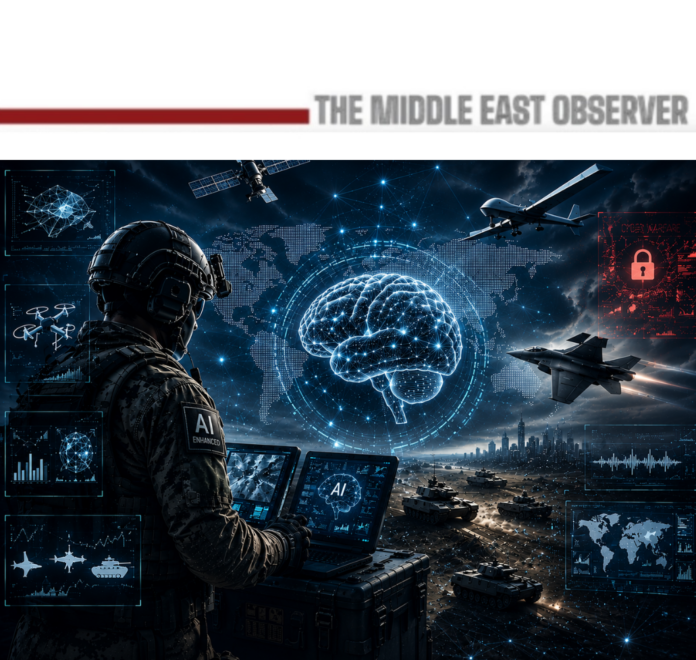
Artificial intelligence is rapidly transforming from a commercial technology into a core infrastructure of modern warfare, reshaping surveillance, targeting, intelligence analysis and the strategic balance of power between states. What was once viewed primarily as a civilian innovation powering search engines, automation and consumer applications is increasingly becoming embedded within the operational architecture of military and security systems worldwide.
The shift reflects a broader transition in warfare itself — from industrial-era military power centred on firepower and hardware toward data-centric conflict driven by computational speed, algorithmic analysis and real-time information dominance. Analysts increasingly warn that control over cloud infrastructure, surveillance ecosystems and machine-learning systems may become as strategically important in the coming decade as conventional military superiority.
The debate has intensified following investigations by journalists, digital rights organisations and academic researchers into the reported integration of AI-assisted systems within Israeli military operations in Gaza and broader surveillance infrastructures across Palestinian territories. Reports cited by critics describe platforms referred to as “Lavender,” “Gospel” and “Where’s Daddy” as systems capable of processing vast volumes of telecommunications, geolocation, biometric and social media data to generate targeting recommendations at unprecedented scale and speed.
Researchers examining these systems argue that they represent a significant evolution from conventional intelligence gathering toward what some describe as “algorithmic warfare” — an environment where predictive analytics, machine-learning systems and AI-assisted surveillance become integrated into broader mechanisms of military operations and territorial control. The strategic importance lies not merely in automation itself, but in AI’s ability to industrialise surveillance and compress military decision cycles from hours into minutes.
Critics argue that such systems effectively reduce the traditional “human bottleneck” that historically constrained large-scale targeting operations. By automating behavioural analysis, data correlation and pattern recognition across enormous datasets, AI systems can theoretically generate operational recommendations at a pace impossible for conventional intelligence structures to replicate manually. Analysts warn that this may fundamentally alter both the economics and tempo of modern conflict.
The controversy extends well beyond Gaza into broader questions surrounding biometric governance and predictive surveillance. Rights groups and surveillance researchers have cited systems including “Blue Wolf,” “Wolf Pack,” “Red Wolf” and “Mabat 2000” as examples of AI-enabled facial-recognition and identity-tracking technologies reportedly deployed across the West Bank and East Jerusalem for movement monitoring, predictive policing and population management.
Analysts increasingly argue that occupied Palestinian territories have evolved into testing grounds for surveillance and security technologies later commercialised internationally. Technologies such as Pegasus spyware and AI-enabled monitoring systems are frequently cited by researchers as examples of tools allegedly refined within conflict environments before wider global deployment.
The militarisation of AI, however, is far from geographically isolated. The United States, China and Russia are all investing heavily in autonomous systems, AI-assisted battlefield analytics, predictive surveillance and drone warfare. The war in Ukraine has further accelerated experimentation with autonomous reconnaissance systems, AI-enhanced targeting and algorithmic battlefield coordination, underscoring how machine-learning systems are becoming embedded within next-generation military doctrine globally.
This convergence of artificial intelligence with cloud infrastructure, telecommunications monitoring and real-time analytics is also redrawing the relationship between the technology sector and national security. Cloud computing, data storage and computational infrastructure are increasingly emerging as strategic military assets in their own right, intensifying scrutiny over the role of major technology firms within defence ecosystems.
Companies including Amazon, Google, Microsoft and Palantir Technologies have faced mounting criticism from activists and digital rights organisations over links between commercial AI infrastructure and military applications.
At the centre of the debate lies the question of accountability. Researchers consistently stress that AI systems do not autonomously make lethal decisions; rather, human operators approve targets generated through algorithmic analysis. Critics nonetheless warn that increasingly sophisticated AI workflows risk creating perceptions of technological neutrality that may obscure political, military and legal responsibility for operational decisions.
The article also references what activists describe as the “deadly exchange” — the transfer of surveillance practices, border technologies, predictive policing systems and military infrastructures between Israel and other countries, particularly the United States. Analysts warn that techniques initially developed within conflict zones may increasingly diffuse into civilian policing, border enforcement and domestic surveillance frameworks globally.
Technology companies insist safeguards remain substantial. OpenAI said it had disrupted more than 40 covert influence operations since launching formal threat reporting in 2024, while Anthropic and Google DeepMind continue expanding alignment and misuse-prevention systems designed to reduce manipulation, misinformation and coordinated abuse.
Regulators are also beginning to respond. The European Union’s AI Act introduces a risk-based framework governing artificial intelligence amid growing concern that machine-learning systems could increasingly shape surveillance, military operations and geopolitical stability itself.
The broader implication is that artificial intelligence is no longer simply enhancing military capabilities — it is restructuring the infrastructure of power itself. In the emerging AI era, strategic advantage may increasingly depend less on conventional weapons platforms alone and more on dominance over data ecosystems, computational infrastructure, cloud architecture and algorithmic decision-making systems capable of interpreting, predicting and operationalising reality in real time.