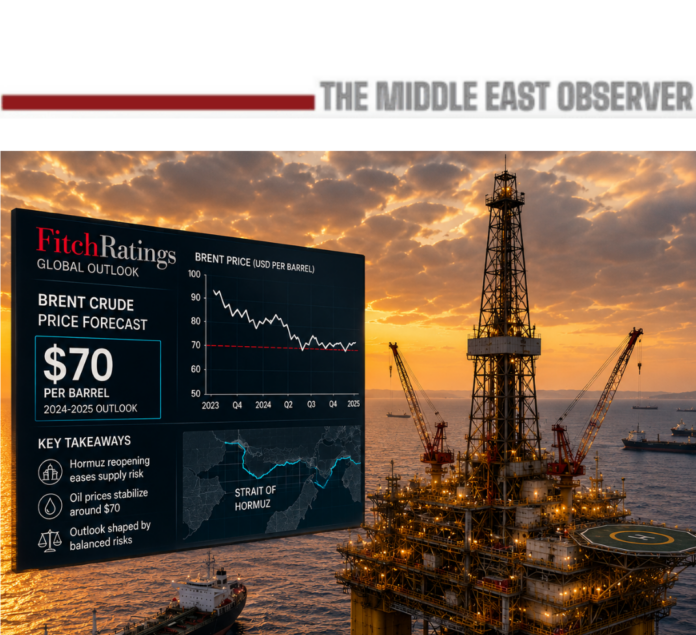
Global oil markets are beginning to unwind part of the geopolitical risk premium that drove energy prices sharply higher during the Iran conflict, as the preliminary agreement between the United States and Iran to reopen the Strait of Hormuz prompts major financial institutions to lower their crude oil forecasts and anticipate a gradual recovery in Gulf exports.
The Strait of Hormuz, through which approximately 20 million barrels of oil per day and roughly one-fifth of global liquefied natural gas (LNG) trade normally pass, has operated at severely restricted levels since the outbreak of hostilities earlier this year. The disruption trapped vessels inside the Gulf, curtailed exports from several producers and triggered sharp increases in oil prices, freight rates and marine insurance costs.
With the prospect of reopening now in sight, market attention is shifting from supply disruption towards the speed and durability of recovery.
Forecasts Turn More Bearish
Ratings agency Fitch now expects Brent crude to fall towards $70 per barrel by the end of 2026 if the agreement is successfully implemented and maritime traffic through Hormuz returns to normal.
The agency nevertheless warned that substantial risks remain. Political opposition could emerge once the details of the agreement become public, while renewed military escalation involving Iran, Israel or regional actors could undermine implementation.
Fitch also cautioned that the agreement may not fully address the underlying causes of regional tensions, leaving open the possibility of future disruptions despite the current move towards de-escalation.
Investment bank Goldman Sachs has similarly revised its oil outlook lower.
The bank reduced its near-term oil price assumption from $90 to $80 per barrel and lowered its average 2027 forecast from $80 to $75 per barrel following the agreement. Analysts now expect Gulf oil exports to return to pre-conflict levels by the end of July, a month earlier than previously anticipated.
Goldman forecasts West Texas Intermediate crude averaging around $75 per barrel in the final quarter of 2026 and approximately $70 per barrel during 2027, supported by stronger-than-expected global demand and improving consumer purchasing power.
Supply Recovery Remains Fragile
Despite improving sentiment, analysts caution that restoring confidence may prove more difficult than reopening the waterway itself.
Goldman estimates that a full normalization of Gulf exports could restore as much as 12 million barrels per day of oil flows through Hormuz compared with current restricted levels. Yet several operational and security challenges remain.
Renewed attacks on commercial shipping, delays in clearing potential maritime hazards and lingering concerns among shipowners and insurers could slow the pace of recovery.
The experience of recent months has highlighted the vulnerability of global energy markets to disruptions in narrow maritime chokepoints. Even if the strait reopens fully, confidence among vessel operators may take considerably longer to recover.
Empty Tankers Become the Market’s Key Indicator
Shipping analysts increasingly view the movement of empty tankers into the Gulf as a more important signal than the departure of loaded vessels.
While loaded tankers can continue clearing cargoes accumulated during the disruption, the willingness of empty vessels to re-enter the region reflects confidence among shipowners, charterers and insurers that safe navigation can be sustained.
According to market observers, vessel traffic through Hormuz remains limited despite the reopening announcement, with much of the activity still linked to Iranian trade.
Analysts at Morgan Stanley noted that the pace of inbound tanker traffic may provide the clearest indication of whether market participants believe the agreement will hold.
Energy analytics firm Kpler expects the number of vessels entering the Gulf to rise from roughly 15 ships per day currently to around 40 vessels daily by the end of the first month following a successful reopening, with tankers accounting for around 60 per cent of total maritime traffic.
Winners and Losers in a Lower Oil Price Environment
A sustained decline towards $70 oil would create a mixed economic picture across global markets.
Fuel-importing economies in Asia, Europe and Africa would benefit from lower energy bills, reduced inflationary pressures and improved trade balances. Countries such as Egypt, Türkiye and India stand to gain from lower import costs, while airlines, petrochemical producers and logistics operators would welcome relief after months of elevated fuel expenses.
Lower oil prices could also support consumer spending by easing transportation and energy costs, potentially contributing to stronger economic growth during 2027. Combined with lower freight and insurance costs, a sustained decline in energy prices could reinforce the disinflationary trend already emerging in several major economies, providing central banks with greater flexibility to support growth.
By contrast, a prolonged decline in crude prices would place renewed pressure on oil-exporting economies. Governments across the Gulf have spent heavily on economic diversification programmes, infrastructure projects and industrial investments, many of which were planned under assumptions of higher oil revenues.
Gulf Fiscal Balances Face New Pressure
For Gulf producers, the reopening of Hormuz presents a paradox.
While restoring exports would increase volumes and support economic activity, lower oil prices could erode government revenues. Several Gulf economies require oil prices above $70 per barrel to comfortably balance public finances, particularly those pursuing ambitious investment and development programmes.
Saudi Arabia’s Vision 2030 projects, infrastructure expansion and industrial investments have been supported by strong hydrocarbon revenues, while Iraq, Bahrain and Oman remain especially sensitive to prolonged periods of weaker oil prices.
As a result, policymakers across the region may welcome the return of stability and exports, but they are unlikely to celebrate a sharp decline in crude prices.
A move towards $70 Brent would also test OPEC+ strategy. The alliance has continued with gradual production increases despite the disruption, but a faster-than-expected decline in prices following a full reopening of Hormuz could force producers to reconsider the pace of supply additions. Should prices weaken materially, pressure could grow within OPEC+ to slow or reverse output increases in an effort to defend revenues and stabilise markets.
Insurance Remains the Hidden Risk
Even if oil prices retreat, one of the most significant costs generated by the conflict may persist.
Marine insurers, reinsurers and shipping companies continue to assess security conditions in the Gulf, while war-risk premiums remain substantially above pre-conflict levels. The availability and affordability of insurance coverage will play a critical role in determining how quickly commercial traffic returns to normal.
For shipowners, the decision to re-enter the region depends not only on diplomatic agreements but also on the willingness of insurers to provide coverage at commercially viable rates.
War-risk insurance costs illustrate the scale of the challenge. Market estimates indicate that premiums climbed from roughly 0.25% of vessel value before the conflict to as much as 3% during the height of tensions, increasing the cost of insuring a large crude tanker by several million dollars per voyage. Such elevated costs help explain why shipowners may remain cautious even after political agreements are reached.
Industry participants note that insurance has effectively become a geopolitical surcharge on global trade. Even after military tensions ease, premiums often remain elevated until underwriters gain confidence that risks have genuinely subsided.
This means shipping costs could remain above historical averages long after oil prices begin to fall.
Strategic Petroleum Reserve Highlights Lingering Vulnerability
The crisis has also exposed a longer-term challenge for the United States.
According to Department of Energy data, the Strategic Petroleum Reserve (SPR) has fallen to roughly 340 million barrels, its lowest level in more than four decades, following efforts to cushion markets from supply disruptions and fuel-price inflation.
If current release plans are fully implemented, inventories could fall to approximately 243 million barrels, equivalent to roughly one-third of authorised storage capacity.
Although the Department of Energy intends to replenish the reserve once market conditions stabilise, the drawdown has reduced Washington’s ability to respond to future supply shocks. The reserve was originally created following the Arab oil embargo of the 1970s and remains one of the world’s most important energy-security tools.
China has emerged as a parallel energy-security story. Chinese refiners have reportedly drawn on commercial crude inventories while reducing refinery processing rates, helping cushion the impact of supply disruptions and elevated prices. The response underscores how major consuming nations have increasingly relied on stockpiles and inventory management to navigate energy shocks while waiting for supply routes to normalise.
The depletion of the SPR therefore serves as a reminder that even if Hormuz reopens successfully, the global energy system remains less protected against future disruptions than it was before the conflict.
Beyond Oil: The Return of Confidence
For energy markets, the reopening of Hormuz is about far more than crude prices.
The conflict triggered sharp increases in shipping costs, war-risk insurance premiums and fuel procurement expenses throughout global supply chains. Producers, refiners and traders were forced to adapt to disrupted trade routes and delayed cargoes.
As a result, the most important measure of success may not be the price of oil itself but the restoration of confidence across the wider energy ecosystem.
Oil markets tend to price expectations of peace quickly. Shipping and insurance markets move far more cautiously because they are assessing operational risk rather than diplomatic headlines.
The next phase of recovery will therefore be determined less by political announcements and more by the steady return of tankers, insurers and cargo owners to one of the world’s most strategically important waterways. If confidence returns, energy markets could experience a significant easing of supply pressures, freight costs and inflationary risks. If it does not, the conflict may ultimately be remembered not for the oil it disrupted, but for the higher insurance, financing and logistics costs it embedded across global trade long after crude prices retreated.