
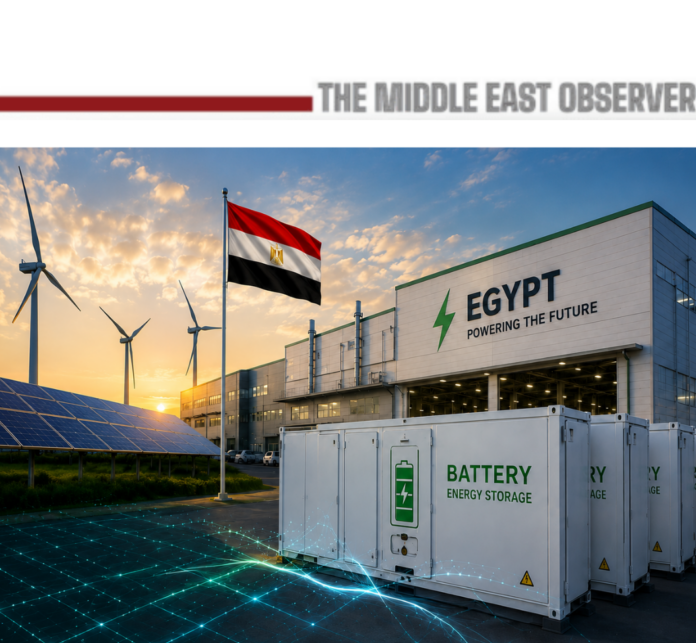
Egypt’s clean-energy ambitions took a significant step forward after UAE-based AMEA Power signed agreements with China Energy Engineering Corporation (CEEC) and China Energy International Group (CEIG) to develop two large-scale battery energy storage projects and a battery manufacturing facility in the country.
The agreements cover a 500 MWh battery energy storage system (BESS) in Zafarana on the Red Sea coast and a 1,000 MWh facility in Benban, Aswan, alongside plans for a battery factory with an annual production capacity of 3,000 MW.
While Egypt has attracted billions of dollars in solar and wind investments over the past decade, the latest projects signal a strategic shift towards solving one of the renewable sector’s biggest challenges: storing electricity when the sun is not shining and the wind is not blowing. Energy storage is increasingly viewed as the missing link between renewable-energy generation and grid reliability.
The investment comes as Egypt seeks to reduce pressure on natural-gas consumption during peak summer months, when surging electricity demand has increased the need for fuel imports and heightened pressure on the national power system. By storing excess renewable electricity and releasing it during periods of high demand, battery systems can help reduce fuel consumption, improve grid stability and strengthen energy security.
Electricity Minister Mahmoud Esmat said the projects support Egypt’s goal of reaching 14,320 MWh of battery storage capacity by 2028 as the country accelerates its transition towards cleaner energy sources. The government is also targeting the addition of approximately 2,500 MW of renewable-energy capacity to the national grid this year while expanding storage infrastructure to support the integration of solar and wind projects.
AMEA Power, which has invested more than $3 billion in Egypt across solar, wind and storage projects, currently operates or develops projects capable of generating 2,500 MW of renewable energy and 2,400 MWh of battery storage.
Beyond the storage facilities themselves, the battery factory may prove to be the most strategically significant component of the agreement. Unlike many previous renewable-energy investments focused primarily on electricity generation, the facility introduces a manufacturing dimension that could deepen local supply chains, support technology transfer and create new industrial opportunities linked to the global clean-energy economy.
The project also reflects a broader investment model increasingly emerging across the Middle East and Africa, combining Gulf capital, Chinese engineering expertise and Egypt’s industrial and infrastructure ambitions. Such partnerships are becoming a key mechanism for financing and delivering large-scale energy-transition projects across emerging markets.
Officials view the factory as a potential platform for serving domestic demand while positioning Egypt as a regional production and export hub for energy-storage technologies serving Africa, the Middle East and Southern Europe. The facility would complement the country’s growing renewable-energy base and support efforts to localise higher-value segments of the clean-energy supply chain.
For Egypt, the significance extends beyond renewable energy. As electricity demand rises and energy systems become increasingly dependent on intermittent power sources, battery storage is emerging as a critical component of long-term energy security, economic competitiveness and industrial development.
The agreements reinforce a broader shift in Egypt’s energy strategy. The next phase of the country’s energy transition is no longer simply about generating more renewable power. It is increasingly about storing it, manufacturing the technologies behind it and building the industrial ecosystem required to compete in the emerging global clean-energy economy.