
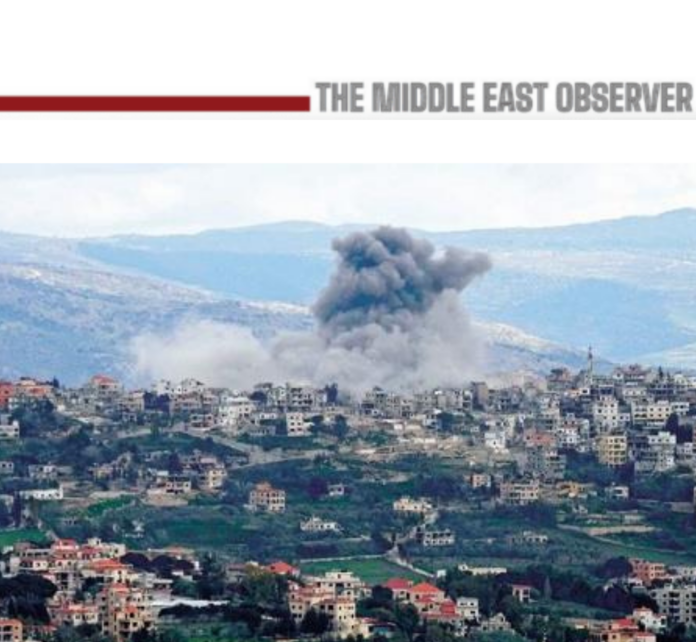
Between Israel’s drive to cement its occupation and Hezbollah’s push to repel it, both sides are attempting to exploit the detailed loopholes in the U.S.-Iranian-brokered agreement to secure strategic gains, without formally declaring the ceasefire’s collapse.
Under pressure from the U.S. administration to end major military operations, Israel is trying to substitute “continuous incursion” with “structural control”, manifested in a calculated, three-pronged strategy:
First: Israel seeks to operate within the agreement’s gray zone by creating a “theoretical” security cordon that grants it legitimacy to move within what it has designated as the “Yellow Zone”. It does so by demarcating this area on the map and claiming full control over it, while in reality, it only holds sway over scattered outposts. This approach disregards the fundamental reality that in guerrilla warfare, military control is measured not by dots on a map, but by the ability to survive securely. Thus, when it attempted to seize ‘Tellet Al-Taher’, it encountered fierce resistance and responded by escalating, claiming it had been attacked by Hezbollah.
Second: Israel is striving to construct logistical fortifications for its forces, which remain exposed in the open in specific areas south of the Litani River. Operating in the open in a hostile environment like southern Lebanon is a nightmare for any conventional army. Hence, Israel considers building berms and fortifications as self-defense, while Hezbollah views it as transforming a temporary occupation into a permanent and stable one.
Third: Israel seeks to exploit demographics. It is preventing Lebanese civilians from returning to their destroyed villages within the “Yellow Zone”, believing that emptying these villages of their inhabitants is the only guarantee that resistance elements will not intermingle with civilians-effectively rendering the area a de facto buffer zone.
The Sovereign Ground for the Resistance
In contrast, Hezbollah maintains that the truce does not justify surrendering to Israeli control over any point its ground forces have not physically reached. It considers any distance between two Israeli positions as Lebanese territory-or more precisely, under Hezbollah’s control. The organisation believes that any land not stood upon by an Israeli soldier is -literally- a free Lebanese soil. Consequently, any Israeli movement between two distant points constitutes a new incursion and a breach of the truce warranting a response, as occurred at Tellet Al-Taher.
Hezbollah also views any Israeli reinforcements reaching its occupied outposts as a violation. It doesn’t interpret the truce as “absolute” but as “localized and geographical”, limited to the cessation of mutual shelling across the border and into the depths. This interpretation provides it, from its perspective, with legal cover to act against any Israeli attempt to reinforce positions or build fortifications, deeming such actions as ongoing offensive operations. For Hezbollah, the truce paves the way for withdrawal, granting it the right to prevent the entrenchment of occupation, halt the construction of fortifications, and block the arrival of Israeli reinforcements.
Given this situation- the details of which the agreement failed to address- the Lebanese truce becomes highly fragile, with direct implications for U.S.-Iranian negotiations. Hezbollah refuses to let the truce become a “surrender document” or a “legitimization of occupation,” while Israel strives to cement its presence in points its forces had never originally reached. This renders the truce merely a “fragile pause”, liable to erupt at the slightest friction.
The Broader Geopolitical Equation
This on-the-ground tension is not isolated from international politics; it serves as a fundamental pressure tool in the Iranian-American dossier. Iran views Hezbollah’s strength on the ground as its first line of defense and its strongest bargaining chip in negotiations with the Trump administration. If Israel succeeds in imposing its terms, cementing its occupation, and weakening Hezbollah militarily, Iran will enter negotiations from a weaker position. Consequently, Tehran is monitoring how serious Washington is in compelling Israel to adhere to the agreement. Should the U.S. administration turn a blind eye to “Israeli violations”- such as pushing reinforcements, erecting fortifications, preventing civilian return, and attempting to solidify control over the Zone- Iran will conclude that Washington is not serious about making concessions on other files, such as the nuclear program or sanctions.
Both parties (Iran and the U.S., through proxies or allies) are attempting to maintain a limited level of escalation to improve their negotiating positions without triggering an all-out war that could derail Trump’s diplomatic efforts.
Despite traditional strategic backing, the Trump administration possesses powerful leverage to pressure Netanyahu’s government to prevent breaching the truce or attempting to impose a new ‘fait accompli’ in the “Yellow Zone.” Perhaps the strongest tool at Trump’s disposal is direct political pressure, driven by a desire to reach comprehensive understandings with Iran to end regional conflicts and open the file of sanctions. Israel’s insistence on a permanent presence in southern Lebanon stands as an obstacle to Trump’s diplomatic ambitions. Thus, Washington could use its political weight to convey to Tel Aviv that undermining this truce harms broader U.S. interests.
However, navigating the Trump administration’s foreign policy requires accounting for its characteristic unpredictability. While the ultimate goal may be a “Grand Bargain” with Tehran, the administration might initially employ a tactical “Maximum Pressure” approach. This could mean Washington choosing to tolerate certain Israeli structural advancements in the “Yellow Zone” or even making new attacks as a means to squeeze Iran and its regional allies before sitting at the negotiating table.
This dual-track possibility makes the truce highly double-edged: it can either serve as a stepping stone toward a historic reconciliation or become the first casualty of an escalated economic and military squeeze.
Missing Mechanisms and Uncertainties
Ultimately, the absence of a “stringent, impartial, and international monitoring mechanism” with a clear definition of what constitutes a “breach” makes it easy for each side to violate the truce while claiming the other side committed the violation first. This brings us back to the recurring problem in the Middle East, where Iran- alongside other regional players- incorporates linguistic and drafting experts into its negotiating teams to precisely define terminology and concepts related to the conflict in a manner that prevents its resurgence.
If the United States truly wishes to avoid a total collapse, it must use its leverage to impose an American ban on building any new Israeli fortifications, in exchange for freezing Hezbollah’s movements. All of this could be facilitated by using U.S. satellite imagery to pinpoint Israel’s actual presence on the ground, preventing any geographic encroachment on Lebanese territory, thereby resolving the dispute over “dispersed distances”.
Without such granular, enforced parameters, the current arrangement will not be a transitional phase toward a comprehensive deal with major international guarantees, it will serve as a mere “fighter’s rest” awaiting the inevitable next round of combat.
Related news:
South Lebanon: The War of the ‘Invisible Bee’ -From Tank Hunting to Soldiers’ Attrition”
Read also:
Lebanon’s Stability May Depend on a Peaceful Integration Formula for Hezbollah